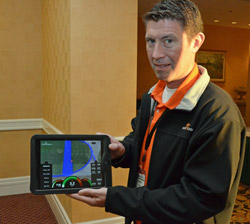

Recruit for NAMA and Win

Jamie Johansen

namaRecruit someone you know to become a National Agri-Marketing Association (NAMA) member and you will be entered to win an iPad Mini.

The “Member-Get-A-Member” campaign will run from October 15 to December 10. The drawing will take place on December 11.

Simply tell your recruit to join NAMA online and add your name and company in the “Referred By” box at the bottom of the page. They can also call the NAMA office, (913) 491-6500, to become a member, just remind them to mention you as their referral.

The more members you recruit, the more your name will be entered into the drawing and the better your chances are of winning the iPad Mini.

Ag Groups, NAMA

Water in the Sunshine State

Cindy Zimmerman

Florida is the third largest state in terms of population and the 14th in agricultural production, so competition for water resources is fierce in the Sunshine State.

ctic-14-budell“Population growth is a big factor in driving water use demand and that will continue in Florida,” said Richard Budell, who is director of water policy for the Florida Department of Agriculture and Consumer Services (FDACS). “The challenge we’ll face is that as those domestic demands grow we don’t lose sight of the fact that agriculture has to continue to have access to adequate quantities of water.”

Budell told the 2014 CTIC Conservation in Action tour last week that Florida’s 47,000 private farms account for 52% of the state’s land use but less than half of the water use. Some of the state’s most populous regions, such as Miami-Dade, Palm Beach and the counties around Tampa and Orlando, are also the most agriculturally productive. “Where that nexus occurs, it makes managing that water balance that much more difficult,” he said.

During his presentation during lunch, Budell provided lots of interesting information about Florida agricultural production and natural resources. Presentation by FDACS water policy director Rich Budell on CTIC tour

I also interviewed Rich about some of his key points and also questioned him about how the state ag department views the proposed Waters of the United States rule: Interview with Rich Budell, Florida Department of Agriculture


2014 CTIC Conservation in Action Tour Photo Album

Audio, Conservation, CTIC, Water

Pollinator Advocate of the US Award

Jamie Johansen

pollinator-partnership-logoThe Pollinator Advocate Award recognizes individuals who have contributed significantly to pollinator protection, conservation, and issue outreach resulting in increased awareness of the importance of pollinators and pollination. The 2014 Pollinator Advocate of the United States Award will be given to Julie Zahniser and The American Bee Project of Ft. Pierce, FL.

Honey bees require proper nutrition gained through a diverse and abundant diet of mixed flowers and crops to be healthy – and they need this sort of food throughout the year. When bees aren’t in pollination contracts beekeepers need to place them in areas of ample, clean (pesticide and chemical-free) forage. Unfortunately these areas are dwindling, and when they are available, they aren’t always available to beekeepers. As with native and wild bees, a lack of habitat is the leading factor impacting the health and viability of honey bees.

The American Bee Project works to solve this problem. Founded by Ft. Pierce, Florida lawyer Julie Zahniser, The American Bee Project seeks legal and legislative ways to increase the habitat that is available to bees. In Florida, where The American Bee Project was born, landowners that lease their land to cattle ranchers, citrus growers and tree farmers see significant tax benefits. Landowners that lease their land to beekeepers, however, didn’t used to see these same benefits, putting bee forage as a second, third, or even last choice in land use decisions. But The American Bee Project is successfully changing that.

Starting in her home state and moving outward, Zahniser is using existing agricultural and tax frameworks to increase feeding opportunities for bees. With uniform standards for agricultural designation in place around the country it will be easier to qualify bees as an agricultural use for the full amount of forage land used by the bees to produce honey and rebuild bee colonies. This is the ultimate goal, one bee yard at a time.

In addition to working the paper trail of local and someday national agricultural laws, the American Bee Project participates in outreach and awareness campaigns that encourage local beekeeping, sustainable agriculture, and advocacy for bee health. As a for-profit service The American Bee Project redirects funds into philanthropic programs that benefit honey bees. This holistic approach using policy and programs, supporting outreach and education, and providing financial support for pollinator conservation efforts, has gained Julie Zahniser and The American Bee Project recognition as the 2014 Pollinator Advocate of the United States.

Ag Groups, Bees

Industry Reacts to WTO COOL Decision

Cindy Zimmerman

Industry reaction to the World Trade Organization decision against the United States on the Country of Origin Labeling (COOL) law have been coming in steadily since the announcement was made earlier today.

nfu-smallNational Farmers Union (NFU) President Roger Johnson says they believe the situation can be handled by USDA. “Under the guidance of USDA, any changes to COOL to ensure full compliance with today’s decision should be able to be made administratively, while maintaining the integrity of COOL labels,” said Johnson, adding that polls show consumers support the rule. “American consumers want to know where their food comes from, and America’s family farmers and ranchers are proud to provide that information,” he said.

nppc_logo_smallNational Pork Producers Council President Howard Hill urged the Obama administration and Congress to fix the law to avoid trade retaliation from Canada and Mexico. “The United States must avoid retaliation from Canada and Mexico,” said Hill. “Retaliatory tariffs on pork would be financially devastating to U.S. pork producers.”

cool-reform-1The COOL Reform Coalition held a press call and webinar to respond to the announcement, offering reactions from a variety of groups including the National Council of Farmer Cooperatives (NCFC), Corn Refiners Association, and U.S. Chamber of Commerce.

“Canada and Mexico are the two largest markets for U.S. exports,” said U.S. Chamber of Commerce Senior Vice President for International Policy John Murphy. “The disruption of these trade ties by WTO noncompliance and the resulting retaliation by our North American neighbors will have a devastating economic impact on U.S. industries including food production, agriculture, and manufacturing.”

“The retaliation list could include many products,” said NCFC president Chuck Conner. “Cheese from Wisconsin, soybeans from Minnesota, corn from Iowa, orange juice from Florida, cherries from Michigan or Oregon, and a whole range of products from almonds to wine in California.”

“USDA has not fixed this, they made it worse,” said John Bode with the Corn Refiners. “We need for Congress to fix this mess right away.”

Listen to all the comments here: COOL Reform Coalition reaction

Audio, Corn, Livestock, NPPC, Pork, Trade

Zimfo Bytes

Talia Goes

Zimfo Bytes

  • By 2050 we will need to feed 9 billion people, join the ENOUGH movement to bring awareness.
  • Swanson Russell announces the promotion of Nate Custard, Jordan Kaiser and Taryn Liess in its Lincoln office.
  • Arysta LifeScience announced that Platform Specialty Products has reached a definitive agreement with a company backed by the Permira funds to acquire Arysta LifeScience for approximately $3.51 billion, subject to regulatory approval, working capital and other adjustments.
  • Kemin Industries is selling its companion animal health line of veterinary supplements, RESOURCES™, to Garmon Corporation of Temecula, Calif.
Zimfo Bytes

Food Dialogue on GMOs

Cindy Zimmerman

What do you know about GMOs? Most people not much with the exception that many have been led to believe they are bad. In a recent Jimmy Kimmel Live, Jimmy Kimmel, he took to the streets to ask people what a GMO was and not one person knew, even thought most bMike Pearson Market to Marketelieved they were bad. In case you don’t know, its a “genetically modified organism” or in the words of 2014 Borlaug CAST Communication Award winner Dr. Alison Van Eenennaam, it means genetically engineered.

Because GMO’s are such a misunderstood technology and a hot topic the U.S. Ranchers & Farmers Alliance (USFRA) hosted a Food Dialogue event in conjunction with CAST and the World Food Prize. “GMOs and the Consumer Mindset: Does Perception and Marketing Outweigh Science?” was moderated by Mike Pearson, host of Market to Market on Iowa Public Television. Panelists included Julie Kenney, farmer and CommonGround volunteer; David Sutherland, activist, blogger and founder of VeganGMO; Dr. Alison Van Eenennaam, University of California-Davis, department of Animal Science; and Jay Byrne, president v-Fluence Interactive.

The dialogue focused on two main topics: what consumers believe about GMOs and how to get the facts into the conversation and more specifically how to get scientists, like Van Eenannaam, more involved in the conversation.

One issue that all the panelists noted was that in the debate, the “experts” have no expertise. They are anti-GMO advocates from various walks of life who have self-proclaimed themselves experts but don’t understand the data or more specifically refuse to acknowledge the data. And what is unnerving, explained Byrne, is that people who are reading about GMOs are taking the word of these experts including high profile media such as Dr. Oz, host of the Dr. Oz Show.

Speaking of media, all the panelists agreed that the media were in part to blame for the mis-information being proGMO Food Dialogues Des Moinespagated about GMOs. They don’t do their research and they don’t understand science. Sutherland noted that the story of GMOs being fine “is not sexy” and thus is ignored.

Kenney added that when speaking to “mom bloggers” when they come to the farm they had the view that GMOs were bad but after seeing firsthand how food was made, many of them became “conflicted” as to which message was the truth.

Sutherland, Byrne and Kenney all stressed that in their roles, the people they are speaking with have no science-based facts and stressed the need for more scientists to speak out. However, Van Eenennaam said that its hard to scientists to speak out when they are attacked and many have difficulty discussing their research in ways consumers can understand.

Yet despite these challenges, Byrne said that this debate will run its course and if the facts continue to be presented by respected people, such as the work Kenney is doing with CommonGround and the work Van Eenennaam is doing on behalf of the scientific community, GMOs will ultimately become accepted and no longer a front line issue.

Agribusiness, Animal Health, Biotech, USFRA, World Food Prize

Verdesian Signs Deal with Los Alamos National Lab

Joanna Schroeder

On the heels of a media day hosted at Los Alamos National Laboratory (LANL) sponsored by Verdesian Life Sciences, comes the announcement the Verdesian has signed a licensing agreement with LANL to develop and market their latest nitrogen enhancement technology for plants. The agreement extends the current relationship with LANL, under which Verdesian is marketing and distributing the research institution’s Take Off® crop nitrogen assimilator.

This next generation of nitrogen innovation helps improve photosynthesis by increasing carbon flow into a plant’s metabolism. This enhances the formation of amino acids, which perform multiple functions in plant metabolism and are critical to healthy plant growth. The improved photosynthesis also positively impacts reproductive growth.

LANL Biosciences Lab“Nitrogen is one of the costliest, but critical, controllable inputs that can lead to a yield advantage,” said Nigel Grech, executive vice president, science & technology, Verdesian. “Unfortunately, our current methods of distributing nitrogen can result in great inefficiencies with a negative impact on the environment and wasted resources. This technology not only significantly adds to the ability of the farmer to improve crop nitrogen efficiency but also assists in coping with expanding regulations that are impacting agriculture globally. Our nitrogen efficiency innovation platforms have the potential to revolutionize agriculture as we know it.”

Verdesian will continue to work on the development of this new technology through 2014 with anticipated market entry by 2017.

“We are proud of our relationship with the Los Alamos National Laboratory; they are an important partner in our commitment to taking tomorrow’s science and delivering today’s returns,” said J.J. Grow, chief executive officer of Verdesian. “The lab’s proven technology helps us bring value to growers in both yield and efficiencies, and we look forward to our continued work together.”

Check out the Verdesian Los Alamos Media Tour photo album.

Agribusiness, Fertilizer, Verdesian

2014 GAP Reports Highlights Food Supply Obstacles

Joanna Schroeder

The 2014 edition of the GAP Report finds that global productivity is not accelerating fast enough to meet the expected agricultural demand by 2050 through sustainable practices. Published by the Global Harvest Initiative (GHI) and released during the World Food Prize, the trend means a new global challenge is emerging: how to sustainably provide enough food, feed, fiber and fuel for a growing population by 2050 when the demands for food and agriculture will be nearly double that of today.

Dr. Margaret Zeigler Global Harvest InitiativeThe annual Gap Report takes a critical look at the state of global agriculture productivity, as well as the policies, innovations and investments needed to provide for a growing world while facing climate change. This year’s report has a special focus on the challenges and opportunities in India.

“This year’s report shows a clear gap that could dramatically impact people all around the world,” said Dr. Margaret Ziegler, executive director of GHI who presented the key findings during a special event. “Raising productivity across all regions and for farmers of any size and scale requires long-term investment and sustained focus if we are going to have sufficient nutritious and affordable food and agriculture.”

The report is based on the measurement of total factor productivity (TFP), the ratio of agricultural outputs to inputs. Several significant productively gaps were found in key regions:

  • In East Asia, only 67 percent of food demand by 2030 will be met from within the region if the  current rate of productivity growth is maintained.
  • At current rates of productivity growth, Sub-Saharan Africa is projected to meet only 15 percent of food demand in 2030, which will require significant imports, or food assistance, or opening up new land to development that may not be suitable for sustainable production.
  • In Latin America, overall regional production is expected to exceed demand with Argentina, Brazil, Chile, Paraguay and Uruguay leading this increase in productivity.

Listen Dr. Margaret M. Zeigler discuss the key highlights of the report: 2014 GAP Report Highlights

2014 GAP Report PanelistsIn addition to the release of the 2014 GAP Report, there was a panel discussion focused on the current state of the regions and ways to overcome regional challenges. The panel included: Dr. Keith Fuglie, Branch Chief of the Economic Research Service of USD; Dr. Dilip Kulkarni, President of Jain Irrigation Systems Agri-food Division; Dr. Thomas J. Herlehy, Practice Area Manager for Crops, Land O’Lakes, Inc. International Development Division; and Mr. Jesus Madrazo, Vice President, Corporate Engagement, Monsanto, and GHI Board Chairman.

Listen to the panel discussion: 2014 GAP Report Panel Discussion

Agribusiness, Audio, Food, World Food Prize

WTO Announces Decision on COOL

Cindy Zimmerman

cool-usdaThe United States’ Country of Origin labeling (COOL) is still not cool with the World Trade Organization (WTO).

In the compliance panel report released today, the WTO found that “the amended COOL measure violates Article 2.1 of the TBT Agreement because it accords to Canadian and Mexican livestock less favourable treatment than that accorded to like US livestock.”

In particular, the compliance panel concluded that the amended COOL measure increases the original COOL measure’s detrimental impact on the competitive opportunities of imported livestock in the U.S. market, because it necessitates increased segregation of meat and livestock according to origin; entails a higher recordkeeping burden; and increases the original COOL measure’s incentive to choose domestic over imported livestock.

National Cattlemen’s Beef Association (NCBA) President Bob McCan of Texas says the expected ruling
“brings us all one step closer to facing retaliatory tariffs from two of our largest trading partners.”

McCan added that “NCBA has maintained that there is no regulatory fix to bring the COOL rule into compliance with our WTO obligations or that will satisfy our top trading partners. We look forward to working with Congress to find a permanent solution to this issue, avoiding retaliation against not only beef, but a host of U.S. products.”

Later today, members of the COOL Reform Coalition will be holding a webinar to respond to the announcement.

Beef, NCBA, Trade

Nephew Gets His First Deer

Chuck Zimmerman

Joe Gets a DoeIt’s deer season at The Pig (short for Crystal Pig Hunt Club). This is my annual woods time to just get away from it all. However, look for lots of good fresh content on AgWired!

On opening day Saturday Paul, Luke, Joe and I were on location. We all got a doe that day! Now, it’s time for a buck. We’re not in the rut yet. We’ve seen over 30 does and only 2 bucks so far.

In the pick, Joe gets his first deer, pictured with his Dad and my brother Paul. You want to talk about excited. He got it with his first shot too.

So, we’ve had some good fresh venison on the grill and in a stew and I think some more recipes are coming.

Now back to the hunt.

Hunting