#FarmCredit Looks at 2016 Challenges

Kelly Marshall

AgriBankDirectors from Farm Credit overwhelmingly believe the greatest challenge facing farmers this growing season are commodity prices.

More than 64 percent of the directors — from the boards of 17 Farm Credit lenders in 15 states and of AgriBank, their St. Paul-based funding bank — said commodity prices are the greatest challenge facing ag producers this year. The directors, most of whom are also farmers or ranchers, indicated the next biggest challenges are input costs (over 21 percent), and Mother Nature (nearly 8 percent). Farm Bill implications and land rents were each cited by approximately 3 percent of the respondents.

“The USDA forecasts real (adjusted for inflation) net farm income will be in the low $50 billion range annually for the next 10 years, which is down dramatically from recent highs and similar to the 1980s,” said Jeff Swanhorst, executive vice president, Credit, and chief credit officer of AgriBank. “The USDA 10-year baseline forecast assumes no domestic or external shocks to global ag markets and is largely driven by prices for corn and other key commodities, which have fallen significantly over the last couple years. All we know for sure is the forecast will be wrong. Farmers will make many adjustments, depending on their circumstances, and they’ll be rewarded for their entrepreneurial spirit, management and good old-fashioned hustle.”

The survey was conducted during the AgriBank 2016 Annual Meeting on March 8.  Ninety participating directors represent 17 Farm Credit affiliated associations and 15 states from Wyoming to Ohio to Minnesota to Arkansas.  Results for this year closely followed trends from 2015.

Agribusiness, Markets

New Cooperative Research Program for Sorghum

Lizzy Schultz

sorghum-checkoff The Sorghum Checkoff, Kansas Grain Sorghum Commission and Kansas State University (KSU) have entered into a cooperative agreement to increase grain sorghum productivity and expand markets by 2025.

Coordinated efforts for the Collaborative Sorghum Investment Program will begin April 1st, 2016, and operate through the Center for Sorghum Improvement at KSU. Results will impact sorghum producers throughout the country.

“After more than a year of planning and orchestrating, the Collaborative Sorghum Investment Program is now a reality,” said Florentino Lopez, Sorghum Checkoff executive director. “This program will serve as a platform aimed at reaching the Sorghum Checkoff’s mission of investing checkoff dollars to increase producer profitability and enhance the sorghum industry. This program helps by aligning many resources to meet the needs of sorghum farmers throughout the U.S.”

The program aims to increase the average national yield from 61.95 bushels per acre to 100 bushels per acre by 2025 by funding research in over-the-top grass control, breeding program developments, and field-level management techniques. Long-term research areas such as seed innovation and information management will also be addressed.

The program will also work to develop marketplaces, attributes, qualities and other factors capable of increasing demand to 1.25 million bushels of sorghum by 2025, including the expansion of international markets, domestic food use, livestock feeding, ethanol production, and specialty products.

“This agreement will provide a valuable investment in long-term sorghum research,” said Stephen Bigge, Kansas Grain Sorghum Commission chairman. “Sorghum producers will benefit from the advancement of sorghum technology for many years to come.”

The Kansas Grain Sorghum Commission and the Sorghum Checkoff have each contributed a $2 million investment to this project, and KSU has contributed an $800,000 investment, bringing total support for the program to $4.8 million.

“We look forward to implementing this agreement to the benefit of the entire sorghum industry,” said John Floros, KSU Dean of the College of Agriculture and director of K-State Research and Extension. “We are pleased to leverage our resources with this new program.”

Ag Groups, Agronomy, Marketing, Research, sorghum, University

Many Grocery Prices Down in Marketbasket Survey

Lizzy Schultz

image003 According to USDA, Americans spend just under 10 percent of their disposable annual income on food, the lowest average of any country in the world, and the American Farm Bureau Federation’s (AFBF) Spring Picnic Marketbasket Survey highlighted a slight decrease in the current retail prices of several popular foods, including salad, orange juice, shredded cheddar, ground chuck, sirloin tip roast, vegetable oil, white bread, ground chuck, and deli ham.

The informal survey shows the total cost of 16 popular food items that can be used to prepare one or more meals was $53.28, down $.59 from last year’s survey. Of the 16 items surveyed, ten decreased and six increased in average price. A total of 87 shoppers in 28 states participated in the latest survey, conducted in March.

Egg prices are up sharply from first quarter of 2015, a year ago but are down even more sharply from the third quarter of 2015.The beef items in the market basket, ground chuck and sirloin tip roast, have lower prices compared to the first quarter of 2015, as retail beef prices peaked in early 2015 at record high levels. Dairy product prices also remain relatively low. Shredded cheddar cheese is at the lowest price in this survey since the third quarter of 2012, and is currently priced at $4.29 for a one-pound bag. The whole milk price rose almost 3 percent from the third quarter of last year, but remains well below the 2015 first-quarter price.

Items showing retail price decreases from a year ago included:

  • orange juice, down 8 percent to $3.21 per half-gallon
  • bagged salad, down 11 percent to $2.20 per pound
  • shredded cheddar cheese, down 7 percent to $4.29 per pound
  • whole milk, down 6 percent to $3.23 per gallon
  • ground chuck, down 5 percent to $4.36 per pound
  • vegetable oil, down 5 percent to $2.55 for a 32-ounce bottle
  • white bread, down 3 percent to $1.69 per 20-ounce loaf
  • flour, down 1 percent to $2.49 for a 5-pound bag
  • sirloin tip roast, down 1 percent to $5.65 per pound
  • potatoes, down 1 percent to $2.71 for a 5-pound bag

This survey tracks closely with the federal government’s Consumer Price Index report for food at home. As retail grocery prices have increased gradually over time, the share of the average food dollar that America’s farm and ranch families receive has dropped.

“Through the mid-1970s, farmers received about one-third of consumer retail food expenditures for food eaten at home and away from home, on average. Since then, that figure has decreased steadily and is now about 16 percent, according to the Agriculture Department’s revised Food Dollar Series,” said John Anderson, AFBF’s deputy chief economist.

Using the “food at home and away from home” percentage across-the-board, the farmer’s share of this $53.28 marketbasket would be $8.52.

AFBF, Ag Groups, Food

NFU Renews Partnership with Feeding America

Jamie Johansen

nfu_logo2The National Farmers Union (NFU) has pledged to contribute to nationwide hunger relief through a renewed commitment to Feeding America’s Invest An Acre program aiming to help fight the food insecurity problem for millions of Americans across the country. The organization officially kicked off its fundraising efforts this week following an announcement at the NFU 114th Anniversary Convention in Minneapolis.

“We often associate food insecurity with impoverished foreign nations, but we cannot ignore the hunger problem here at home in many rural communities,” said NFU President Roger Johnson. “As family farmers and ranchers, we have a responsibility to help families in need through local hunger relief efforts.”

investanacreMore than 48 million Americans lived in food-insecure households in 2014, according to the USDA. To combat the problem in rural America, the domestic hunger relief organization created Invest An Acre to make it easy for farmers to donate a portion of their crop proceeds to the food bank serving their local community. Every dollar donated by farmers is matched by Monsanto to double the impact. From 2011 to 2014, NFU and its members contributed nearly $200,000 to various hunger relief initiatives through Feeding America, the Invest An Acre program and local food banks.

“Food insecurity is not an individual problem; it can take a toll on an entire community. We are proud to renew our partnership with Feeding America and to continue NFU’s longstanding support of hunger relief efforts in rural America,” commented Barbara Patterson, a government relations representative with NFU, who is coordinating the renewed partnership.

Ag Groups, Food

AAEA Members Take Their Message to Capitol Hill

Jamie Johansen

aaeaFarm income, assets, and equity are all expected to decline nearly three percent in 2016, while farm debt is forecasted to rise about two percent. However, the Agricultural & Applied Economics Association(AAEA) reminds us these numbers may not tell the whole story.

AAEA members Ani Katchova (The Ohio State University) and Allen Featherstone (Kansas State University), along with Jeffrey Hopkins (USDA’s Economic Research Service), met with Senator Pat Roberts (R-Kan.), Chairman of the Senate Committee on Agriculture, Nutrition, and Forestry. The meeting was part of a day on Capitol Hill focused on “Dynamics of Farm Profitability: Factors Influencing the Decline in Income.”

“I felt honored to have the opportunity to share information and present at the Capitol Hill briefing,” Katchova said. “Overall, the ag sector is coming down from historic highs but is currently in a strong position.”

“The financial situation of the farm sector is currently in excellent shape,” Featherstone said, “but farmers need to begin thinking about restructuring debt and adjusting crop insurance levels.”

Ag Groups, Markets

Zimfo Bytes

Talia Goes

Zimfo Bytes

Zimfo Bytes

National Potato Promotion Board Makes Big Updates

Kelly Marshall

The United States Potato Board is no more.  Instead the board has chosen Potatoes USA as their new business name.

Potatoes USAThis new update comes as a result of a recently created mission and strategic plan to “strengthen demeaned for U.S. potatoes.”  The organization promotes potatoes in all their forms and hopes to make potatoes exciting!  Their new goals include making a positive change in the potato industry through innovation, collaborative and inspiring approaches in marketing, education and research.

The new strategic plan for Potatoes USA includes the collective input of over 450 members of the United States potato industry, Potatoes USA staff and the Board’s agency representatives from around the world. Thoughts, ideas, wants, needs and desires were presented and documented over an 18-month period beginning the summer of 2014.

With access and utilization of over $6 million in USDA funding annually, Potatoes USA works in more than 20 countries around the world. Exports of U.S. potatoes have experienced unprecedented growth over the past 30 years and now account for 18 percent of production.

“In the United States, Potatoes USA is the leading organizer of potato nutrition, research, education and varietal development,” said Potatoes USA President and CEO Blair Richardson. “We will have a positive impact on long-term demand, consumer awareness, research efforts and utilization of our potatoes by foodservice and retail operators, consumers and other entities.”

“Potatoes USA is ready to fight for the future of this industry and will take an aggressive approach in doing so,” added Potatoes USA Chairman Mike Pink. He is one of the 2,500 farmers and grows potatoes in Pasco, WA. “The potato is an essential part of the American diet and should be something people can enjoy with pride. With its new strategic plan, mission and business name, Potatoes USA is prepared to lead the way.”

Ag Groups, Potato

Discovering FARMLAND Offers Virtual FieldTrip

Kelly Marshall

Discovering FarmlandAs the generations become further removed from agriculture and farms become more technologically advanced the gap between the two is ever widening.  The U.S. Farmers and Ranchers Alliance (USFRA) and Discovery Education are working to bridge that gap with a program designed to give students a firsthand look at modern agriculture–Discovering FARMLAND.  Now the two programs are offering a live education tool.  The Smart Farm: Where Technology and Innovation Meet will air on Tuesday, April 5, 2016 EST.

Available at no cost, this live virtual event hosted from Deere & Company World Headquarters in Moline, Ill., will transport classrooms across the country to a hog, corn and soybean farm to see today’s modern agricultural practices in action. Students will also hear from fourth generation farmer Ryan Veldhuizen, who was featured in James Moll’s award-winning documentary, FARMLAND, as he discusses technology and innovation on today’s smart farms. Students and educators can register for the 45-minute event and submit questions ahead of time to be answered live at: www.discoveringfarmland.com/virtualfieldtrip.

“Technology drives all aspects of American society, and modern farms are leading this revolution in a very important area – food production,” says Mace Thornton, American Farm Bureau Federation Executive Director, Communications, and USFRA Communications Committee Vice Chair. “Through this virtual field trip to the farm, technology also will create an opportunity for interactive transparency between high school students and the men and women who grow food for their families.”

Discovering FARMLAND provides teachers with standards-aligned curriculum guides, lesson plans and resources and offers students real-world insights about where their food comes from.  The program will cover technology and its affects on the industry, weather and growing challenges faced by producers, stereotypes surrounding farmers and ranchers, and market supply and demand.  The curriculum highlights themes from the documentary FARMLAND and makes real-life connections to food choices, sustainability, entrepreneurship and antibiotics.

“Discovery Education is proud to continue our partnership with U.S. Farmers and Ranchers Alliance to offer classrooms nationwide this unique learning opportunity that supports students’ understanding of STEM applications in the real world,” said Lori McFarling, Senior Vice President, Discovery Education. “The Smart Farm virtual field trip challenges students to think critically about the relevance and importance of science and technology in our everyday lives while also reinforcing key concepts of food production, sustainability and innovation.”

To learn more about the virtual field trip or Discovering FARMLAND, visit www.discoveringfarmland.com/virtualfieldtrip.

Ag Groups, Education, USFRA

Two Essay Contest Winners Awarded on Ag Day

Lizzy Schultz

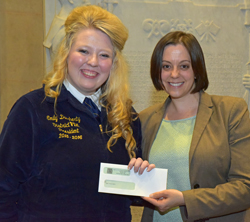
agday-16-daugherty Another agricultural award recipient present in Washington, D.C. on National Ag Day was Emily Dougherty, one winner of the Annual Ag Day Essay Contest.

The Annual Ag Day Essay Contest encourages students in 9th-12th grade to submit a written or video essay. This year’s contest theme was “Agriculture: Stewards of a Healthy Planet.” The winner of the video essay content was Ayodeji Ogunlana, South Texas High School for Health Professions, Mission, TX, and the winner of the written essay contest was Emily Dougherty, Whiteland Community High School, Greenwood, IN. More than 500 written essays were submitted by agriculture students across the country, and Emily was on hand during National Ag Day to read her essay, where she was also presented with a $1000 check.

“The same soil has continually been plowed and planted by my family for over 160 years. Every time I smell the sweet aroma of fresh tilled soil, I quickly think of the history behind the humble soil. My Great-Great-Great Grandpa cleared the forested land and hand dug a ditch so that he could have fertile farm ground. This land has provided for every generation since 1853. Now, my brothers and I have the honor to become the next generation of our family to farm the land. Generations before us have been phenomenal stewards of the land and now it is our turn to embrace technology to leave the land better than we received it,” reads one excerpt of the essay, entitled Stewardship for Generations.

Listen to the full winning written essay here:
2016 Ag Day Written Essay Contest Winner, Emily Dougherty

Watch the full winning video essay here:


View and Download Photos here: National Ag Day Activities Photo Album

Ag Day, Ag Groups, Audio, FFA, University

Meet the 2016 Charles Eastin Award Winner

Lizzy Schultz

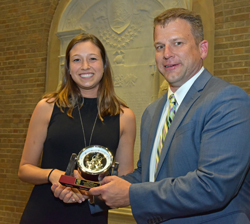
agday-16-obrien Christina O’Brien, Norz Hill Farm, Bridgewater, NJ, was awarded the 2016 Charles Eastin Award for encouraging communications between rural and urban audiences. The award was presented at the Celebration of Agriculture Dinner held at USDA in Washington, D.C. on National Ag Day, March 15, 2016.

O’Brien is involved with many organizations, keeping her focus on spreading the message of agriculture through education. She has served as a 4-H leader, running a workshop for “Science-sational day.” She also has brought in baby livestock to educating kids in grades 1-3, and ran a workshop in 2014 on making healthy dog biscuits using ingredients straight from the farm. Through her farm, Norz Hill, she has planned field days teaching kids how to care for livestock.

She serves as junior advisor to the New Jersey Holstein Association, and works with other advisors to plan youth competitions including quiz bowl, speeches, and trifolds/research. She has initiated a lease program for the Garden State Sheep Breeders and currently leases out her Oxford sheep to four inner city girls, ages 8-13. She was the 2010 County Dairy Princess, using her title to help plan and coordinate an event at the local YMCA that featured agriculture questions, prizes, milk and cheese, as well as healthy recipes for a well-balanced diet.

“It’s heartbreaking when I see kids from the city come on school trips who don’t know what a pig is or have never seen a horse before,” said O’Brien during her acceptance speech. “Our main goal is just to educate them, and I can’t stress how important agriculture and livestock both are.”

Listen to Christina’s full speech here:
Christina O'Brien Accepting Charles Eastin Award

View and Download Photos here:
National Ag Day Activities Photo Album

Ag Day, Ag Groups, Audio