Climate FieldView Helps @GROWMARK Customers

Cindy Zimmerman

Growmark_logoClimate Corporation’s Climate FieldView products are among the most exciting innovations that GROWMARK’s Ron Milby has seen come along for agriculture in the past two decades.

“I’ve been involved with precision ag for over 20 years and just having satellite images so you can see what’s going on, that really is a tremendous value,” says Milby, GROWMARK’s executive director for agronomy marketing, who explains that the Climate FieldView suite of products offers three different tiers – Prime, Plus and Pro.

climate-fieldviewMilby says the Climate FieldView Prime is a free offering that provides weather, scouting and alerts. “Climate FieldView Plus allows an in-cab experience,” he said. The Plus product also offers the ability to connect to FieldView Drive, which allows farmers to collect and send data directly from the cab to the cloud.

FieldView Pro takes all that to the highest level, adding advising capabilities for nitrogen, field health, and script creation and Milby says GROWMARK has certified local dealers within the FS System to provide that service for customers and can work cooperatively with a grower’s crop specialist. “We are an integrated partner with them where we can make recommendations through the portal to allow a grower to get scripts that we created,” Milby says. Growers can also allow their crop specialists access to monitor their fields for alerts and help manage their resources.

Milby adds that the Climate FieldView suite of products fit in very well with GROWMARK’s System Sustainability Endure initiative. “We’re really looking for the best management practices that are enduring over time to help keep our farmers profitable,” he said.

Learn more about GROWMARK and Climate FieldView in this interview: Interview with Ron Milby, GROWMARK Agronomy

Audio, FS System, GROWMARK, Precision Agriculture

I AM USFRA – Brad Greenway

Cindy Zimmerman

i-am-usfra-webBrad Greenway of Mitchell, South Dakota owns a wean-to-finish operation that markets 6,400 hogs annually, also raises corn, soybeans, wheat and alfalfa on 1,700 acres, and is proud to be able to serve as vice chairman of the U.S. Farmers and Ranchers Alliance (USFRA) to represent the National Pork Board.

“Since I’ve been on the board the last three years, it’s been a tremendous experience,” Brad says. “It’s a huge opportunity to sit on a board with members from all different commodities, all different areas across the U.S.”

usfra-pork-greenwayBrad says that being involved in an organization that encompasses all facets of agriculture gives everyone a big picture view of the industry as a whole. “Serving on a board with so many different perspectives and coming up with issues important to consumers is a huge benefit,” he said.

The National Pork Board was one of the founding members of USFRA with the goal of helping to build consumer trust in food production. “We thought USFRA was a nice fit, coming out with a unified voice (for the industry),” he explained.

USFRA has developed a number of consumer-targeted initiatives in just over five years of existence and Brad says one of his favorites is the Faces of Farming and Ranching, which is a group of young agricultural producers who represent the diversity of the industry. “Getting them out, visiting with consumers, putting them on panels, putting a face on agriculture has been a wonderful program,” he said.

Learn more about Brad and his commitment to USFRA here: Interview with Brad Greenway, South Dakota pork producer

Check out all of our I AM USFRA spotlights here.

usfra-banner

Audio, USFRA

MARY, MARY, QUITE CONTRARY

Melissa Sandfort

IMG_1452Today, Aunt Jeanette writes:

How does your garden grow?
With bleeding hearts, hostas, hyacinths, daffodils, clematis, moonflowers, roses, coral bells, and … BATS. What?

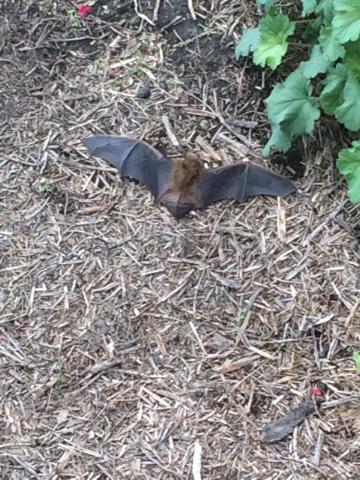
This little baby was hanging by my front door one afternoon when our son happened to see it. It startled me, and I have to admit, kind of scared me. I know bats are nocturnal and I figured it was probably sick since it was out in the daytime.

I am normally quite brave (except for snakes), but I decided to wait until Dan came home to remove the little critter. I had been pulling weeds, planting flowers, reseeding some grass, and rearranging flowerpots on my deck. I continued my work, keeping one uneasy eye on the bat.

When Dan got home, he brushed the bat off with a broom and it ended up in the flowerbed under the bay window. Of course this provided a photo opportunity.

Living on a farm provides many chances to see different kinds of wildlife. However, this was the first bat we have seen. We have lived here 34 years and I hope it is another 34 years before I see another one!

Until we walk again …

Uncategorized

USDA Announces $21M for Bioeconomy R&D

Joanna Schroeder

USDAThe U.S. Department of Agriculture (USDA) has made $21 million available to support the development of regional systems in sustainable bioenergy and biobased products. The funds can also be allocated to train the next generation of bio-scientists. The funding is offered through the AFRI Sustainable Bioenergy and Bioproducts challenge area designed to create or sustain jobs by improving existing food and fiber production systems, boost ecosystems by reducing greenhouse gases and improving water and habitat quality. The program is also designed to enhance resiliency of food systems and ensure food safety.

“Over the course of this Administration, America has more than doubled our renewable energy production, and today we import less than half our oil. We are saving money at the pump, bolstering national security by relying less on foreign oil, and combating climate change with investments in technologies that reduce greenhouse gas emissions and provide for cleaner air,” said Agriculture Secretary Tom Vilsack. “Today’s investment into regional production systems and the development of our next generation of scientists will have a direct impact on local economies now and set us up for a brighter, more innovative future.”

In fiscal year 2016, the Sustainable Bioenergy and Bioproducts challenge area is soliciting applications that focus on the following priorities:

  • Regional Bioenergy Coordinated Agricultural Projects (CAPs), which support the production and delivery of regionally-appropriate sustainable biomass feedstocks for bioenergy and bioproducts. While the focus of CAPs will be on feedstocks, competitive proposals must present the feedstock development and production in the context of comprehensive regional sustainable bioenergy and bioproducts supply chain systems.
  • Investing in America’s scientific corps: Preparing a new generation of students, faculty, and a workforce for emerging opportunities in bioenergy, bioproducts, and the bioeconomy.

Application deadlines vary by program area. See the request for applications for more information.

Agribusiness, Biofuels, USDA

BASF’s Varisto Herbicide Receives Registration

Kelly Marshall

BASF-logoThe EPA has given the go-ahead to BASF‘s Varisto herbicide.  The product may be used on clover grown for seed, dry beans, dry peas, English peas, lima beans (succulent), snap beans and soybeans.  The herbicide offers a wide spectrum of broadleaf and grass weed control.

Varisto herbicide offers multiple sites of action for excellent weed control and resistance management in a convenient pre-mix formulation with low crop response,” said Christa Ellers-Kirk, Technical Market Manager, BASF. “The introduction of Varisto herbicide to the market gives growers best-in-class weed control.”

A 2013 University of Idaho research trial showed that Varisto herbicide was 98 percent effective in controlling hairy nightshade, 96 percent effective in controlling redroot pigweed, 90 percent effective in controlling common lamb’s quarters and 84 percent effective in controlling green foxtail. Results were measured 29 days after treatment.

In that same research trial, a post-emergence application of Varisto herbicide preceded by a pre-emergence application of Outlook® herbicide was 99 percent effective in controlling hairy nightshade and redroot pigweed, and 98 percent effective in controlling green foxtail and common lamb’s quarters.

Varisto is recommended as part of a comprehensive weed management program that also includes Prowl herbicide or Outlook herbicide applied at pre-emergence, with Varisto applied at post-ermergence.

You can learn more about the product at  www.varistoherbicide.com.


Agribusiness, BASF, EPA, Herbicide, weed management

GROWMARK Welcomes 61 Summer Interns

Lizzy Schultz

imageGROWMARK has announced that sixty-one college students will spend this summer exploring agricultural career opportunities as GROWMARK interns in the company’s 57th summer internship program. Interns will work at FS member cooperatives in Illinois, Iowa, Wisconsin, Missouri, and Ontario, Canada, as well as GROWMARK FS, Mid-Co Commodities, and the GROWMARK corporate office in Bloomington, Illinois.

Interns will work in the areas of accounting, marketing, communications, and product and service-related activities. An orientation program was held for the entire group at the GROWMARK corporate office on Monday, May 16, and all 61 will reconvene in June for an agribusiness tour. Each intern will also complete am individual project and deliver a presentation on that project in August.

“We are excited to celebrate the 57th anniversary of the GROWMARK internship program,” said Amie Hasselbring, GROWMARK university relations manager. “The program continues to be a key component in identifying and retaining top talent into the GROWMARK System. Students engage with industry professionals on important projects and have the opportunity to clarify career goals, while we get exposed to the most talented university students,” she added.

A full list of the summer interns can be found here

Ag Groups, Agribusiness, Education, GROWMARK, University

ITC Study Predicts #TPP Benefits for Farmers

Cindy Zimmerman

usitcThe U.S. International Trade Commission (USITC) this week released a report on the expected impact of the Trans-Pacific Partnership (TPP) on various industries and agriculture fares especially well.

The report finds that, “Among broad sectors of the U.S. economy, agriculture and food would see the greatest percentage gain relative to the baseline projections, output would be $10.0 billion, or 0.5 percent, higher by year 15.”

“The ITC report provides another strong argument for why TPP should be passed this year,” said U.S. Trade Representative Michael Froman. “If you are a poultry farmer in Delaware this report shows that chicken exports will increase by $174 million annually under TPP. If you are a rancher in Nebraska this report shows that beef exports will increase by $876 million annually under TPP.”

Agriculture Secretary Tom Vilsack says all studies so far have shown the strong benefits TPP would have for agriculture. “TPP would further expand the markets for our American-grown products, allowing our goods to compete on a level-playing field and reach more consumers hungry for U.S. agriculture,” said Vilsack. “If we don’t act, not only will we lose these opportunities, we will be ceding our leadership in the region to China, allowing them to define the rules that the Pacific Rim plays by. We can’t afford to delay passage; there is simply too much at stake.”

The TPP agreement is with Australia, Brunei Darussalam, Canada, Chile, Japan, Malaysia, Mexico, New Zealand, Peru, Singapore, and Vietnam.

Trade, USDA

Zimfo Bytes

Talia Goes

Zimfo Bytes

  • American Seed Trade Association’s new website is now live.
  • ET Works, parent company of the Apache Sprayer brand and one of the largest manufacturers of self-propelled sprayers in North America, has selected Lessing-Flynn to lead strategic marketing efforts for its line of Apache Sprayers.
  • In the fall of 2015, FFA advisors and members were challenged to share the message of agriculture through social media and using the hashtag #SpeakAg.
Zimfo Bytes

ASFMRA Offers Summer Professional Development

Kelly Marshall

SEWThe American Society of Farm Managers and Rural Appraisers (ASFMRA) is putting the finishing touches on this year’s Summer Education Week (SEW).  This event, scheduled for June 22-July 2 in Des Moines, Iowa, will offer education of licensure, accreditations and continuing education for farm managers, rural appraisers, consultants and agriculture students.

In addition to professional development seminars and courses, the week will also include many opportunities for networking, as well as program for young professionals.

“Summer Education Week is a great time for new members to develop professional friendships and take the required education classes for their accreditation,” says Corey Prins, ASFMRA management and consulting education committee chairman. “For the seasoned professional, it’s an opportunity to network and learn more about the latest trends in our industry.”

This year features newly redesigned curriculum for those taking classes for accreditation.  The new courses are relevant to today’s agriculture, assures Skye Root, CFA, ASFMRA instructor.

For those looking to keep current the program will offer specialized management courses and programs for appraising rural residential properties, natural resources and poultry facilities.  Attendees can also expect to learn about weather outlooks, ag markets and technology and data management.  It also includes a tour of Iowa State University’s biomass research facility.

To learn more about the SEW schedule and to register, please visit http://www.asfmra.org/sew.

Ag Groups, Education, Events

Poll Shows Overwhelming Support for US Farmers

Lizzy Schultz

NCISlogo The results of a new national poll released this week reveal that nearly 90 percent of Americans have a favorable view of farmers, and 92 percent feel it is important to provide them with federal funding. Positive marks from respondents also cut across party lines, showing that a strong farm policy is a bipartisan issue.

The public opinion poll was administered as a phone survey of 1,000 registered voters. The poll was commissioned by the National Crop Insurance Services, and was conducted April 3-7. The poll’s margin of error is 3.1 percent. The results are available online here.

“Americans overwhelmingly like farmers and support the programs that protect them,” explained Jon McHenry, vice president of North Star Opinion Research, the polling firm that explored the general public’s views on farmers, farm policy and crop insurance. “This response is not surprising when you consider that eight in 10 voters believe a vibrant agricultural industry was critical to the country’s national security.”

More than 70 percent of respondents said they believed farmers should help fund part of their own safety net. This cost-sharing structure is at the heart of America’s crop insurance policy, with farmers paying a portion of their insurance premiums and shouldering, on average, 25 percent of crop losses through deductibles.

Nearly 80 percent of respondents support giving farmers discounts on insurance premiums, and the vast majority agreed with the current premium and deductible amounts absorbed by farmers.

Support for farm policy and crop insurance continued to remain high even when poll respondents were read a misleading statement often used by farm policy’s critics.

“In a question providing both sides, the security argument in favor of protecting farms wins by a two-to-one margin over the argument used by farm policy opponents,” McHenry said.

Ag Groups, Crop Protection