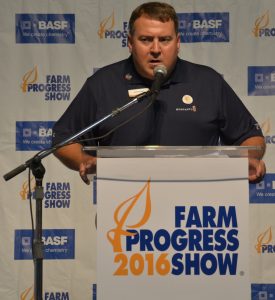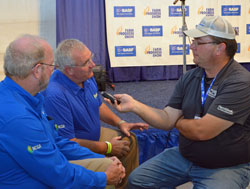
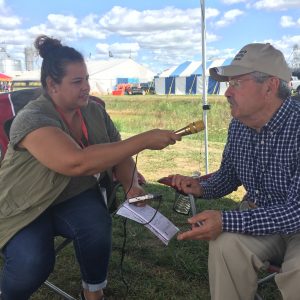
A Glimpse into the World Economy Outlook

Jamie Johansen

ussec-16-211-editedThe international audience at the U.S. Soy Global Trade Exchange went home with a head full of key insights for soybeans and the “World Economic Outlook – Now through 2017” was a small part. Tim Quinlan, Director, Senior Economist, Wells Fargo Securities, Global Division, keynoted the closing plenary and provided an analysis on the macro U.S. and major foreign economies.

He sat down with me before he took the stage to share how he hopes his words will impact the international soybean market. “What I am here to do is provide some context around the global economy, the U.S. economy specifically and where the federal reserve will guide interest rates over the next few years.”

Tim said we are in year seven of an economic expansion and they typically only last about five years. Are we living on borrowed time? “I think the biggest thing globally is we have much slower growth in China. The world economy has to get used to that…How do we cope in a world where global GDP growth is in the 2.7-2.9 percent change when we are used to 3.5-4 percent. It’s the new normal folks have to come to terms with.”

The top twenty trading partners with the U.S. are Tim’s bread and butter, but when it comes it emerging markets he said China has slowed, Brazil is having hard economic times and Russia is in a recession. So, who does he believe to be the next emercing market? “If I had a $100 and had to pick a horse over the next ten years, I’d bet on India to have the fastest growth rate.”

Listen to my complete interview with Tim to learn more: Interview with Tim Quinlan, Wells Fargo Securities

View and download photos from the event here: 2016 US Soy Global Trade Exchange Photos
Agribusiness, Audio, International, Markets, Soybean, USSEC

IA Gov Branstad Visits #FarmProgessShow

Joanna Schroeder

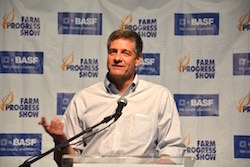
Another successful Farm Progress Show has wrapped up in Boone, Iowa. We ended on a high note with Iowa Governor Terry Branstad visiting exhibitors and stopping by the BASF Media Tent to speak with reporters about key ag issues. I spoke with him about three issues: ethanol, water quality and trade.

IMG_5257Branstad said that we appreciate the private sector support to improve water quality and said he and the Lt. Governor have been to over 40 sites in the state this summer to see water conservation in action. They are strongly advocating with Iowa legislators to pass water quality legislation again.

In terms of ethanol and the Renewable Fuel Standard, Gov Branstad visited Quad County Corn Processors this week along with Iowa Senator Joni Ernst to see both first-gen and cellulosic ethanol in action. He said that the industry needs continued federal support and now Ernst can share her personal experience in DC.

Speaking on the topic of TPP Gov. Branstad said we have problems with both parties. He believes support will be difficult and they may have to renegotiate.

Learn more about these three issues by listening to my interview with Iowa Gov. Terry Branstad: Interview with IA Governor Terry Branstad

2016 Farm Progress Show Photos

Coverage of the Farm Progress Show is sponsored by
Coverage of the Farm Progress Show is sponsored by New HollandCoverage of the Farm Progress Show is sponsored by BASFCoverage of the Farm Progress Show is sponsored by Growmark
Audio, Ethanol, Farm Progress Show, Trade, Water

New Holland Expands Self Propelled Forage Harvesters

Joanna Schroeder

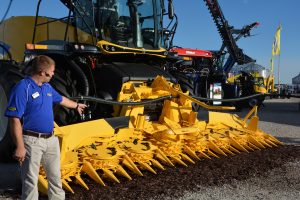
New Holland has continued the launch of its Self Propelled Forage Harvester line that started last year. The five model line-up ranges from 480 horsepower all the way up to 825 horsepower according to New Holland’s Doug Otto, with whom I spoke with during the 2016 Farm Progress Show in Boone, Iowa this week.

fps-16-ottoOne of the greatest features of the SP Forage Harvest says Otto is length of cut. This issue is one of the most critical for a cow’s feed ration. “So depending on the local dairy nutritionist and their theories about the balance of ration with that particular herd, he will request various lengths of cuts,” says Otto. The machine allows you to adjust on the go. “With New Holland, in the monitor, you can set what length you want to cut, with only minor limits based on the machine but most units will go from a half inch all the way up to an inch and a quarter and then if you want longer or shorter you might have to make some mechanical changes.”

Other key features? The New Holland FR Forage Cruiser (aka Chopper) has the widest feed row and feed channel in the industry. The cutter head is 32 inches wide. With that Otts says a producer gets a really thin crop mat and when it goes past the cutter head it gets chopped very consistently. “So I liken that to a paper cutter. If you take a whole ream and try to cut it you get ragged edges but if you take 10 pages and cut it you get nice cuts. Well it’s the same with the Chopper, it’s a thin mat going across the knife blade so you get very consistent length of cut then in the bunk produces a better quality feed. If the lengths of cut are different, it doesn’t ferment as well so when it goes to the cow the protein quality isn’t as high.”

Another cool feature is the Variflow System, which allows you to take the kernel processor that is used to process corn in and out in a matter of three minutes. Otto says you can chop hay in the morning, take the head off, put the processor on and go chop corn in the afternoon even this late in the season. Ultimately, says Otto, it’s the best Chopper on the market to blow forage.

Learn more about New Hollands Self Propelled Forage Harvester by listening to my interview with Doug Otto: Interview with New Holland's Doug Otto on SP Forage Harvester

New Holland 2016 Farm Progress Photo Album

2016 Farm Progress Show Photos

Coverage of the Farm Progress Show is sponsored by
Coverage of the Farm Progress Show is sponsored by New HollandCoverage of the Farm Progress Show is sponsored by BASFCoverage of the Farm Progress Show is sponsored by Growmark
Agribusiness, Audio, Equipment, Farm Progress Show, New Holland

GROWMARK Excited for What’s “Next”

Lizzy Schultz

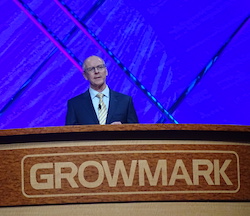
growmark-spradlin The 2016 GROWMARK Annual Meeting and Agribusiness Symposium was held this week in Chicago, Illinois. This year’s event theme was “Next,” with a focus centered on the innovations and ideas that will lead the future of agriculture and ensure its success.

Jim Spradlin, CEO of GROWMARK, sat down for an interview during the Annual Meeting. He discussed the company’s vision behind this year’s event, including this year’s new addition of the Agribusiness Symposium.

“We took a different approach this year by expanding it by a day and adding in some educational components, and we tried to choose topics that fit our current ag environment, which is currently in a down cycle,” he said. “There are challenges relative to economics, there are challenges related to regulations, and there are added environmental pressures, so we tried to pick speakers that help us could provide insight to our audience and our members and educate our owners on how to deal with these issues going forward.”

Highlights at this year’s event included a comprehensive panel on sustainability, an economic outlook from Dr. Mark Dotzour, and keynotes from retired General and former Secretary of State Colin Powell and retired U.S. Army Staff Sergeant Keni Thomas, whose acts of bravery during a famous mission in Somalia were recounted in the movie “Black Hawk Down.”

“GROWMARK’s mission is to improve the profitability of our member-owners, so we try to focus everything we do on how we can help our farmers become more profitable, which starts with providing trusted advice,” said Spradlin.

Listen to Lizzy’s full interview with Jim here:
Interview with Jim Spradlin, GROWMARK

View and download photos from the event here:2016 GROWMARK Annual Meeting & Agribusiness Symposium Photo Album

Ag Groups, Audio, Events, GROWMARK, Sustainability

Finalists Chosen for @USFRA Faces

Cindy Zimmerman

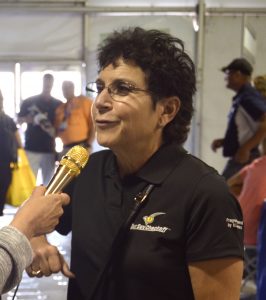
I-AM-USFRA-Nancy-KavazanjianThe U.S. Farmers & Ranchers Alliance (USFRA®) has announced the finalists of its third class of Faces of Farming and Ranching, a nationwide search to help put real faces on agriculture. This is the third class of Faces of Farming & Ranching that USFRA has sought to speak on behalf of the industry in this capacity.

The finalists are:

  • Lauren Arbogast, VA
  • Emily Buck, OH
  • Katie Roth, WI
  • Lauren Schwab, OH
  • Jeremy Brown, TX
  • Paul Lanoue, MN
  • Geoff Ruth, NE
  • Joy Widerman, PA

“Farmers and ranchers care immensely about their animals, the environment, and their customers, and we need to share their stories in order to protect many of the tools and technologies that agriculture utilizes today,” said Nancy Kavazanjian, USFRA Chairwoman. “These incredible finalists make it their highest priority to provide a nutritious and sustainable food supply, which is the story we intend to share with today’s consumer through this program.”

Kavazanjian says from October 10-16, people will be able to visit USFRA’s Facebook Page to learn more about each of the finalists and the work they do, including short videos highlighting their operation. From there, the public can vote for the farmers and ranchers whom they believe best represent today’s agriculture and the final winners will be announced in November at the National Association of Farm Broadcasting (NAFB) Convention in Kansas City.

We talked with Nancy at the Farm Progress Show yesterday about the Faces of Farming and Ranching program and what USFRA has been able to accomplish with this program. Interview with Nancy Kavazanjian, USFRA

2016 Farm Progress Show Photos

Coverage of the Farm Progress Show is sponsored by
Coverage of the Farm Progress Show is sponsored by New HollandCoverage of the Farm Progress Show is sponsored by BASFCoverage of the Farm Progress Show is sponsored by Growmark
Audio, Education, Farm Progress Show, Farming, USFRA

Iowa Home to New Ag Tech Accelerator

Joanna Schroeder

Iowa is the new home of a new startup business accelerator: Ag Tech Accelerator (The Accelerator). Four investors have provided funding for the initiative including DuPont Pioneer, Farmers Mutual Hail Insurance Company, John Deere and Peoples Company. Each company has committed to providing $100,000 for the first year. The Accelerator was announced by the Greater Des Moines Partnership and the Cultivation Corridor in a press conference during the Farm Progress Show.

Jay Byers, CEO, Greater Des Moines Partnership announces the formation o of the Ag Tech Accelerator during the Farm Progress Show.

Jay Byers, CEO, Greater Des Moines Partnership announces the formation o of the Ag Tech Accelerator during the Farm Progress Show.

Kathryn Kunert, Vice President of Economic Connections and Integration at MidAmerican Energy Company and Cultivation Corridor Officer said The Accelerator is modeled after the Global Insurance Accelerator and will build upon the one of the state’s key industries, agriculture. The new ag tech start-up program will be closely aligned with the goals of the Cultivation Corridor, launched in 2014, the home of many leading and start-up agbioscience, agritechnology, biorenewables, plant sciences and advanced manufacturing
companies.

The Ag Tech Accelerator will assist with the Cultivation Corridor’s mission to support and sustain the science that feeds the world,” said Kathryn Kunert, Vice President of Economic Connections and Integration at MidAmerican Energy Company and Cultivation Corridor Officer. “The Cultivation Corridor relies on support from Central Iowa businesses, and I am pleased that key collaborators DuPont Pioneer, Farmers Mutual Hail Insurance Company, John Deere and Peoples Company have committed to support the Ag Tech Accelerator.

Deere Information Solutions business director Lane Arthur. John Deere is a founding partner in the new Ag Tech Accelerator.

Deere Information Solutions Business Director Lane Arthur. John Deere is a founding partner in the new Ag Tech Accelerator.

Jay Byers, CEO of the Greater Des Moines Partnership added, “Today’s announcement is an example of Central Iowa celebrating its agricultural roots and leveraging that key industry into further global economic growth. Our state is at the top in so many areas in terms of agriculture, and The Accelerator will help ensure that we are a world leader for years to come.

The four investors will have company representatives on the board, of which will select the first set of companies to participate in the program in 2017. Companies from around the world are encouraged to apply. If accepted, the start-ups will send team members to Iowa for 100 days where they will receive mentoring from experts who work in the ag industry’s leading companies.

John Deere has long been dedicated to those who are linked to the land, and is always ready to embrace change that leads to new opportunities,” noted Lane Arthur, Deere Information Solutions Business Director. “Being able to support the continuing progress in the field of precision ag is important both here in Iowa, as well as around the world.

Listen to the Ag Tech Accelerator press conference here: Ag Tech Accelerator Press Conference Read More

Agribusiness, Audio, Farm Progress Show, International, John Deere, Pioneer, Precision Agriculture

Report Finds #Ag Can Help Combat Climate Change

Joanna Schroeder

Growers to provide feed, fiber and fuel and now according to a new report released during a press conference at the Farm Progress Show this week, farmers, or agriculture, can also help combat climate change through the reduction of greenhouse gas emissions (GHGs). ICF International conducted the research entitled, “Charting a Path to Carbon Neutral Agriculture: Mitigation Potential for Crop Based Strategies,” and found that widespread adoption of recommended practices could potentially result in more than 100 million metric tons of CO2 equivalent emission reductions in the U.S. alone.

Dion McBay, Monsanto, unveils the results of the new report, "“Charting a Path to Carbon Neutral Agriculture: Mitigation Potential for Crop Based Strategies," during the 2016 Farm Progress Show.

Dion McBay, Monsanto, unveils the results of the new report, “Charting a Path to Carbon Neutral Agriculture: Mitigation Potential for Crop Based Strategies,” during the 2016 Farm Progress Show.

This report shows promising results and helps confirm the significant impact farmers can make when they adopt and maintain the practices noted in the report,” said Michael Lohuis, Ph.D., Lead Scientist for Environmental Strategy for Agriculture for Monsanto who commissioned the report as part of the company’s commitment to achieve a carbon neutrality by 2021. “The carbon-smart practices mentioned, coupled with innovations like biotechnology and advanced breeding, are vital tools that can help farmers adapt to and mitigate climate change. At Monsanto, we are committed to encouraging the use of innovative farming techniques and carbon smart practices that will help reduce emissions.” Lohuis also noted that Monsanto is sharing data and modeling results to help encourage the ag community to adopt the best sustainability practices.

The report focused on near-term strategies, including:

  • Cover crops. The report found that the greatest near-term potential for reducing GHG emissions through agriculture comes from the planting of cover crops, grown between primary crop seasons. Cover crops, which are currently grown on only about 3-5 percent of U.S. crop acreage, can prevent soil erosion and help to absorb and keep carbon stored in the soil. (Also during Farm Progress the Iowa Ag Water Alliance announced a conservation strategy that also included the role of cover crops in nutrient management.)
  • Conservation tillage. The second largest potential comes from reducing or eliminating soil tillage, which enables farmers to save money and resources while limiting the amount of carbon released from the soil into the atmosphere. This practice also helps preserve soil structure and soil organisms, which improves soil health. (During Farm Progress a new multi-industry collaborative was announced, the Midwest Row Crop Collaborative, with a focus on expanding conservation practices and tools as promoted in part by the Soil Health Partnership.)
  • Precision nutrient management. Precision agriculture and nitrification inhibitors can be effective in reducing GHG emissions. Precision agriculture helps determine the appropriate amount of fertilizer and pesticide to use on the field, and where they need to be applied. By using GPS guidance and variable rate technology when applying the inputs, farmers optimize nutrient and fuel use while improving profitability. By adding inhibitors, farmers utilize fertilizer more efficiently, reducing emissions and achieving the same yield.

The report also found that long-term strategies also can help reduce carbon emissions, but will require more research and time to scale-up. These strategies include:

  • Ethanol production from corn stover. Corn stover (the stalks, leaves and cobs left in the field after corn harvest) represents a sizeable renewable source of biomass to augment ethanol production. This material could help reduce emissions from fossil fuels while sustainably managing excess crop residues in the field.
  • Utilize crop material left in the field after harvest. There also is a possibility that available excess corn stover could be burned alongside coal in coal-fired power plants, which would reduce the amount of fossil fuel used through the use of this renewable source of energy. Available corn stover also could be processed into plant-based charcoal (biochar) that could be incorporated into the soil to increase soil health and store carbon in the soil not in the atmosphere.

Agriculture has the potential to play a critical role in addressing climate change,” added Debbie Reed, Executive Director with the Coalition for Agricultural Greenhouse Gases. “This report adds another critical set of data points to help quantify and demonstrate how the agriculture community can take actionable steps, both in the near-term and long-term that will have a substantial and positive impact on our planet.”

Listen to the Combating Climate Change with Ag press conference here: Combating Climate Change Report Presser

2016 Farm Progress Show Photos

Coverage of the Farm Progress Show is sponsored by
Coverage of the Farm Progress Show is sponsored by New HollandCoverage of the Farm Progress Show is sponsored by BASFCoverage of the Farm Progress Show is sponsored by Growmark
Agribusiness, Audio, Conservation, cover crops, Farm Progress Show

#FarmProgressShow Powered by @FSServices Fuel

Cindy Zimmerman

fps-16-fs-jasonThere are lots of vehicles and farm equipment on the grounds at the Farm Progress Show and it’s GROWMARK FS and STAR Energy that keep them all running.

“Not only do we offer the fuel for the field demonstrations, we also do all the generators, the air conditioning and power in the tents, but also during the set up,” says STAR Energy retail fuel manager Jason Stauffer. “100 percent of the fuel that powers the Farm Progress Show here in Boone comes from GROWMARK STAR Energy.”

Energy is a focus of the FS exhibit at the show, including propane autogas. “We brought a Ford F-150, which is duel-powered, that runs on gasoline and propane,” said Stauffer. “So if you can’t have access to propane, just pull into your gas station and fill it up.”

Learn more about STAR Energy in this interview: Interview with Jason Stauffer, FS Star Energy

2016 Farm Progress Show Photos

Coverage of the Farm Progress Show is sponsored by
Coverage of the Farm Progress Show is sponsored by New HollandCoverage of the Farm Progress Show is sponsored by BASFCoverage of the Farm Progress Show is sponsored by Growmark
Audio, Energy, Farm Progress Show, FS System, GROWMARK

China Commits to $1.8 Billion Worth of U.S. Soy

Jamie Johansen

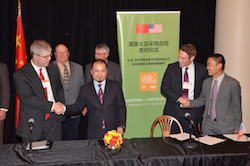
ussec-16-42-editedDuring the 2016 U.S. Soy Global Trade Exchange in Indianapolis, buyers from China committed to buy nearly $1.8 billion worth of U.S. soy, totaling 146 million bushels of new crop U.S. soybeans. Several of these commitments were made official at a signing during the event, hosted by the U.S. Soybean Export Council (USSEC).

“China continues to be the No. 1 importer of U.S. soybeans,” says Xiaoping Zhang, USSEC Country Manager – China. “International buyers have many options, so the fact that Chinese buyers purchase such a magnitude from the U.S. is testament to the U.S. Soy Advantage and the quality and sustainability that it provides.”

Last year, U.S. soybean farmers exported a record 62.88 million metric tons of soy and soy products, valued at $27.7 billion – a record high. Economists are predicting even more in 2016.

More than a dozen Chinese representatives are in attendance this week at the Global Trade Exchange to network with U.S. farmers and learn more about the sustainability of U.S. soybeans. In addition to signing commitments for U.S. soy, they will network with buyers from other countries around the world, learn from industry experts and get a firsthand glimpse of U.S. farmers’ sustainable practices.

The USSEC connects U.S. soybean farmers with opportunities to improve human nutrition, livestock production and aquaculture. This mission is accomplished with a science-based technical foundation and a global network of partnerships including soybean farmers, exporters, agribusiness and agricultural organizations, researchers and government agencies.

Following the signing I spoke with Xiaoping to learn more. Listen to my complete interview here: Interview with Xiaoping Zhang, USSEC China

View and download photos from the event here: 2016 US Soy Global Trade Exchange Photos


Agribusiness, Audio, Soybean, Trade, USSEC

NCGA Shares Messages & Priorities at #FarmProgressShow

Joanna Schroeder

fps16-ncgaSeveral members and staff from the National Corn Growers Association spent time with media, farmers, industry partners and academics during the 2016 Farm Progress Show to share the organization’s key priorities and messages.

The clear intent of our effort is to communicate the economic challenges farmers are facing and leverage NCGA’s position as a thought leader to raise awareness and drive solutions,” said Wesley Spurlock, NCGA’s incoming president. “We are working on everything from developing new fuel infrastructure for greater consumer access to ethanol, to trade issues, to combating regulatory barriers, and virtually all of our issues come back to the same thing…demand. The quickest and best way to address the looming economic crisis is increasing demand and grinding corn.

As Spurlock noted, tens of thousands of farmers, representatives in related industries and dozens of ag media outlets attend the Farm Progress Show each year. So, it provides a unique opportunity to discuss issues and potential solutions as well as relay messages to farmers across the nation not in attendance.

Farmers, industry and government all have a responsibility to come together to solve this economic challenge. I think our efforts to rebuild research and development capabilities, engage consumers and address our eroding infrastructure represent a big step in the right direction,” Spurlock added. “But, we must all share this commitment and pull in the same direction for us to be successful.

Listen to an interview with Spurlock and NCGA incoming First Vice President Kevin Skunes here: Interview with NCGA Officers Wesley Spurlock and Kevin Skunes

Coverage of the Farm Progress Show is sponsored by
Coverage of the Farm Progress Show is sponsored by New HollandCoverage of the Farm Progress Show is sponsored by BASFCoverage of the Farm Progress Show is sponsored by Growmark
Agribusiness, Audio, Corn, Farm Progress Show, NCGA