
- Those in the ag industry following the movement of western bean cutworm (WBCW) are not surprised by the latest find in Frankfort, Mich. In the last decade, WBCW has moved from the dry bean fields of western Nebraska into eastern Nebraska and throughout Iowa. Within the last two years, WBCW crossed the Mississippi River and became a pest of cornfields in northern Illinois and southwestern Wisconsin. After capturing WBCW moths the past two years in Indiana, Purdue University entomologists confirmed in August that they had identified western bean cutworm larvae in a Jasper County cornfield, located in northwestern Indiana, officially marking WBCW as a pest of Indiana. Insecticides can control WBCW; however, the window of application is narrow. Once larvae hatch, they quickly get to the cob. The husks provide protection and cover from the insecticide. Farmers need to proactively scout fields to see whether they have a WBCW infestation. Usually, WBCW isn’t detected until it’s too late. A better way to protect corn from WBCW damage is with an in-plant trait. Farmers who grow corn hybrids with HERCULEX® Insect Protection in-plant traits have built-in protection against WBCW. A 40 percent yield loss is not uncommon, and even a 5 percent loss can cost a grower $25 per acre at today’s corn prices where yields run about 175 bu./A. You can learn more about WBCW by viewing a slide show from Iowa State University extension.
- The Meyocks Group has added two people to its team. Justin Stevens joins as a web development manager. He previously was a web and graphic designer with EFCO Corp., Des Moines, and also has several free-lance credits. Stevens earned an associate’s degree in visual communication at Brown College in Minnesota. He’s a Des Moines native. A’Leisha Stycket joins as a media coordinator after two years with the in-house agency for Casey’s General Stores, Ankeny. Stycket received her education at Drake University, earning a bachelor’s degree in business administration with a major in marketing. She’s also a Des Moines native.
- Elanco Animal Health has announced the promotion of Dr. Bill Platter to the position of manager of technical consultants for beef cattle. In this role he will lead a team of professionals conducting post-product-approval research, and providing technical services with a feedlot and stocker focus in the United States. These activities focus on work with veterinarians, nutritionists and meat scientists to improve animal health, production efficiencies and profitability within the beef industry. Platter has relocated to work from Elanco’s global headquarters in Greenfield, Ind.
- Shauna Trusas has joined Allflex USA as Associate Western Regional Manager. Shauna will be responsible for supporting Allflex’s sales and marketing efforts in the western U.S. including the states of Arizona, Nevada, California, Oregon, Idaho, Montana, and Wyoming. Trusas is an Animal Science graduate of California Polytechnic State University in San Luis Obispo with an emphasis in livestock production and agricultural communications.
- David Loos has been hired as Technology and Business Development Director by the Illinois Corn Growers Association (ICGA) and the Illinois Corn Marketing Board (ICMB). In his new position he will be responsible for collecting and analyzing technical, economic, regulatory, political and social information relevant to market development projects for both boards. He will act as a liaison with public and private companies and various industry organizations and individuals which have projects involving new and innovative corn-related technology. He will also manage the ICMB research program as well as solicit and evaluate research proposals and work with universities and industry on patent and royalty issues representing the ICMB.
Getting a New Media Fix
 It looks like I’ll be able to attend the third annual Podcast & New Media Expo. I’m finding it hard to believe we’ve been doing this new media thing in agribusiness for over 3 years now. Starting Friday, I’ll be getting my new media fix with educational sessions and a trade show.
I’ll be attending the conference with longtime friend and former business partner (now client), Gary Cooper, Southeast AgNet. You can be certain that there will be some posts from the event here on AgWired.
It Feels Good To Be Home
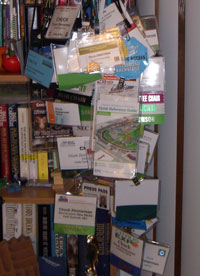 At least for a few hours. Once upon a time gunslingers notched their pistol for fights they’d won. Agribloggers just add another lanyard/name badge to the stack.
These are actually just from the last year or so since I start it over once the trophy I’ve got it hanging from falls off the book shelf. Now it’s got a 2007 IFAJ Congress one on top that also has an Alltech pin in it.
I think it took Cindy and me about 27 hours to get back from Japan. Nothing like leaving Sendai on a Sunday. I hope everyone made it home safely regardless of which country you are from.
You can look for some good stuff to come here on AgWired this week. Tomorrow I’ll be on the road again. I’ll be adding a couple more to the stack. See you then.
IFAJ Congress 2007 Photo Album
AgWired coverage of IFAJ 2007 is sponsored by: 
Americans in Japan at IFAJ
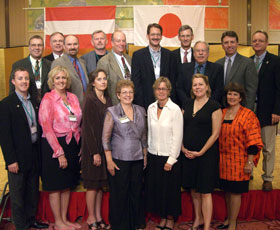 Here’s a fine looking group of Americans don’t you think?
We numbered 17 of the total in attendance. Maybe next year some more U. S. ag journalists will attend the IFAJ Congress? I interviewed the chairman, Franz Fischler, former Ag Commissioner for the EU and will be posting that later. He provides an overview of what we can expect and it sounds like it’s going to be a great event just like here in Japan.
Today we’ve got to take a cab to a train, train to Tokyo, pick up our bags from a hotel at the Tokyo train station and take a bus from there to the airport.
Since it will be a while before I’m back online I want to thank Masaru Yamada and all the Japanese delegation that worked so hard to put on this Congress and host people from so many countries. We learned a lot. I also interviewed most of our group here and will be posting their comments in my ZimmCast which should be up tomorrow.
IFAJ Congress 2007 Photo Album
AgWired coverage of IFAJ 2007 is sponsored by:
Passing the IFAJ Flag
 The IFAJ Congress is over and we’re about to head on out for the long trek home. Here’s the ceremonial passing of the IFAJ flag from the Japanese to the Austrians.
Our events yesterday were held in different locations without me being able to get online again. So, I’ll be working up some posts with interviews and some video clips on the way home to post later.
In the meantime there’s about 450 photos in the photo album you can enjoy.
IFAJ Congress 2007 Photo Album
AgWired coverage of IFAJ 2007 is sponsored by:
Final Day in Sendai
 Today we had a free morning to shop or just plain relax here in Sendai. Our IFAJ Congress is coming to a close with tonight’s final reception. I’ll have some more posting to do which might have to wait until I’m home. Tomorrow is a travel day. The photo album is up to date though.
This afternoon we were bussed to the Sendai City Welfare Plaza for the International Symposium, “Japan’s Food and Agriculture From a Global Perspective.” Cindy was a participant in the first panel discussion. She’s seated 2nd from the right. She got to ask a question about biofuels which was answered mostly by Kazunuki Ahizumi, Professor, Miyagi University. He was sort of the featured 1st speaker on the program.
I’ll have more on the day’s activities later. For now though I’ve got to get moving to the final reception.
IFAJ Congress 2007 Photo Album
AgWired coverage of IFAJ 2007 is sponsored by:
Fending Off Body Odor With Corn
 Inventive ag producers have come up with yet another way to use corn in an eco-friendly way. Dupont and Tate & Lyle are now offering corn-based deodorants.
The DuPont Tate & Lyle Bio Products joint venture today announced that it is providing its innovative Zemea(TM) renewably sourced propanediol (Bio-PDO(TM)) product to Terra Naturals Inc., a personal care company, that has developed a line of natural deodorants that are corn-based, aluminum- and petroleum-free. Under the branded GREEN line of products, the deodorants are distributed through United Natural Foods in the United States and Purity Life in Canada and also are available at the Terra Naturals website, www.terranaturals.com.
Zemea(TM) renewably sourced propanediol is a 100 percent renewably sourced ingredient made from corn sugar. The Terra Naturals GREEN line includes deodorant sticks, sprays and roll-ons for men, women, teens and sport uses. These products offer excellent odor elimination, excellent texture and a non- sticky residue. The GREEN line products are free of petroleum-based chemicals, free of synthetic parabens and aluminum and use only plant derived ingredients.
“Zemea(TM) propanediol offers a luxurious and non-sticky texture to deodorants,” Terra Naturals co-founder Svetlana Ratnikova said. “It replaces propylene glycol in petroleum-based deodorants and vegetable glycerin in existing natural deodorants. Vegetable glycerin can be very sticky and reduces overall product performance, and propylene glycol is derived from natural gas, a product that energy-conscious consumers are trying to reduce their dependence on.”
Read More
Dow AgroSciences Earns International Recognition
 The United Nations has recognized Dow AgroSciences‘ latest breakthroughs in technology with an innovation award. Dow AgroSciences is the latest recipient of the Montreal Protocol Innovators Award for its work in developing alternatives to chemicals that harm the ozone.
Dow AgroSciences LLC, a subsidiary of The Dow Chemical Company (NYSE:DOW), has been named a winner of the United Nation’s Montreal Protocol Innovators Award at the annual Meeting of the Montreal Protocol, an international agreement designed to protect the earth’s ozone layer. The award honors the company’s innovation, investment and commitment to protect the environment through its efforts to develop alternatives to methyl bromide, an ozone-depleting substance being phased out under the Protocol. At this meeting, which commemorates the 20th anniversary of the Protocol, Dow AgroSciences was also named a winner of the United States’ Environmental Protection Agency’s (EPA) “Best of the Best” Ozone Protection Award which honors an elite group of companies, organizations and individuals who have demonstrated long-term excellence in efforts to protect the stratospheric ozone layer.
Both awards honor the company’s long-standing commitment to providing critical alternatives to methyl bromide, an ozone-depleting substance used for pre-plant, post-harvest and structural fumigation uses. Dow AgroSciences products containing the active ingredients 1,3-dichloropropene and sulfuryl fluoride have been widely adopted on a global scale to coincide with the scheduled phase-out of methyl bromide.
“I am delighted that Indianapolis, Indiana-based Dow AgroSciences has been recognized for their continued leadership in developing technical and economically feasible alternatives to methyl bromide in accordance with this important international treaty,” stated Sen. Richard Lugar (R-IN).
Read More
Get to Know an Alpaca During National Alpaca Farm Days
 The Grand Alpaca Farm is opening its gates to anyone who’s interested in learning more about Alpacas. The invitation recognizes National Alpaca Farm Days.
Tim Talbott saw a news story in 1984, about Americans importing alpacas from South America and raising them for their cashmere-like fiber. Intrigued, the established surgeon sought more information. In 1985, he and his wife, Jane, invested in six alpacas and made a long-range business plan to increase the herd to 100 animals by the time he retired. Dr. Talbott, who recently retired, has more than met his goal. “We have more than 100 Chilean and Peruvian Huacaya alpacas – the largest herd in Michigan,” he says. “And although we started raising and selling alpacas as an investment 22 years ago, we enjoy them more each year.”
An alpaca, cousin to the Llama and a member of the Camelid family, is about 36 inches tall, weighs about 150 pounds fully grown and can live up to 20-25 years. Tim says, “Because of their manageable size and calm dispositions, they make wonderful companion animals and are very gentle with children … making them ideal for families.”
The Talbotts, early pioneers in the alpaca industry, and one of the founding members of the national organization, the Alpaca Owners and Breeders Association, take pride in the history they have in the alpaca business, the quality of alpacas they sell, and the level of service they provide. Their alpacas are fully guaranteed ARI registered alpacas that are personally raised and managed by Tim and Jane.
When the Talbotts purchased their six alpacas in 1985, there were about 350 alpacas in North America. Today, there are about 100,000 alpacas. The reason for such growth is simple; “People recognize the many benefits of alpaca ownership,” according to Tim.
Now Tim and Jane wish to share their enthusiasm with others during National Alpaca Farm Days. “We invite anyone interested in raising alpacas or are just curious about the animals to come, tour the farm and meet our alpacas,” Jane says.
The Grand Alpaca Farm, 4344 Four Mile Road, N.W., will be open to the public Saturday, September 29 and Sunday the 30th from 10:00 A.M. to 4:00 P.M.
DuPont Funds Biofuel Projects
 A million dollar pledge from DuPont means Iowa State University can begin development of its “New Century Farm.” The farm will be the center for biofuel and biomaterial farm production research on the Iowa State campus.
DuPont has announced a pledge of $1 million to the Iowa State University (ISU) New Century Farm, the first research effort in the United States to focus on producing cellulosic ethanol on the farm. The research efforts also will focus on enhancing the production, processing and utilization of feedstocks for biofuels and biomaterials.
“The need for renewable sources of energy requires a dynamic new way of thinking. The New Century Farm will research the practical things farmers can do in the future to grow, harvest and store biomass in a sustainable manner,” said Dean Oestreich, DuPont vice president and general manager and president of Pioneer Hi-Bred, a DuPont business. “We’re proud to partner with Iowa State to create a demonstration farm that will be the first of its kind to integrate both the growing and processing of biomass into biofuels.”
The New Century Farm will include a facility for research in biomass crop breeding, crop rotation needs and ways to efficiently store and process biomass material. It also will feature a teaching laboratory for training future scientists and farmers, and an extension facility to demonstrate the economic, social and environmental viability of bioenergy.
The funding from DuPont, through its Pioneer Hi-Bred business, will be allocated from 2008 to 2012.
Read More