
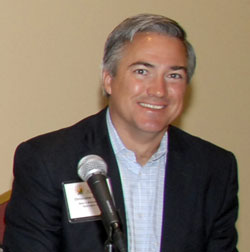
 The issue of investment and financing for ethanol plants and bio refineries in general was addressed today by Chris Groobey, Baker & McKenzie, LLP. He works on project financing with investors and lenders and mostly in renewable fuels. He painted a pretty bleak picture.
In fact, he says the New York investment community is not interested in biofuels right now. He says they’re tapped out and that ethanol and biodiesel are not of interest to them at all. So with that being said, what’s next? He says there needs to be a combination of making more money from existing plants by co-locating other facilities or finding other sources of income from the same plant. He also thinks there needs to be more and bigger business structures.
He says this means we’re returning to more traditional models of rural development that take a longer term view. He recommends growing local agriculturally skilled management teams with people who understand farm risk.
You can listen to my interview with Chris here: ff-bio-08-groobey.mp3
You can also download the interview using this link (mp3).
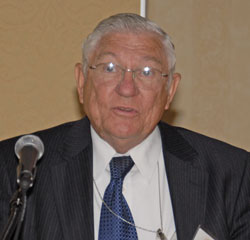 We had two Under Secretaries talk to us here today. It was my first time to meet our USDA Under Secretary for Research, Education and Economics, Gale Buchanan. He was here at the Transition To A Bio Economy conference to talk about the need for research in a growing bio economy. In fact, he sees a need for a tremendous amount of research to address the opportunities presented by the whole energy picture.
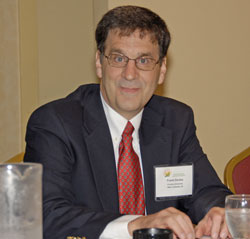 When it comes to infrastructure needs for a bio economy our rural road system is a key component. To speak about it here at the Transition To A Bio Economy conference we heard from Frank Dooley, Purdue University. He sees a big increase in grain production, primarily in the midwest. With that comes a growing demand for transportation. He thinks we should be concerned because most of the corn will be moved by truck and that’s going to impact rural roads. He also sees an increase in rail transportation but not significantly.
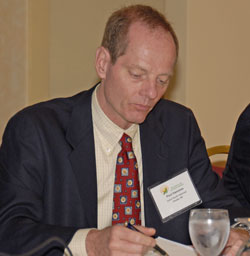 We hear a lot about the growth in ethanol production but do you know how it gets from the plant to where it needs to be to enter our fuel supply? How about rail car? During our discussion on the infrastructure needs of a Transition To A Bio Economy, we heard from Paul Hammes, Union Pacific Railroad. Of course his focus was on rail infrastructure and as it relates to biofuels. Specifically, he spoke to the different pieces of that supply chain like rail cars, the rail network and unload/load capacity.
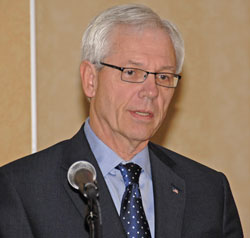 My good friend Tom Dorr, USDA Under Secretary for Rural Development, was our opening speaker for day two of Farm Foundation’s Transition To A Bio Economy conference. He was glad to see the golden ZimmComm microphone once again! We visited for a while before the session got started.
 Okay. This is the last one for today. But there’s more to come tomorrow.
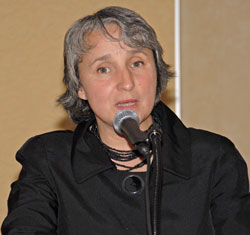 We hear a lot about co-products with ethanol production like the DDGS but what about in cellulosic ethanol production? Well, Danielle Julie Carrier, Arkansas State University is doing work on that subject.
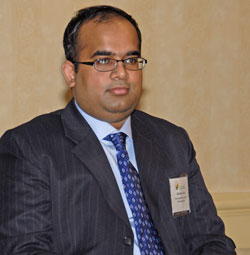 I know you’re getting a healthy dose of biofuels here on AgWired today but it all has to do with agriculture and rural America so I hope you’re enjoying it. I’ve been learning a lot, including just how much work the Farm Foundation does.
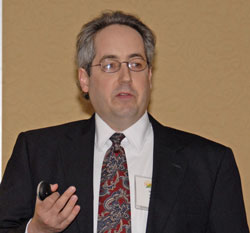 On the subject of locating a biorefinery we had another presentation on the subject here at the Transition To A Bio Economy conference. This one was by David Perkis, Purdue University.