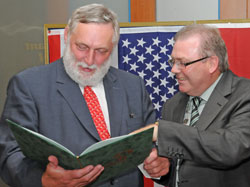
 The final night’s activities at the IFAJ Congress was a historic event for me. The only IFAJ President I’ve ever known up until this Congress was David Markey and this was when he turned the reins over to a new leader.
I can tell you one thing. When you’ve got a group of people from countries all over the world it can be a challenge to get them all heading in the same direction. However, when David takes the microphone, people stop talking and listen.
Before he said his goodbyes though, he distributed some medals and mementos to the people who made this year’s Congress happen. One of those was the President of the Congress, Franz Fischler.
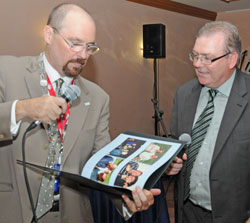 Then David had some time to talk about his opportunity to serve IFAJ as President. If you know David then you know that he’s a professional and a businessman. I think he brought the organization a new outlook that has helped it to grow significantly. He looks at things a little differently than your average person with an insight that comes from years of successful business management.
For example, he said, “I always believe change is good. No matter how much it challenges us, change is the only way we can bring out the best in us.”
David received a number of gifts in honor of his service. One of those was this book of photos presented by new IFAJ President Mike Wilson.
You can listen to David’s remarks here: ifaj-08-markey-goodby.mp3
IFAJ Congress 2008 Photo Album
AgWired coverage of IFAJ 2008 is sponsored by:  and
and 

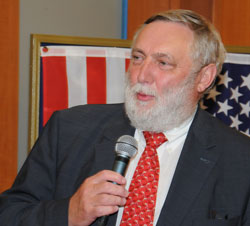 I like the way Fran Fischler, President of the IFAJ Congress 2008, started his remarks at the end of the event.
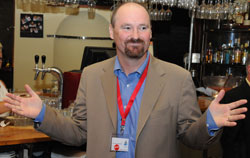 The new President of IFAJ is Mike Wilson, Farm Progress Companies.
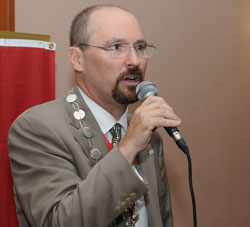 Then during our final dinner of the IFAJ Congress in Portoroz Mike took the microphone as the new man in charge.
  Here’s something you just don’t see much any more. Telephone booths. I remember when we used to be able to unscrew the mouthpieces and plug our recorders into them with alligator clips to send audio back home. I also remember moving to Missouri and stopping at one of these in north Illinois during the winter to call home when the wind chill was about 10 below. I like emailing or uploading from the warm comfort of my room now!
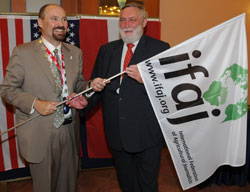 The IFAJ Congress has concluded but AgWired coverage of the event has not. Over the next several days I’ll be featuring more interviews and video clips. Our schedule and internet access has worked against me a little bit. Cindy and I just got back into Graz where we’ll fly out early tomorrow for St. Louis. At the moment, the internet access here in the hotel is not working. However, I was able to get online behind the desk in the lobby.
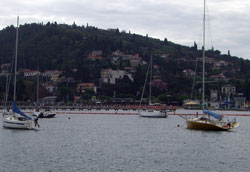 Portoroz is a beautiful little town on the Adriatic coast. The weather changed last night as we came in from Austria and we’ve been getting some light sprinkles all morning.
 Greeting the IFAJ Congress at our first dinner in Portoroz was the Minister of Agriculture, Forestry and Food, Iztok Jarc. He had a challenge because just prior to our dinner the weather changed completely and we had a drenching lightning storm. It forced the restaurant to make some major adjustments to the settings but finally we got everyone under cover and seated.
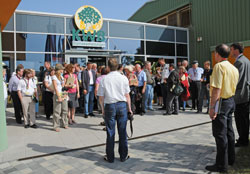 Our first stop on the Tour III group yesterday was KWB, a company that manufactures biomass heating systems. Basically these are various size heaters using wood chips or wood pellets for fuel.
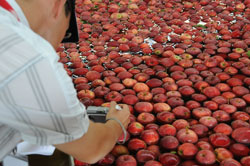 On my first IFAJ tour stop I spoke with our host, Johann Scholler, Steirerfrucht. They are a fresh fruit packing facility. The main product is apples although they also handle pears and other fruit.