
 Rural America’s infrastructure challenges cut to the heart of the six challenges outlined during this morning’s session of the Farm Foundation’s Food and Agriculture Policy Summit being held in Washington, D.C.
As you might remember from my earlier post, this morning, Farm Foundation Pres. Neil Conklin outlined the six major areas of challenges facing agriculture over the next 30 years: 1. Global financial markets and recession, 2. Global food security, 3. Global energy security, 4. Climate change, 5. Competition for natural resources, and 6. Global economic development. Gene Griffin with the Upper Great Plains Transportation Institute at North Dakota State University told the group attending today’s Farm Foundation session that a crumbling rural infrastructure, in particular, the roads, touches each one of these six challenges and threatens to make them even worse.
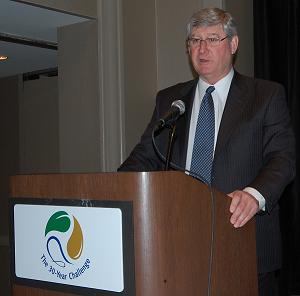 “The engineers will tell you [the pavements] look OK on the surface, but underneath it is starting to crumble.” Griffin says by the time the damage is clearly noticeable, it costs two to three times as opposed to normal maintenance and repair.
“Just getting the political will of people to pay for systems they want to use… but they’ve gotten used to the idea they don’t necessarily have to pay for it. And I think those are two huge problems.”
Griffin says in his home state, where rural roads are seeing a huge amount of big trucks working the biodiesel and ethanol industries and North Dakota’s burgeoning petroleum industry is also taking a toll, that infrastructure needs the funding… although it might not see the same amount of traffic a higher-density population area would see. He says if the cities want the fuels that are produced in rural areas, we need to develop a system that links the high-density traffic areas with the low-density ones.
He says it comes down to deciding if we’re going to pay for the infrastructure that will help us be more energy independent now at a lower price or at a much higher price… down the road.
Listen to my entire conversation with Gene here: Griffin1.mp3
Download the audio here.
 America is losing rural farm and forest land… some of it the best farmland in the world… at an alarming rate, the equivalent of losing the entire states of Connecticut and Vermont over a six-year period.
 “Being taken out of production PERMANENTLY!” And Wagner pointed out that this isn’t land that is being retired into some conservation program. He says it is going into commercial development and rural residential developments.
  It’s back on location time here in Gainesville, FL at
  One of the really great things about Farm Foundation events is how the group brings together people from divergent backgrounds and points-of-view to freely discuss the issues affecting American Agriculture today. The latest session at the Foundation’s Food and Agriculture Policy Summit it is hosting here in Washington, D.C. is another great example of that.
 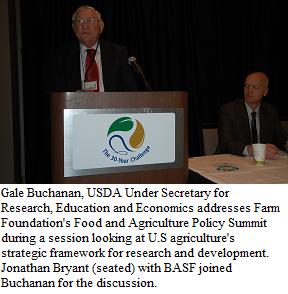 Just a few minutes ago, Dr. Jonathan Bryant with BASF North America and Dr. Gale Buchanan, Under Secretary for Research, Education and Economics at USDA finished their presentations bringing private and public sector viewpoints to the research and development session of the conference.
 The world’s population will grow by 33 percent by the year 2040, but the amount of farmland to feed and fuel that growing demand won’t have to grow by that same one-third… that’s what attendees at the Farm Foundation’s Food and Agriculture Policy Summit in Washington, D.C. heard this morning.
 “Agriculture’s role is not one of conflict between food or fuel. It is one that is quite compatible. Producing more food results in more fuel being produced as well.”
 More fascinating conversation today at the Farm Foundation’s Food and Agriculture Policy Summit in Washington, D.C. as former Rep. Charlie Stenholm is on the stage again leading a discussion on how to restructure agriculture infrastructure.
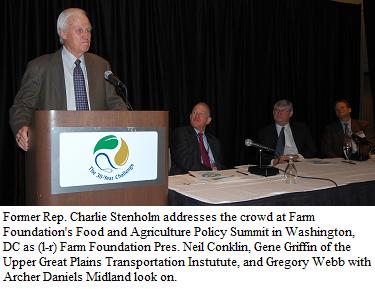 In the spirit of the current talk of whether the government should bailout the American auto industry, Stenholm is asking the question: “Who will bailout the American farmers?”
 An increasing world population coupled with increasing incomes will pose agriculture with some major challenges over the next three decades, as the world puts greater and greater demands on farmers to meet the world’s food and energy needs.
 “Global population is expected to increase by one-third by 2040. Increasing incomes, particularly in developing countries, may bring changes in dietary preferences and greater demand for agriculture to provide food and energy,” says Farm Foundation President Neilson Conklin. All this will increase pressure on and competition for natural resources at a time when the impacts of climate change on production systems are not yet fully understood, he adds.
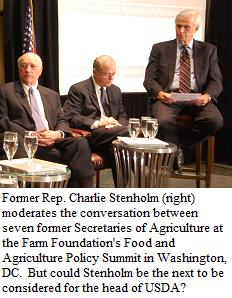 On a day when he moderated a conversation between seven former Secretaries of Agriculture, speculation swirled that former Rep. Charlie Stenholm would be the next person to lead the U.S. Department of Agriculture.
 It was a pretty historic meeting this afternoon at the Farm Foundations’ Food and Agriculture Policy Summit in Washington, D.C. as six former Secretaries of Agriculture shared the stage and another joined by videotape.