
Tuesday was a busy day for Agriculture Secretary Tom Vilsack.
He started the day by attending the National Agriculture Statistics Service lock up briefing prior to the prospective plantings report release first thing in the morning.
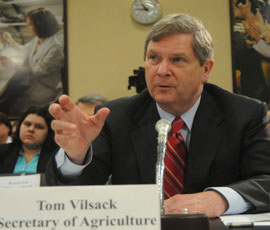 Then, he testified before the House Appropriations Subcommittee on Agriculture about the Administration’s plans to bring reform to USDA and discussed how the President’s budget will revitalize rural America. During his testimony, the secretary used the opportunity to make three announcements of actions being taken to help producers struggling with the recent downturn in commodity prices.
Vilsack announced that: 1) USDA will begin making Milk Income Loss Contract payments (MILC) to dairy producers; 2) USDA will be spending $117 million to make bonus purchases of walnuts, pork, turkey, and lamb; and 3) USDA is extending the sign-up deadline for the new ACRE program to August 14.
Then, yesterday afternoon, Vilsack held a telephone press conference with reporters where he answered questions on a number of topics. After that, not sure what he did – but it definitely was a full day. Agriculture secretary is no job for slackers!
Listen to Vilsack’s opening statement here: vilsack-announcements.mp3
 While attending this year’s Commodity Classic, I had a chance to talk with Ed Shoup of Shoup Brothers Farms, who has both a hog operation and grows corn in Orville, Ohio, to chat about some of the ways he is increasing yields. He is pictured here on the left in the Stoller booth with Dan Denman of Cortland, OH and Steve Wiser of Carlton, PA. Ed was kind enough to let me in on a few of his secrets. His first line of defense is
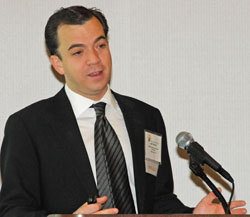 I think Joel Velasco, Brazilian Sugarcane Industry Association, had the quote of the day here at the Farm Foundation Transition To A Bio Economy Conference.
 A new website is helping to spot the latest job opportunities in agribusiness.
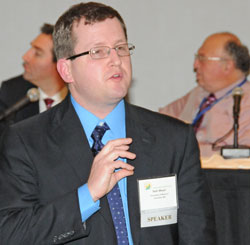 Seth Meyer is with the Food and Agricultural Policy Research Institute (FAPRI). He’s also a speaker here at the Farm Foundation’s Transition To A Bio Economy Conference.
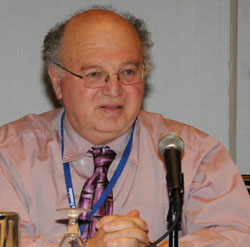 We know that OPEC has had a monopoly control over the price of oil on the world market and we hope that the increase of more environmentally friendly biofuels will force that to change. However, David Zilberman, University of California, Berkeley, has created a model to measure how much impact we’re having.
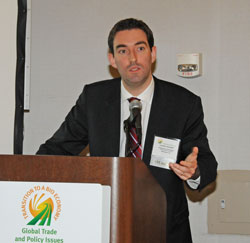 Speaking on behalf of the European Commission To The United States here at the Transition To A Bio Economy Conference was Laurent Javaudin. Laurent sent me a message about coming to the conference via
 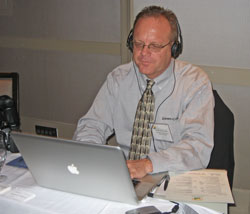 Mary Thompson, Farm Foundation, took my photo yesterday as I was doing some concluding work for the day here at their Transition To A Bio Economy Conference: Global Trade & Policy Issues.
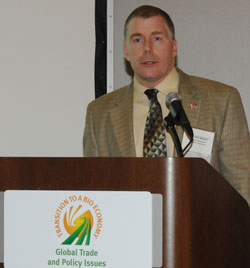 Biofuels production in Canada will impact meat trading patterns according to research by Al Mussell, George Morris Centre, University of Guelph. He says that the increase in biofuels production will turn the country into an importer of grains instead of an exporter. Al was one of the speakers at the Transition To A Bio Economy Conference.