
Update on IFAJ and Ag Media Summit

Chuck Zimmerman

ZimmCast-211 - IFAJ/AMS ProgramIn this week’s program we’ll get an update on the IFAJ and Ag Media Summit program from Joann Alumbaugh, Farms.com. Joann is co-chair of the program committee this year.

Our planning committee for the conference met after Commodity Classic in the Worthington Hotel, Ft. Worth, which is where we’ll be at the end of Joann AlumbaughJuly and first of August. To start things out we’re going to have a debate between former Congressman from Texas, Charlie Stenholm and Barry Flinchbaugh, Professor Emeritus, Kansas State University. That should be not only an entertaining but thought provoking session. We’ve got sessions over several days on a variety of topics from photography to writing and you can find the schedule here.

This week’s program ends with music from the Podsafe Music Network. It’s a song called, “Fort Worth Stomp” by the Defibulators. I hope you enjoy it and thank you for listening.

You can download and listen to the ZimmCast here: Listen To ZimmCastZimmCast 211 (11 min MP3)

Or listen to this week’s ZimmCast right now:Interview with Joann Alumbaugh - ZimmCast 211

The ZimmCast is the official weekly podcast of AgWired which you can subscribe to using the link in our sidebar. You can also subscribe in iTunes

Ag Media Summit, Audio, IFAJ, ZimmCast

Commodity Classic Media Room Survey

Chuck Zimmerman

Commodity ClassicOkay Commodity Classic media people. Now’s your chance to provide some feedback on this year’s media room.

The Commodity Classic Media Room Survey is online.

I’d like to see them ask some different questions but there’s plenty of room to provide comments so I hope you’ll take the time to respond. It will be very helpful to the staff in planning for future conventions.

Commodity Classic

Rural Broadband At A Glance

Chuck Zimmerman

Rural Broadband at a Glance 2009Take a look at this interesting document from USDA, “Rural Boradband At A Glance 2009 Edition.” It points out how fast farmers are adopting the use of the internet for business purposes and clearly outlines the challenges many areas of the country still have in getting broadband access.
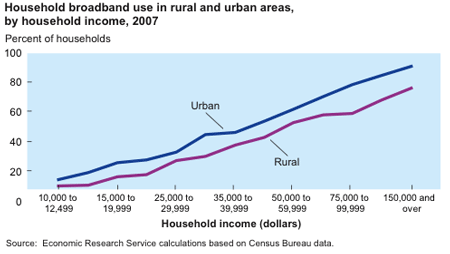
It has a number of interesting graphs like the following one comparing rural vs. urban internet use by income.

Rural Broadband at a Glance 2009

Broadband Internet enables businesses to increase efficiencies in existing commercial relationships, increase market presence by reducing the cost of reaching larger markets, and introduce new services. Broadband Internet, however, can also increase competition between businesses (e.g., local banks must compete with Internet-only banks). Business adoption of the Internet has been rapid. In 2005, 30 percent of farmers were using the Internet for farm business; 2 years later, use had increased to 63 percent. As Internet adoption increases, the need for high-speed Internet also rises as online purchasing and marketing become the norm. Rural businesses, however, use broadband less than urban businesses, perhaps due to higher prices for rural broadband service.

Uncategorized

Ketchum Has Director of Online Relationships and Reputation

Chuck Zimmerman

KetchumKetchum has created a new position called director of online relationships and reputation for their Food and Nutrition Practice. Filling that role will be Tom Barritt. Good idea. It will be interesting to see how they manage this. Tom says that food is “emotional and evocative and perfectly suited to social media.” So is agriculture in general and greater use of these mechanisms he mentions would help farmers and farm groups get their message out by joining “the conversation.”

Barritt was previously director of the agency’s global Issues and Crisis Management Network.

In his new role, Barritt will be responsible for working with clients to embrace online channels to help them better manage their communications needs to achieve their business goals. As associate director, the practice will capitalize on Barritt’s six years as head of Ketchum’s Issues and Crisis Management Network as he takes on the role of chief adviser on food reputation management, as well as builds and activates growth plans to benefit the practice’s client relationships and business development. This move aligns the Food and Nutrition practice with the agency’s growing global digital strategy capabilities and follows the appointments of Jonathan Kopp as global director of Ketchum Digital and Clement Lau as senior vice president of digital communications in Ketchum’s Greater China division in February.

“There is a dynamic conversation around food taking place online from recipe sharing to food blogs to photos to social networks,” said Barritt. “Food is emotional and evocative and perfectly suited to social media. We have a great opportunity to help our food clients navigate this space and join in the conversation.”

Agencies

Three Lessons for Renewables Communicators

Cindy Zimmerman

Communicating Renewables SummitFrom “Darling to Devil” in the blink of an eye – that’s what happened to the biofuels industry in the past year or so – but better communications on the part of the industry could have helped with the damage control and could still help repair some of the damage done. What’s more, the damage done to biofuels could also happen to other alternative energy products like wind, solar, geothermal, and hydrogen unless communicators implement three important lessons learned from the attack on biofuels. They will be presented by experts in the field at the upcoming Communicating Renewables Summit, April 21-23, 2009 in Minneapolis, MN.

1. Learn to create key messages that resonate with consumers – Suzanne Shelton, President and CEO of The Shelton Group,
 will tell you “What consumers really think about green.”

2. Unify with “one voice, one message” – Matt Williams, partner in The Martin Agency
, will discuss how to ‘green’ your brand from the core to create sustainability efforts that build your brand and differentiate you from your competition.

3. Prepare an Issue Management Plan in advance of attacks – “Crisis Communications vs. Issues Management” will be presented by Eileen Wixted, principal of Wixted, Pope, Nora and Thompson (WPNT).

Become a communications victor, not communications victim at the Communicating Renewables Summit. Register online by March 13th and receive $150 off the early-bird registration rate.

Energy, Media, Public Relations

Zimfo Bytes

Melissa Sandfort

    Zimfo Bytes

  • International agricultural accounting and financial record keeping will be the focus of the Farm Financial Standards Council’s 2009 Symposium which will be held in Bloomington, Ill., on July 22.
  • In order to advance the organization’s ability to respond to the scientific and regulatory challenges facing its membership, the National Milk Producers Federation announced changes to its regulatory staff, including the hiring of Betsy Flores as Director of Regulatory Affairs.
  • The Mosaic Company has just updated www.microessentials.com as a resource for growers with production questions about plant fertility needs, nutrient deficiency syndromes and overall plant nutrition.
  • The United States Soybean Export Council Board of Directors named Dr. Miguel Escobar the USSEC interim Chief Executive Officer.
    Zimfo Bytes

    Food Price Drivers Unchanged

    Cindy Zimmerman

    Farm Foundation logoFarm Foundation has issued an update of a report last year on “What’s Driving Food Prices?” and found the same factors affecting commodities.

    “In July 2008, crude oil prices were at record levels, as were most agricultural commodity prices. Low supplies generated fears of food shortages. The rhetoric of the food-versus-fuel debate rose along with food prices. Today, despite remarkable course changes, the key drivers of food prices and their complex interactions remain the same,” according to the new report.

    Farm Foundation Food Price StudyThe new report updates the analysis Purdue University economists Phil Abbott, Chris Hurt and Wally Tyner did just nine months ago for Farm Foundation. That report, released in July 2008, identified three major forces driving food prices: World agricultural commodity consumption exceeding production growth, leading to very low commodity inventories; the decline in value of the U.S. dollar; and the new linkage between energy and agricultural markets.


    In the second half of 2008, each of these driving forces completely reversed direction. “The transitions were truly remarkable—almost a 180-degree course change—yet the key drivers of food prices remain the same: supply and utilization of grains and oilseeds; the exchange rate of the dollar and related world macroeconomic factors; and the energy/agriculture linkage,” says Tyner. “Our updated analysis verified the role of the key drivers, although they sometimes play out in somewhat different ways.”

    Tyner and his colleagues are participating in a Farm Foundation forum to discuss the results of the study this morning at the National Press Club.

    Listen to an interview with Wally Tyner here: farm-foundation-tyner-09.mp3

    Download the interview for broadcast use here: Wally Tyner on Food Price Drivers

    Audio, Farm Foundation, Food

    Pioneer Launches New Optimum Brand Innovations Products

    Joanna Schroeder

    tracy-lindo-pioneerPioneer recently launched several new products within their Optimum Brand Innovations line. I was able to speak with Tracy Lindo, the Senior Marketing Manager – Optimum GAT about these new products. “Optimum Brand Innovations is the umbrella brand for our high quality input traits that Pioneer is hoping to bring to the market in the next few years,” explained Linbo. The first product is Optimum GAT, a herbicide tolerance trait. “GAT” stands for glyphosate ALS tolerance. The uniqueness of this trait is that it, “provides new herbicide choices and flexibility,” said Lindo.

    commodity classic gat bannerThe second trait is the Optimum Acre Max, which provides an insect protection system. These products will be brought to market pending approvals over the next few years.

    These traits, explained Lindo, provide maximum yields, “the right product for the right acre, and cleaner fields through harvest.” 

    Pending approvals, Pioneer hopes to have the GAT for corn available in the 2010 selling season and GAT soybeans in 2011. 

    In addition, DuPont Crop Protection is bringing five new herbicides that will be available to be used on this trait as well. There will be demonstrations throughout the summer. Contact your local Pioneer sales rep to learn more or visit www.pioneer.com.  

    Listen to my full interview with Tracy here: cc-09-joanna-pioneer.mp3

    Commodity Classic, Corn, Pioneer, Soybean

    Sights and Sounds of the Dixie Deer Classic

    Chuck Zimmerman

    I don’t know if you’ve ever been to a hunting show but even though I’m a hunter I haven’t until last week at the Dixie Deer Classic. This was a pretty cool event and I didn’t buy too much stuff.

    So if you’d like to get a feel for it I put together a string of video clips from this year’s event. This way you get the sights and sounds and believe me there are some sounds.

    Hunting, Video