
Several times in the last couple years I’ve tried to point agrimarketers to the concept of “community” in online communications/marketing. By that I mean the fact that employing today’s new and social media tools allows us to connect and interact with our customers and members in ways we never could before. Using AgWired as an example, I don’t just reach readers who think, “I’ll visit AgWired.com to see what’s new.” I reach them in Facebook, Twitter, FriendFeed, Flickr, YouTube, LinkedIn, email and in all the ways those people re-post or pass along or tell their connections. So for you marketers who just look at website visitors, you’re missing a lot of the story.
I still find so many in corporate communications who can’t wrap their mind around this concept. Granted there are a lot of control freaks out there who fear loss of the control they’ve enjoyed for so many years. It’s a mentality that says “I’ll build what I want them to see and give them the choices I want them to make.” But those days are coming to an end.
Today’s consumer (any kind, farmers included) not only want and demand freedom of choice but they’re just creating their own destinations and touch points. They’re leaving the old destination websites behind. I was prompted to write this after reading Steve Rubel’s post on Micropersuasion, “The End of the Destination Web Era.”
After years of erosion it now it appears the destination web era is drawing to a close. This a trend that digital thinkers like Om Malik have long noted. In fact, the numbers prove it.
In March the average American visited a mere 111 domains and 2,500 web pages, according to Nielsen Online. What’s worse, our attention across these pages is highly fragmented. The average time spent per page is a mere 56 seconds. Portals and search engines dominate, capturing approximately 12 of the 75 hours spent online in March. However, people-powered sites like Wikipedia, Facebook and YouTube are not far behind, snagging nearly 4.5 hours of our monthly attention.
He points to an article by ARAnet in conjunction with Opinion Research Corporation that talks about what you can do to break through the clutter. The answer doesn’t include fancy pop up ads.
Long-shunned pop-up ads remained the least favorable option for every audience segment, regardless of age, race, income, sex, region or size of household: 87% of respondents said they were not very likely or not at all likely to read and respond to them.
Their conclusion is that brand mentions in articles is one of the best ways to reach consumers. I would call that “meaningful content” that is posted into social networking locations and on highly search engine optimized websites (blogs). That’s why public relations folks are trying to figure out ways to present information to bloggers now. We’re not your ordinary msm journalists!
Do you get it? Are you willing to venture out into the online conversation or are you going to stay inside your “safe” online house and hope someone comes to visit?
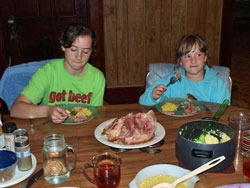 As of right now, the terms “Swine flu” and “#swineflu” are trending at positions 2 and 6 on Twitter. The term “H1N1” is trending in the 10th spot. I think that shows that as much as we’d like to think that everyone, media included, would call this what it is, it’s not happening. This thing blew up way too fast and is now branded in the public psyche. It has meant serious problems for hog producers. However, we shouldn’t give up and in fact, we’ve got an opportunity to do something about it by taking advantage of our new media tools to “get our message out.” How you might ask? Well, get busy and tweet, post on your blog or website and join in this online conversation and make a difference. Here’s an example of how Trent Loos,
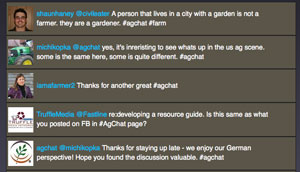 We just concluded another great #AgChat session via Twitter. Here’s the questions posed.
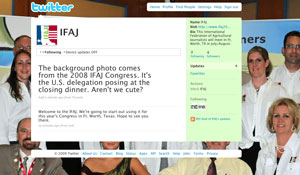 Have you made your reservation for the
 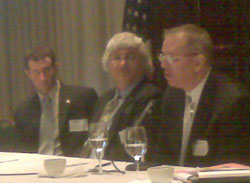 I take it from Mace Thornton’s (
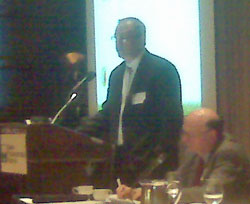 This time we’ve got Tim Amlaw, Director of the Farm Animal Program of the American Humane Association on the podium at the Farm Foundation Forum on animal welfare.
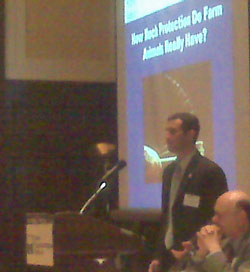 Here’s Paul Shapiro, Senior Director of the Humane Society of the United States, speaking now at the Farm Foundation Forum on animal welfare. Thanks again to Mace Thornton’s Blackberry.
 Thanks to
 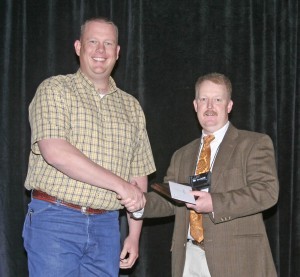 Scott Speidel, research associate in breeding and genetics at Colorado State University, Fort Collins, Colo., was a recipient of the 2009 Frank H. Baker Memorial Scholarship Award. Speidel accepted the award from Robert Williams, Ph.D., director of breed improvement and foreign marketing for the American-International Charolais Association, Kansas City, Mo. A California native, Speidel holds a bachelor’s degree in Animal Science from California State University, Fresno; a master’s degree from the University of Arizona, Tucson, Ariz., and plans to complete his doctorage this fall at Colorado State University.
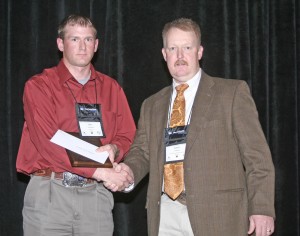 Lance D. Leachman, Christiansburg, Va., was also a recipient of the 2009 Frank H. Baker Memorial Scholarship Award. The award was presented by Robert Williams, Ph.D., director of breed improvement and foreign marketing, American-International Charolais Association, Kansas City, Mo., during the 41st Beef Improvement Federation (BIF) Research Symposium and Annual Meeting, April 30- May 3, 2009, in Sacramento, Calif. Leachman was born in Maidstone, Sask., Canada. He holds a bachelor of science degree in Animal Sciences and Industry with a business option from Kansas State University, Manhattan, Kan., and a master’s degree in Animal and Poultry Science – Breeding Genetics from Virginia Polytechnic State University (Virginia Tech), Blackburg, Va. Currently, Leachman is a graduate student at Virginia Tech.
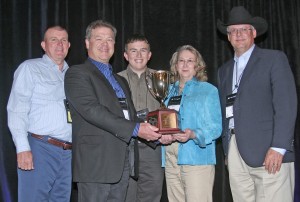 The Beef Improvement Federation (BIF) named the