
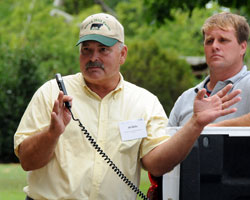
 While the Conservation in Action Tour was parked under the trees in the shade at one stop, we heard from local farmer, J.N. Mills. Pictured behind him is Eric Randolph, another local farmer we also heard from.
A portion of the farm that J.N. operates was a grant from the king of England in the 1600’s. We were definitely seeing some historical places on this tour! One of the ways this farmer has worked to keep soil and nutrients in place is by installing waterways, stream buffers, stream fencing and wetlands. Besides row crop farming he also has a 165 unit cow/calf operation. J.N. says he hopes to have a family farm that he can pass along to the next generation. J.N. Mills Presentation
Conservation In Action Tour 2010 Photo Album
AgWired coverage of the Conservation In Action Tour is made
possible by  and the
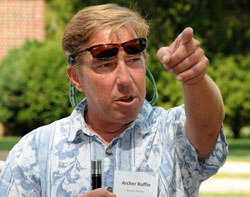 During the Conservation in Action Tour we visited Evelynton Farm which is home to Archer Ruffin who told us about the rich history of this farm which is on the National Register of Historic Places. Our tour group sat in the shade of the largest magnolia tree I’ve ever seen.

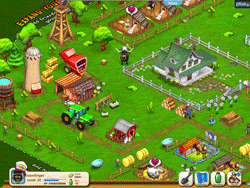
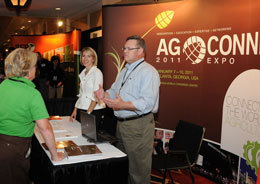
 Former intern does good. That’s how I describe Curt Blades. Yes, Curt was an intern for me once upon a time. He was also my guide for my day at Successful Farming headquarters and this behind the scenes look at the new
 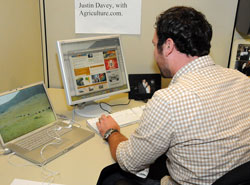 The newest member to the
  When it comes to markets