I recently attended the Iowa Power Farming Show and one of the technologies that I featured in a post on our sister blog Precision Pays, was Ag Leader’s new SMS Mobile Technologies. As I result, I was asked to write a guest post for Broadband for America. They asked if I could write a blog about how broadband technology has really changed the way agriculture does business. Precision Agriculture has not only made agriculture a bit easier, but its also made it a bit more profitable. Now, with the internet, precision ag can take it one more step.
With their permission, I am reprinting the article here.
 For my mother, who grew up on a farm in Iowa, it was hard to imagine how far technology would advance agriculture in such a short time. For instance, the introduction of broadband would be a welcome surprise for many. It’s hard to fathom living without internet access; however, in the past, those in rural America did not have as much access as those living in urban areas. Fortunately, this is changing. According to Pew Internet, adults living in rural America have witnessed high-speed usage grow from 38% in 2008 to 46% in 2009. Many of these adults are farmers.
With the introduction of broadband also came the introduction of many precision agriculture technologies. For example, Ag Leader’s new SMS Mobile Technology helps farmers gain important information. The technology is designed to run on their handheld Mesa Rugged Notepad and provides a platform for farmers to gather information such as soil tests, scouting records and documentation of test trials. With the help of a wireless broadband network, farmers can instantaneously transfer the data to his SMS desktop software. The data can be combined with previous data and take his crop management to another level – a level that is designed to improve his profitability.
While this technology is still somewhat in its infancy, access to wireless communications has offered possibilities not before thought possible. Precision agriculture is taking full advantage of this technology. Each year, data integration and programs are more effective and easier to use as adoption among growers increases.
According to Tim Murphy, in a 2002 article, “Broadband Connection Highs and Lows Across Rural America“, the census found that half the farms in the country were connected to the internet in some way whether it be via broadband or dial-up. By 2007, the percentage of farms connected rose to 56.5 percent. As precision ag comes of age, I expect to see greater growth in the adoption in broadband in rural America. Why? Because broadband and precision ag, together, are helping to change the face of agriculture in a positive and profitable way.

 The voice of the Championship Tractor Pull at the Western Farm Show is Dave Bennett. He was also one of the announcers last week at the National Farm Machinery Show Championship Tractor Pull. I was there and I can tell you he does a great job.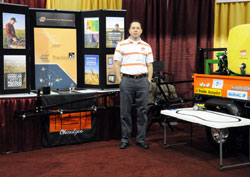

 This happy group of agricultural PR professionals are meeting in Ft. Myers, where the weather is in the 80s and gorgeous, while the Midwest is back in the cold and snow. We feel bad (not!).

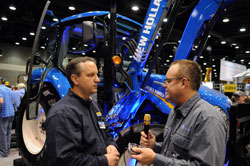 I didn’t get to go to the World Ag Expo to see these tractors unveiled but they were on display at the National Farm Machinery Show. They are the
 Let’s learn what’s new with