What do agribusiness employers see as the most important challenges for recruiting and keeping the best talent in the future?
 At the opening of the AgCareers.com North American Ag HR Roundtable on Monday, Dr. Allan Gray, director of the Center for Food and Agricultural Business at Purdue, presented some new findings from a survey of agribusiness company CEOs on what they consider the most important internal and external factors impacting human resources in the industry, as well as what leadership competencies they expect to need in the future.
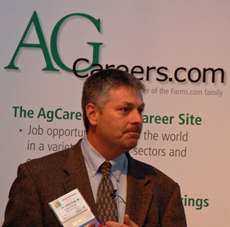 “From an external perspective, not a lot of surprises,” Gray says. “The economic environment we’re in and the uncertainty associated with that and what’s happening with farmers” were most important. On the internal side, Gray says he was surprised by the importance the CEOs placed on marketing functions. “I suspect that’s a reflection of the changing nature of their customer base as farmers are becoming more differentiated, larger and more sophisticated.”
Under leadership competency, the clear front runner is people leadership, but Gray was interested to see that the CEOs ranked thought leadership – strategic and innovation thinking – lowest. “It was a bit surprising to me because we think that thought leadership is going to be critically important in an environment with so much uncertainty and so much change taking place,” he said.
So far, Gray says 59 agribusiness CEOs have responded to the survey and they expect more yet. The purpose of the survey is to “measure the gaps between what we need in the industry” and what our current levels of leadership competency are, and then develop educational programs to fill that gap.
He also talked about the importance of partnerships between educational institutions and corporations, such as LEAP, an Executive Agribusiness Program at Purdue sponsored by Land O’ Lakes.
Find out more in my interview with Dr. Gray here: Dr. Allan Gray Interview
 When we talk about having the resources to feed the world in the future, most of the time we’re thinking land and water, but having adequate human resources is equally, if not more, important.
 “Really the long term prospects for this industry are so bright, dealing with a growing population and increased need for food,” Dean Akridge said. “At the same time, it’s an industry that’s buffeted by tremendous change. So, this idea of how we manage for today, yet keep our eyes on tomorrow is really a fundamental issue as we prepare talent for the next generation.”

 Measuring the return on investment of social media is a big challenge. We deal with the question of “how to” all the time. More importantly though is answering the question of what your goal is with social media. This topic was on the agenda at the Agricultural Media Summit.