
After more than four years in limbo, trade agreements with South Korea, Colombia and Panama have finally been sent to Congress by the White House and could be voted on by next week.
 “The series of trade agreements I am submitting to Congress today will make it easier for American companies to sell their products in South Korea, Colombia, and Panama and provide a major boost to our exports,” President Obama said in a statement.
Agriculture Secretary Tom Vilsack said completing the agreements “will level the playing field and secure markets for America’s farmers, ranchers, growers and producers ahead of competitors in the global marketplace.”
Once the agreements were turned loose by the president, agricultural organizations immediately began calling on Congress to end the wait and pass them. “America’s farmers and ranchers have much at stake and the fact these three agreements are moving forward is very good news for our economy,” said American Farm Bureau Federation president Bob Stallman. “Combined, the three FTAs represent nearly $2.5 billion in new agriculture exports and would create the economic growth that could generate support for up to 22,500 U.S. jobs. These gains will only be realized if the three agreements are passed by Congress and implemented.”
National Cattlemen’s Beef Association (NCBA) President Bill Donald welcomed the news but cautioned that the agreements are far from implemented.
“Today marks the biggest leap forward we have seen in nearly five years when the trade pact with Colombia was signed,” said Donald. “Our entire country, especially rural America, is nearing a historic moment.”
Donald said cattlemen “will not rest easy until the agreements are fully implemented.”




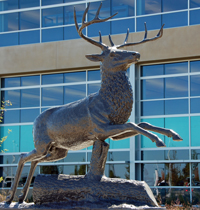 One of the highlights of the ceremony was the unveiling of the new building’s crowning centerpiece that stands at the main entrance – one of the original John Deere deer statues that were first made some time around the early 1900s. Regional controller Mike Snyder explained that an unknown number of the statues were commissioned by the son of John Deere in 1893 to be made by the W.H. Mullins Company of Salem, Ohio. “The statue is made out of hand stamped copper sheets, riveted and welded together and mounted on a steel frame,” he said, noting that Charles Deere saw the statue at the 1893 World’s Fair in Chicago and liked it so much he decided he wanted enough of them to be placed at every John Deere branch office and factory in the country. “Over the years, the importance faded and some were lost but recently company CEO Hans Becherer began a program to find and restore as many of them as possible.” The statue at the Olathe office is one of only 14 the company currently has.