Agriculture.com recently released an updated mobile version of the leading agriculture site, m.agriculture.com, which now features an up-to-the-minute markets ticker, video, upgraded weather coverage and in-depth news and markets analysis.
Eighteen months after the introduction of the iPad, 11% of U.S. adults now own a tablet computer of some kind. But a majority says they would not be willing to pay for news content on these devices, according to the most detailed study to date of tablet users and how they interact with this new technology.
A total of 25 county Farm Bureaus from across the country were recognized by the American Farm Bureau Federation for innovative program ideas in this year’s County Activities of Excellence program.
Merck Animal Health has launched EXPERTIS Udder Health, an innovative farm management tool for veterinarians to better enable them to monitor and improve udder health in dairy cattle.
Make your donation of $100 or more to the NAFB Foundation, and your name will be entered in a chance to win an iPad 2 tablet!
The real reason you should donate is because the NAFB Foundation helps ensure a strong future for the farm broadcasting profession and industry. The NAFB Foundation is the nonprofit charitable and educational arm of NAFB. It is focused on enhancing the value of agriculture, food production and rural lifestyle through the various forms of broadcasting, while assisting and benefiting industry partners, students, future broadcasters and the general broadcast audience.
So when NAFB president Tom Steever or one of the other officers calls and asks you to donate this year, just say yes. And you might win a new iPad.
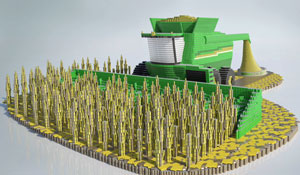
John Deere is trying to build a combine out of cans.
We’re talking about 300,000 cans of food here to replicate a full-sized S-Series combine in a field. It would be a world record. Kind of like what America’s farmers do every year – set new records in feeding the world.
The John Deere Project ”CAN DO” combine sculpture and food donation program are designed to raise awareness of the essential role farmers and ranchers play in producing safe, healthy and abundant food for a growing world population, while supplying much needed food supplies to a local food bank during the holiday season. The more than 300,000 cans of food needed to complete the sculpture are donated by John Deere with delivery from Hy-Vee Food Stores. When completed, the sculpture will be 60 feet wide, 80 feet long and 16 feet tall and will weigh nearly 170 tons. The sculpture depicts John Deere’s new S-690 Combine, which is the world’s most powerful combine that can harvest more than 350 acres of grain a day.
Project “CAN DO” also gives consumers a chance to be a part of building the can sculpture by ‘virtually’ creating cans of food, explains Richard Williamson, art director for John Deere Ag and Turf. “Anyone interested in participating can go to the John Deere Facebook page www.facebook.com/johndeere to submit their name and a photograph, which will be wrapped around their virtual personalized food can as part of a virtual sculpture.”
Helping to design the combine sculpture is a team from the Chicago office of architectural firm, RTKL. John Deere employees and retirees will also volunteer to assist with the overall project. The combine can sculpture will be on display at the John Deere Pavilion in downtown Moline, Ill., from mid-November to mid-December. All the canned food will be donated to the River Bend Foodbank when the sculpture is dismantled.
FS PARTNERS in Ontario is pioneering a new use for QR codes in the field so farmers can access updated information about test plots. In case you are not yet familiar with them, QR is short for Quick Response and they are those bar code looking things you can read with a smart phone that are starting to pop up every where these days.
Juli Paladino, FS PARTNERS retail energy administrator in Ontario, helped develop the use of this communications technology for Pursuit of Maximum Yield corn and soybean plots. “So, you’re at a Pursuit of Maximum Yield site, you’re going to scan it and it’s going to take you right to information on our field trials,” she explains. That information can include seed information, treatments, planting dates and even audio updates tailored specifically to that particular site.
As smartphones become more prevalent, people are becoming more familiar with using QR codes to get information, but Juli says they have actually been around for a while. “Originally they were developed in 1994 by Toyota in Japan to track parts,” she said. “It’s been a very commonplace technology in Japan and Asia.”
While consumers in the United States has been slower to adopt the use of QR codes, Juli says farmers are quicker to pick up on new technology. “Farmers are at a higher rate than the general public to be adopting mobile phone technology. They’ve got the smart phone and they’re ready to use it.”
I am completely behind 100% Cork for my wine bottles. It looks like I’m not alone according to a recent survey by the Cork Quality Council. So sniff the cork.
More than 60 percent of the top 100 domestic premium wine brands are now sealed with natural cork, another sign of the growing resurgence of cork and the diminishing use and acceptance of alternative closures.
Case sales of the top 100 domestic premium wine brands sealed with cork surged 7.7 percent during the four-weeks ended Sept. 17, 2011, compared to the same period a year earlier. During the same period, the sale of the top 100 brands finished with alternative closures plummeted 11.9 percent. The results are from a survey of A.C. Nielsen data by the Cork Quality Council.
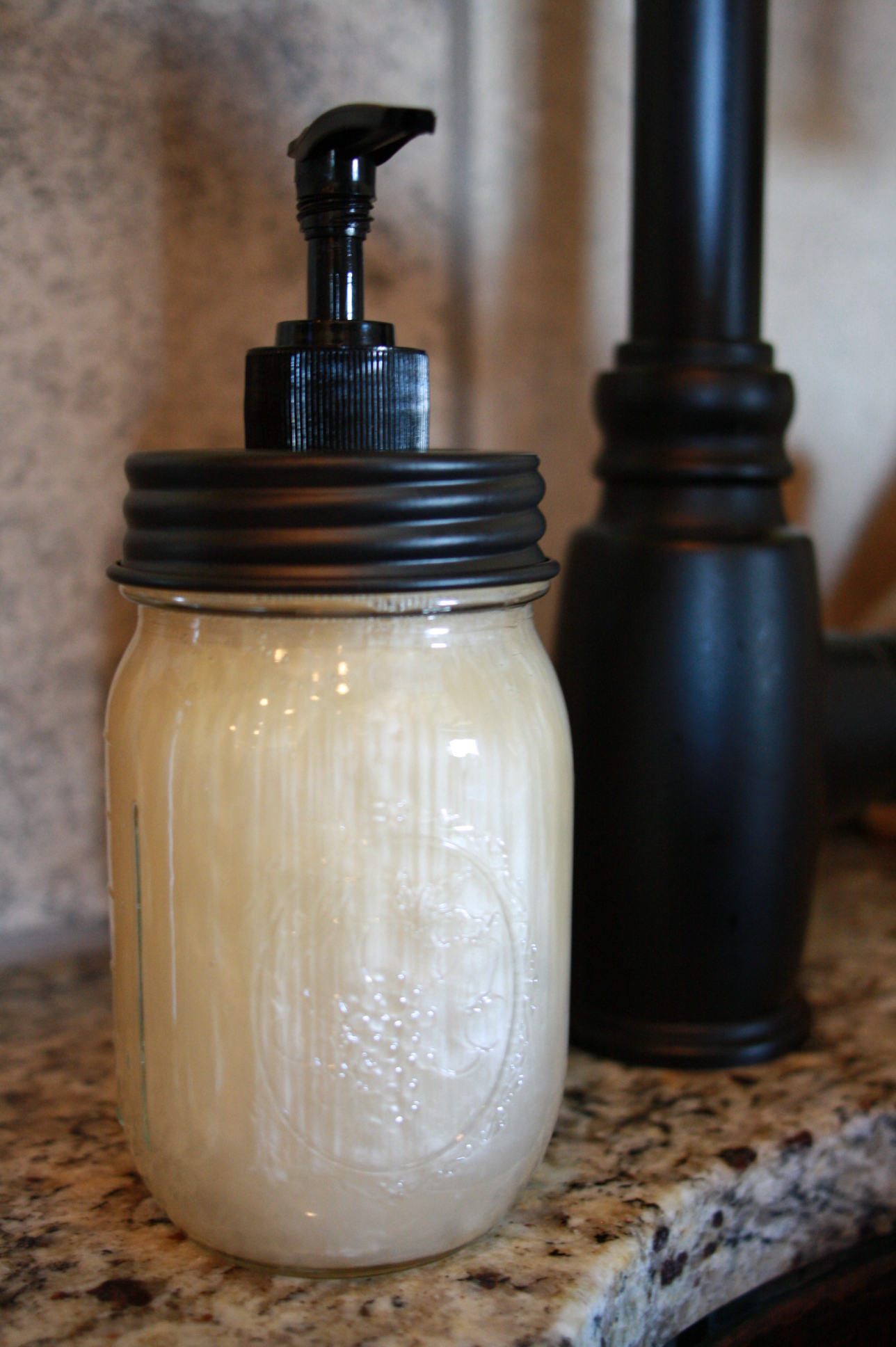
I wanted to share with you my latest purchase…these oil rubbed bronze mason jar soap pumps. I ordered four of them for bathrooms and kitchen sinks and I must say, I haven’t been this excited for the UPS man in a long time. Now, I know there’s a way to make them yourself but my crafting abilities leave much to be desired.
That got me to thinking about how many uses mason jars have. I used to toss my spare coins in them, use them to stick plant ends in to take root (I still have a quart jar with a philodendron just growing in water), as a vase, a soap dispenser, a drinking mug and of course the obvious, for canning … the list goes on.
In fact, I can’t think of anything else in my house that’s been used for that many different things. Can you?
These four jars had green beans in them.
And just for consistency sake, I used two Ball and two Kerr.
Agriculture Secretary Tom Vilsack chose the John Deere Des Moines Works facility to talk about his priorities for the 2012 Farm Bill, which he says is really a misnomer.
“After all, for decades this bill has been about a whole lot more than just farming. It’s been about energy, it’s been about nutrition, it’s been about jobs. Now, some may keep calling it the Farm Bill out of convenience, or maybe even out of tradition; but I think we’re doing it a disservice,” Vilsack said.
The secretary acknowledged that fiscal and political realities will have an impact on the outcome for any legislation in the coming year. “So our priorities must be clear. We simply need to do more with less,” he said.
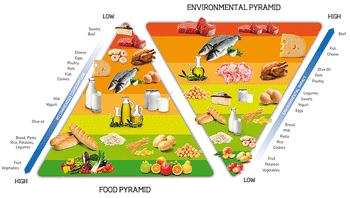
So we had the USDA Food Guide Pyramid. Now we’ve got the Barilla Center For Food & Nutrition Double Pyramid? Okay. What do you think about that? Good research and information? Just another organization trying to insert their ideas into the food conversation? One side of the double pyramid focuses on food types by their definition of nutritional value and the other is inverted by their definition of environmental impact.
By the end of October, it is estimated that the world’s population will reach seven billion people, growing to nine billion by 2050. In order to satisfy the world’s food needs, production will need to increase between 70 and 100 percent in the face of environmental changes, a destabilized agrifoods market and continued global economic turmoil. The Barilla Center for Food & Nutrition (BCFN), launched in the U.S. today, is working to address these topics through the development of concrete research and findings for government leaders and policymakers around the world to use as a relevant and meaningful resource.
“While we cannot stop the continuing evolution of the planet, we have the moral duty to suggest courses of action and propose policies that encourage responsible interaction with it. Food and nutrition will be an increasingly important focus in dialogues among governments, corporations and civil society, all of which are working to address the immediate and future challenges we face in meeting nutritional needs of a growing population while ensuring the health of our planet,” stated Guido Barilla, President of the BCFN. “We understand what it takes to bring food from the farm to the table in an efficient and sustainable way, as well as the importance of developing environmentally sustainable production models. We are committed to bringing the world’s best and brightest minds together to provide guidance on how to effectively navigate these complex topics.”
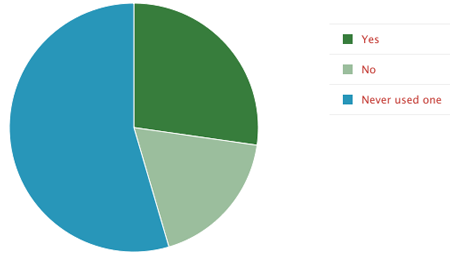
Our latest ZimmPoll asked the question, “Are Farm Show Smartphone Apps Helpful?” Although 55% said they had Never used one, 27% said Yes and only 18% said no. I think these results reflect the fact that these apps are new. I used several during the course of the year and some are more helpful than others. One of the features I like most is being able to open a show map to find where I am currently located and where I want to go to find a particular exhibitor. Have you used any of these apps? What did you like or wish was different about the ones you used?
Our new ZimmPoll is now live. We’re asking the question, “How do you view the new free trade agreements for U.S. ag?” President Obama signed legislation last Friday implementing free trade agreements with Korea, Colombia and Panama. These agreements were supported by most agricultural member organizations. What do you think? Take our poll and feel free to comment. Thank you.
ZimmPoll is sponsored by Rhea+Kaiser, a full-service advertising/public relations agency.
Farm Journal Media’s AgWeb.com launched its mobile application, providing smartphone users with easier, more graphic access to its market-leading content.
Croplife recently released a new video on fertilizer, crop protection product handling and distribution. Watch the video here.
The soybean-checkoff-funded U.S. Soybean Export Council launched a revamped website for its global aquaculture program to communicate the benefits of soy in aquaculture feeds to both consumers and the global seafood industry.
FMC Corporation announces the promotion of David Wheeler to Business Solutions Manager.



 We’re talking about 300,000 cans of food here to replicate a full-sized S-Series combine in a field. It would be a world record. Kind of like what America’s farmers do every year – set new records in feeding the world.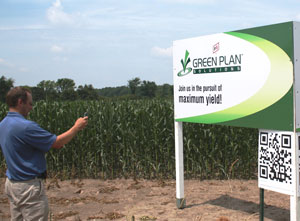

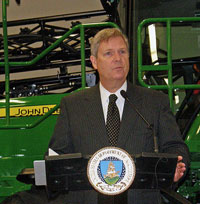 Agriculture Secretary Tom Vilsack chose the John Deere Des Moines Works facility to