 I tweeted this yesterday morning, “Chuck. What’s the next “big” thing in ag communications/social media?” I get asked a lot. What do you think?” And I got replies thank you very much. Here are some of them:
From Twitter:
currently, Pinterest RT @AgriBlogger: “Chuck. What’s the next “big” thing in ag communications/social media?” What do you think?
Pinterest RT @AgriBlogger: “Chuck. What’s the next “big” thing in ag communications/social media?” I get asked a lot. What do you think?
Understanding integration of new technologies, forces & needs. Are you agile enough to adjust? RE: next big thing in ag comm/sm @AgriBlogger
@AgriBlogger I think #Pinterest…..
@AgriBlogger Rural #4G LTE and the smart #farm #app revolution?
@AgriBlogger Video, both one-on-one , group and broadcast streams are the next wave in social media.
Rise of the App Internet http://bit.ly/xu9GSz MT @AgriBlogger: What’s the next “big” thing in ag comm/social media?” What do you think?
From Facebook:
If we knew, it wouldn’t be the next “big” thing. I think Pinterest is catching a lot of momentum though. Google+ doesn’t seem to be getting much traction though. Probably the next “big” thing hasn’t arrived yet or we just aren’t aware of it.
We almost have it today but a “reality tv” show about the farm. That is correct and unbiased (well maybe slanted a little our way)! You could be the leader Chuck. BTY, I don’t want to be in it.
So there seems to be one word that’s popping up enough to take a look and that’s Pinterest. Hopefully I won’t get in trouble here but I have been aware of Pinterest for a while since my daughters use it and have showed it to me. I looked at it and mostly saw fashion photos and thought, “This is not for me.” Interestingly, the responses above mentioning Pinterest are all from women. I’m not sure what to make from that but . . . If you search “agriculture” in Pinterest you’ll find a couple of boards and some pins. “Pinterest is an online pinboard.
Organize and share things you love.” How about agriculture photos and images? Maybe this is a good place to share your farm message!
You’ll also notice in the responses that mobile apps and 4G LTE are mentioned. I personally agree with this. We’re going to see more and more use from mobile devices and the apps that let us do customized tasks.
Please feel free to add your thoughts via comments.

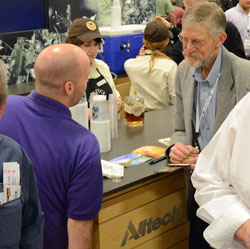 During the Cattle Industry Convention trade show attendees stopping by the Alltech booth got a rare treat, if you were there for the Alltech Beef, Bourbon and Beer Happy Hour Reception. Served at the reception were Alltech’s new Town Branch Bourbon and Kentucky Bourbon Barrel Ale. I’m not sure what the status is of distribution and availability of the bourbon yet but the beer is world class award winning.
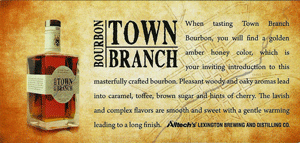 Yes. That pretty well describes our taste taste in Nashville.
 In this week’s ZimmCast you can hear about how
 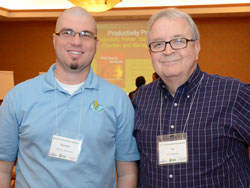 At the NCGA biennial Membership Symposium last week in Florida, Chuck talked with Director of Development Tim Brackman and

 In the national 2011 NCGA Yield Contest, BASF Crop Protection products helped to capture three first-place finishes, four second-place finishes and three third-place finishes. Headline AMP was overwhelmingly the fungicide of choice, helping yield four of the top five overall national winners.
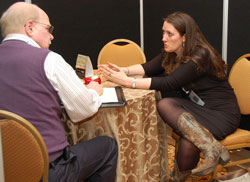 Contrary to popular belief, eating beef is not bad for the environment and Dr. Jude Capper with the Department of Animal Sciences at Washington State University has
 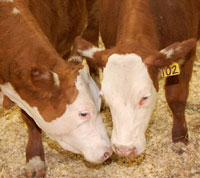 American consumers have never had a safer supply of beef, but there’s always room for improvement, according to Dr. Guy Loneragan, professor of food safety and public health at Texas Tech University,
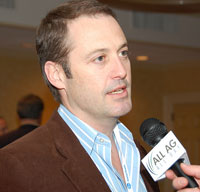 Guy says that there are several ways producers can do even more to avoid problems on the pre-harvest level. “The first thing I would say is for producers to stay engaged and be engaged, because knowledge is a very powerful weapon,” he said. “Beyond that, the industry has invested quite heavily into the development of several promising controls, like pro-biotics – the beneficial bacteria we find in yogurt, some strains appears to be quite effective in cattle too.”
 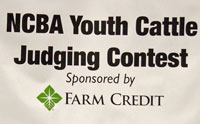 More than 200 young people from 25 states participated in the youth cattle judging contest held in conjunction with the 2012 Cattle Industry Convention and
 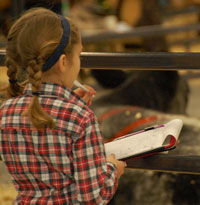 NCBA youth programs were championed by former NCBA President Andy Groseta of Cottonwood, Ariz., who prompted the organization to develop additional programs for youth in the cattle industry. The judging contest has grown significantly since first introduced at the 2009 Cattle Industry Convention, where 60 young people competed.
 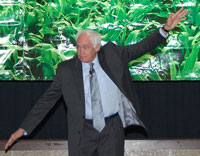 Dr. Lowell Catlett, New Mexico State University economist and futurist, has been looking into the agricultural crystal ball for nearly 30 years. I remember seeing him speak back when Timbuk3 had their one-hit wonder
 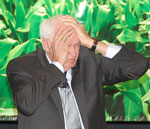 One thing that makes him so entertaining is his facial expressions – that’s why I wanted to use several photos here. He makes his points without the aid of power points – he certainly doesn’t need them!
 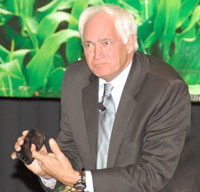 Lowell also talked about how smart phones are helping farmers. “You’ve got the ability to take that mobile technology and do plant diagnostics with it,” he said. In the future, he sees the use of open source hardware (not just software) and 3D assembly that could allow manufacturing to actually be done on site with local materials, like building tractors on farms in developing nations.