Senate Transportation Bill Includes Ag Provisions

Cindy Zimmerman

By a vote of 74-22, the Senate has approved a highway transportation re-authorization bill that includes agricultural-related amendments passed Tuesday.

The amendments include one by Senator Jeff Merkley (D-OR) which will exempt drivers of farm vehicles from having to acquire a commercial driver’s license, and another by Senator Amy Klobuchar (D-MN) which will waive hours of service restrictions during harvest seasons.

These were among 2012 priority issues for the National Cattlemen’s Association (NCBA). “Farmers and ranchers are not professional truck drivers and shouldn’t be treated as such,” said NCBA Associate Director of Legislative Affairs Kent Bacus. “Hauling livestock to market two times a year is hardly the same as hauling goods across the country on a daily basis. Subjecting family farmers and ranchers to costly and requirements is an unnecessary burden we cannot afford.”

Meanwhile, amendments to the bill related to biodiesel and advanced ethanol tax incentives failed to make it in the final bill. An amendment offered by Sen. Debbie Stabenow (D-MI) and another by Senator Pat Roberts (R-KS) would have extended the $1 per gallon biodiesel tax incentive, which expired at the end of last year, through the end of this year. “We thank Sen. Stabenow and Sen. Roberts for including biodiesel in their amendments, and we urge Congress to break this partisan gridlock and find a way to enact policies like the biodiesel tax credit that have strong bipartisan support,” said Anne Steckel, vice president of federal affairs for the National Biodiesel Board.

The Senate bill now moves to the House for consideration.
Biodiesel, Biofuels, Farming, NCBA

Midwest 2011 Farm Mom of the Year

Chuck Zimmerman

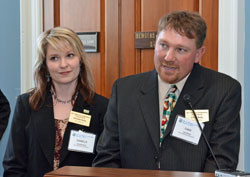
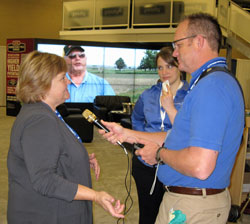
During the Commodity Classic I met April Hemmes, 2011 Midwest Region winner of the Monsanto Farm Mom of the Year contest. Thanks to Janice Person for taking the photo.

April is the farmer in the family. Her husband works at a job in town. She was nominated by her daughter. Here’s an excerpt of the essay she wrote for the nomination:

Hi, I’m Ruth. I’m 16, and I would like to nominate my mom, April Hemmes, for Farm Mom of the Year. My mom IS the farmer in our family. My dad works in town, and mom operates our family’s century farm, totaling 1000 acres, and has a 30-head cow/calf herd. She makes all the decisions from planting to harvest, bulls to banking.

. . . She also found time to raise funds for my junior prom and took me on a Caribbean cruise! She always tells me “Do what you love doing – happiness and success will follow.” I know this is true because my mom is the most enjoyable and funniest person know.

April is very passionate about farming and is a great advocate for farming. She tells the full story of her nomination in my interview with her: Interview with April Hemmes

The 2012 Farm Mom of the Year Contest is now underway.

2012 Commodity Classic Photo Album

Audio, Commodity Classic, Farming

BASF Personality Profile – Neil Bentley

Cindy Zimmerman

We’re starting a new series here on AgWired to tell you more about the people behind the products at BASF Crop Protection. Our first BASF Personality Profile features Neil Bentley, Director of Marketing for BASF’s U.S. crop business.
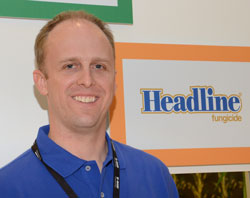
Neil started his career in retail agriculture in northwest Illinois and became a sales rep for BASF and American Cyanamid (dating yourself there, Neil!). After spending several years with the BASF marketing team at headquarters in North Carolina, in 2008 Neil took an assignment as a global marketing manager for BASF in Germany. “I had the chance as a global marketing manager to see a lot of agriculture around the world,” said Neil. “It was interesting to see the diversity of agriculture, the practices, and how we can help farmers get the most from every acre.”

Neil and his family enjoyed their time in Germany, but he’s happy to be back in the United States now and working with the growers here to help them improve their efficiency and productivity. “We really want to make sure that we continue to work with farmers, to help bring the solutions that we can create in a way that’s very meaningful to them,” he said.
One way they are doing that is offering incentives to help growers manage risk. “We call it our Advantage Suite of offers,” Neil said. “What it really starts with is making the right selections of the right products to maximize the yield on the acre.” Once the grower makes the decision to use BASF products for yield advantage, Neil says they offer other advantages. “We have offers such as Finance Advantage, which is a way growers can purchase our products and have zero interest financing until December,” he said. “We have a very innovative tool called Investment Advantage, in which if a grower purchases our high yield packages, BASF is willing to participate in the risk of the market.”

Investment Advantage has a March 15 deadline, but there is still time to participate in BASF’s other offers. Information on all BASF Grower Advantage offers is available at growersadvantage.basf.us.

Learn more about Neil and his dedication to helping farmers get the most from every acre in this interview: BASF Director of Marketing Neil Bentley

Audio, BASF

Both RFS and Farm Bill Important to Agriculture

Chuck Zimmerman

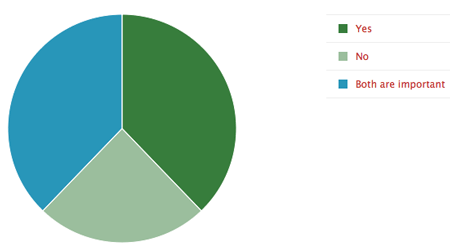
Our latest ZimmPoll asked the question, “Is maintaining the Renewable Fuel Standard more important to agriculture than the farm bill?” The statement was made during a recent meeting I attended that the Renewable Fuel Standard was more important to agriculture than the Farm Bill. In a show of how important it is 38% each of respondents said Yes and Both are important. Only 24% said No. What do you think? Many people seem to think the RFS only benefits corn/soybean growers but they don’t take into account that all farmers receive benefit from lower fuel costs just like the general public.

Our new ZimmPoll is now live and asks the question, “Is “Organic” food healthier than “Conventional” food?” During last night’s AgChat this topic received a fair amount of discussion. Even though there is a USDA Certified Organic program it appears that the term is not widely understood. I haven’t seen any evidence that the public in general really cares that much either and I’m sure that most would not want to pay more for food that has to conform to the certified standards. What do you think? Take our poll and/or comment. Thanks.

ZimmPoll is sponsored by Rhea+Kaiser, a full-service advertising/public relations agency.

ZimmPoll

Zimfo Bytes

Melissa Sandfort

    Zimfo Bytes

  • Agro Culture LIQUID Fertilizers has announced its intention to break ground on a new corporate headquarters facility in St. Johns, MI this spring.
  • The Georgia Peanut Commission will hold a referendum March 15 through April 15 giving peanut producers an opportunity to vote on reaffirming the commission.
  • The U.S. EPA has granted registration approval for DuPont Fontelis fungicide.
  • DuPont announced that it has received registration from the U.S. EPA for Optimum AcreMax XTreme insect protection for corn.
Zimfo Bytes

Outstanding Young Farmers Attend Ag Day Activities

Chuck Zimmerman

During National Agriculture Day activities we heard from 2011 National Outstanding Young Farmer Chad Budy and his wife Danielle from Oklahoma. They were introduced during our Meet & Mingle lunch. Chad and Danielle were introduced by Orion Samuelson.

Both Chad and Danielle come from families with five generations in farming. They have a diversified farm of row crop and livestock. You’ll hear why they’re considered outstanding in their remarks.

Listen to remarks from our Outstanding Young Farmers here: Remarks from Outstanding Young Farmers

2012 National Agriculture Day Activities Photo Album

Coverage of the 2012 National AgDay Activities is sponsored by the American Seed Trade Association
Ag Groups, Audio

The Expanding World of Hog Feed Choices

Cindy Zimmerman

Once upon a time, commercial hog diets consisted mainly of corn and soybeans, but the menu has greatly expanded out of necessity since commodity prices increased a few years ago.

That expansion has brought with it both opportunities and challenges for producers, according to Iowa State University Professor of Animal Science Dr. John Patience, who spoke to swine veterinarians last week at the Boehringer Ingelheim Vetmedica (BIVI) Swine Health Seminar in Denver. “Corn and soybean meal are relatively uniform ingredients. Now that we’ve moved to using products like wheat middlings, bakery by-products, and distillers grains, those are ingredients that are quite variable in their nutrient composition. So, we have to do a lot more quality control, for example,” he explained. “We also have to make sure when we use these ingredients that they fit into our feed manufacturing system since some of them are a lot less dense, bulk-wise.”

Dr. Patience says we are seeing diets now with 20% or less corn in them. “Right now the Europeans have a lot more experience with using these diverse kinds of diets than we do, but we’re catching up,” he said, adding that the U.S. pork industry is extremely innovative and responsive to new information “and that has really shown itself remarkably well in the last five years.”

Listen to my interview with Dr. Patience here: ISU Animal Scientist Dr. John Patience

BIVI Summit at Mile High 2012 photo album

Audio, Boehringer Ingelheim, Feed, Pork, Swine

Increasing Productivity Through Innovation

Chuck Zimmerman

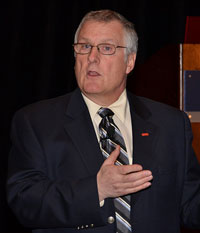
I met Lykele vanderBroek, Global COO, Bayer CropScience, during the 2012 Ag Issues Forum. He was on the welcoming committee to all the media who attended this event. When it was my turn for an interview with him I asked him what take away message he wanted us to have. He says that global trends like increasing population, higher affordable income, dietary shifts and others, contrasted with our inability to add much more farmland, make it important to increase productivity both in terms of quantity as well as quality. Lykele believes we can only increase productivity through innovation and that it should be done in a sustainable way so we can continue to do so in the future. He thinks that innovation needs to be centered around the grower keeping in mind what his customers want.

When it comes to how Bayer CropScience is creating customer solutions to the issues created by these trends he points to their investment in research and development of new products. They also want their products to be used in a responsible way. An example of how they encourage this is with their Respect the Rotation Initiative.

You can listen to my interview with Lekela here: Interview with Lykele vanderBroek

2012 Bayer CropScience Ag Issues Forum Photo Album

Agribusiness, Audio, Bayer, Biotech

Important Issues to Sorghum Producers

Chuck Zimmerman

During Commodity Classic I got to visit with Terry Swanson, Chairman, National Sorghum Producers. I asked him what his message is to not only sorghum producers but all the farmers belonging to the four commodity groups at Classic and he says, “We have to be unified.” He says that altogether they’re still a small group of people that need to speak with one voice.

Terry farms in Colorado which he calls the “epicenter of the dust bowl.” This means that a safety net and crop insurance are critical for them. Conservation is also an important issue for him. He says that NSP is looking at ways that the sorghum crop can play a role in water conservation. He also says that a third of the sorghum crop is used to make ethanol, a third to livestock feed and a third is exported. Biofuels and issues surrounding them like the RFS are very important to sorghum producers. He says the RFS creates markets and that’s important to producers.

Listen to my interview with Terry here: Interview with Terry Swanson

2012 Commodity Classic Photo Album

Coverage of the 2012 Commodity Classic Show is sponsored by BASF and New Holland
Ag Groups, Audio, Biofuels, Commodity Classic, Ethanol, NSP, sorghum

Stabilized Nitrogen For Faster Plant Start

Chuck Zimmerman

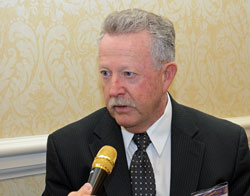
The Director for Agronomy for Koch Agronomic Services, Greg Schwab, visited with me in the media room at Commodity Classic. Greg runs the company research program. He says they have twenty five land grant universities working on their products. He coordinates that effort.

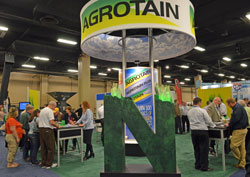
Since it’s planting season I asked him what advice he has for growers. Greg says that with farmers managing larger amounts of land these days it is becoming increasingly important to get in the field to plant quickly and that the planting date means a lot in terms of final yield. He points to their AGROTAIN nitrogen stabilizer which allows a farmer to use a broadcast application of urea instead of a more traditional incorporated or injected application. The AGROTAIN treated urea prevents volatilization loss that would normally occur with surface applied urea. This means a faster start for plants. He says growers are also finding a split application helpful.

Listen to my interview with Greg here: Interview with Greg Schwab

2012 Commodity Classic Photo Album

Coverage of the 2012 Commodity Classic Show is sponsored by BASF and New Holland
Agribusiness, Audio, Commodity Classic, Fertilizer