Colorful Way Shows How BASF Herbicide Works

Cindy Zimmerman

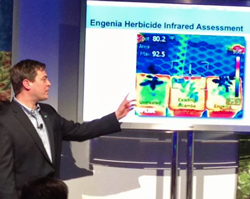
basf-classic13-infaredDuring the recent “Science Behind BASF” event, Senior Biologist Dr. Chad Brommer gave an infrared imaging demonstration to assess Engenia™ herbicide, a technologically advanced dicamba formulation developed by BASF.

Chad explains that they wanted a quantitative way to measure the safety and effectiveness of Engenia. “What we see with the camera is often things we can’t see with the human eye and that’s whether the plant is physiologically functioning the same way,” Chad said. The idea is to make sure that Engenia only kills the weeds and does no harm whatsoever to the plant.

The infrared technology allows them to see whether the crop is taking up any of the dicamba through secondary loss, even if it shows no visible signs of damage, basically by taking the temperature of the plant. Comparing existing dicamba formulations with Engenia, they found about a 10 degree difference in temperature. “That doesn’t seem like much, but that’s a real indication that plant has taken up some of the dicamba through secondary loss and it’s not functioning properly,” Chad said, noting that the infrared showed no difference between the Engenia-treated and untreated control.

You might remember that we shot a little video with Chad about Engenia last year at Commodity Classic. BASF anticipates the commercial launch of Engenia herbicide in the U.S. in 2014, in a complimentary time frame with the commercialization of dicamba-tolerant soybeans. BASF expects Engenia herbicide use on cotton in 2015 following the commercialization of dicamba-tolerant cotton.

Listen to my interview with Chad here: Chad Brommer interview
Check out more photos from the Science Behind BASF here

Agribusiness, Audio, BASF, Soybean

Farm to Fork Politics

Chuck Zimmerman

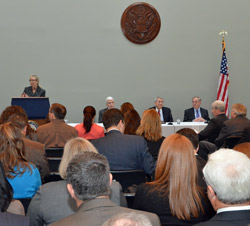
Agri-Pulse Ag DayThe first in the series of 2013 National Ag Day activities is an Agri-Pulse sponsored session titled, “Farm to Fork Politics: An Insider’s look at the year ahead for food and agriculture”

Join us for this panel discussion moderated by Sara Wyant of Agri-Pulse and featuring J.B. Penn of John Deere, former USDA Chief Economist, Dr. Keith Collins and B. Hudson Riehle, the Senior Vice President of the Research and Information Services Division for the National Restaurant Association.

I spoke with Sara before we got started tonight and asked about her perspective of what the year ahead will hold. Sara is very optimistic about agriculture and food. She sees heightened interest in these subjects here on Capitol Hill. She says it’s a time of fiscal austerity with budget cutting and a need to figure out what’s best to maintain a sustainable ag industry and work to feed a growing population.

We’ve got a big crowd here tonight. There were over 330 pre-registered and we’re expecting House and Senate leadership to join us for the reception following this session.

You can listen to my interview with Sara here: Interview with Sara Wyant

I’ll be saving a lot of photos to my online photo album: 2013 National Ag Day Activities Photo Album

Coverage of the National AgDay Activities is sponsored by the BCS think tank and American Seed Trade Association
Ag Day, Ag Groups, Agri-Pulse, Audio, Farm Policy

Media Bias in Animal Ag Story

Cindy Zimmerman

media-biasFox News loves to point out media bias in mainstream reporting on politics in particular, but probably not when it comes to agriculture.

Fox carried an AP story over the weekend about state bills seeking to make it more difficult for animal rights activists to go undercover at agricultural operations to get video of abuse and sometimes hold it for weeks or months before alerting authorities. Reasonable enough, unless you are the Humane Society of the United States (HSUS) which is vehemently opposed to such legislation.

The media bias in the story was clearly on the side of HSUS, quoting three different HSUS spokespersons and only one agricultural organization person. Two other quotes supporting such legislation were from a California assembly staffer and a spokesperson for the American Legislative Exchange Council, a state level public policy organization.

There was one interesting item in the story that raised a question in my mind about USDA’s plans to furlough meat inspectors under the sequester. According to the story, last year USDA created “24 new positions in the Food Safety Inspection Service were dedicated to humane handling.” Now, the quote was attributed to a “high-ranking food safety official not authorized to speak publicly” – which makes one question its accuracy – but if it is true, you have to wonder if the sequester will impact those positions as well. Just sayin’.

Animal Activists, Animal Agriculture, Meat, Media, USDA

2013 National Ag Day Activities

Chuck Zimmerman

National Ag DayIt is time for National Ag Day and activities to celebrate it will kick off today in Washington, DC. National Ag Day is a project of the Agriculture Council of America.

My coverage of this year’s activities is being sponsored once again by the American Seed Trade Association along with BCS Communications. I talked with Andy Lavigne, President/CEO, ASTA, about this year’s theme of Generations Nourishing Generations. It evokes a great image of the family and most people need to know that it is mainly family farmers who are providing the food on their table. Hopefully we’ll be able to get that message out so people who are far removed from the farm will better understand it and not fall into the trap of believing very erroneous messages being spread by organizations and people with an agenda that is very detrimental to today’s sustainable farming practices.

Andy urges all agribusiness companies and farm organizations to support National Ag Day and the activities that take place each year.

Listen to my interview with Andy here: Interview with Andy Lavigne
March 19th is National Ag Day, a time when producers, agricultural associations, corporations, universities, government agencies and countless others across America gather to recognize and celebrate the abundance provided by American agriculture.
As the world population soars, there is even greater demand for the food, fiber and renewable resources produced in the United States.
Read More

Ag Day, Ag Groups, ASTA, Audio

Innovations in Every Corner

Jamie Johansen

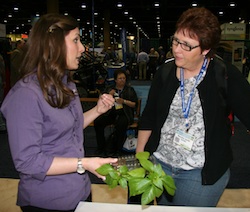
classic-13-jamie-86-editedI had so much fun talking with Dr. Jennifer Holland in the BASF booth during Commodity Classic because the passion she has for her job simply radiates through. Jennifer is the Technical Marketing Specialist with the Row Crop Fungicide Team at BASF.

She had a wealth of knowledge to share with me and more importantly to growers about their proven products and what we can see from BASF in the near future.

“In 2012 we launched Priaxor to much acclaim and a lot of challenges in the marketplace with the drought of 2012. And one of the things we were able to do was get 60 on-farm trials looking at Priaxor compared to Headline. What we were able to see was Priaxor actually out performed Headline with a 2 bushel better increase in yield. Which really delivers significant value for growers. We believe that yield is underpinned by all the plant health benefits we’ve researched and we can offer with Priaxor. For us those plant health benefits really fall under three buckets. First and foremost, is disease control, which we know is very important with fungicide, but also with growth efficiency in maximizing photosynthesis and nutrient utilization. And finally stress tolerance, which of course the drought of 2012 falls into that bucket.”

“In 2013 we’re really excited because we are looking to continue the integration process with Becker Underwood. Both of us have very strong innovative pipelines and I think growers are going to see new, exciting innovations from from us as we move forward with that process. And one of the things BASF has always prided itself on is it’s commitment to the agricultural industry and to innovation. In fact, in 2015 we will of launched 33 new products, which really speaks to our commitment. In terms of research and development, we spend approximately $2 million a day, and that’s Monday – Friday and weekends, making sure we are bringing the most innovative solutions to growers.”

Listen to my interview with Jennifer from here: Interview with Jennifer Holland

2013 Commodity Classic Photo Album

Audio, BASF, Research

Zimfo Bytes

Talia Goes

    Zimfo Bytes

  • American Royal’s annual meeting included an update on plans to replace Kemper Arena with a new Agricultural Events Center and officer elections.
  • S&W Seed Company announced that it has agreed to purchase 100% of Seed Genetics International Pty Ltd, subject to due diligence and other customary conditions.
  • As a steadfast supporter of open markets and free trade, Cargill welcomes Japan’s decision to enter the Trans-Pacific Partnership negotiations.
  • A new state-by-state audit funded by the United Soybean Board aims to support poultry and livestock farmers by helping them keep track of environmental rules and regulations.
Zimfo Bytes

New USDA Rural Definition Stirs Controversy

Cindy Zimmerman

A guest post by Agri-Pulse Editor Sara Wyant

agri-pulseA proposed definition of the term “rural” submitted by the Department of Agriculture to Congress last month could have broad implications for small towns across America and not everyone is happy about it. The report, delivered two and one half years late after it was required by Congress to be delivered by June 18, 2010, was expected to assess how the various definitions in rural development programs are working and to make recommendations on ways to better target funds.

At issue is the definition’s new population limit for “rural,” now raised up to 50,000. Currently, each USDA RD program has its own population limit to correspond to its specific function. For example, USDA now has a 10,000 population limit for rural water/wastewater programs and 20,000 for community facility programs. USDA believes a new across-the-board limit “would remove confusion over what constitutes a rural area and would encourage more multi-jurisdictional collaboration,” according to the official proposal.

Critics, including House Agriculture Committee Chairman Frank Lucas, R-Okla., and ranking member Rep. Collin Peterson, D-Minn., are concerned that the new definition will crowd out smaller communities. “We are disappointed in USDA’s proposals to shift funding away from the most rural areas by inflating the definition across the board,” Lucas and Peterson said in a joint statement. “This will result in smaller communities competing with larger and more urban areas for funding.”

The new definition would force the department’s Rural Development (USDA-RD) program to “spend money in a way that’s perhaps not the best for the United States,” said Duane Ischer, former Rural Development senior advisor, in an interview with Agri-Pulse. The federal government “needs to keep (the definition) as simple as possible and probably let the states define (rural) to the extent that they can within their own state,” he said.

The report’s authors say the change would streamline funding procedures and provide “a more transparent process for accessing financial and technical assistance from the Mission Area.

Read the rest of Sara’s story here.

Agri-Pulse, USDA

New Documentary to Feature Next Gen Farmers

Chuck Zimmerman

ZimmCast 388It is very encouraging to see major film projects taking a realistic and truthful look at farming in America today. Examples are “Harvesting the High Plains” and “The Great American Wheat Harvest.” Now here’s a new one that is not yet in production. It isn’t even titled yet but was announced last week. Working with the U.S. Farmers & Ranchers Alliance is James Moll, Oscar® winning and two-time Emmy® winning filmmaker. I visited with James to learn more about the project. He admits to knowing little about agriculture but I think that is a good thing. James takes a very unbiased look at his subject matter and lets the people he interviews tell the story. That is a lot like what we do here on AgWired!

James has decided to profile farmers and ranchers in their twenties, all of whom have assumed the generational responsibility of running the family business.

Made in cooperation with U.S. Farmers & Ranchers Alliance® (USFRA®), the film will give us an up close and personal look at some of the young farmers and ranchers who grow and raise the food we consume daily, and into the latest farming procedures, practices, and technologies that are changing and improving the landscape of modern agriculture.

“I’ve always strived to make films that are unbiased testaments to the subject matter,” said Moll. “It’s about telling real stories that resonate. I’ve been looking for the right subject to tackle in my next documentary, and I’ve found the perfect topic in American agriculture.”

Learn more about James Moll’s new project in this week’s ZimmCast: New James Moll Documentary on Agriculture

Thanks to our ZimmCast sponsors, GROWMARK, locally owned, globally strong and Monsanto, Roundup Ready Plus, for their support.

The ZimmCast is the official weekly podcast of AgWired. Subscribe so you can listen when and where you want. Just go to our Subscribe page.

Ag Groups, Audio, Farming, USFRA, ZimmCast

Celebrate National Biodiesel Day

Joanna Schroeder

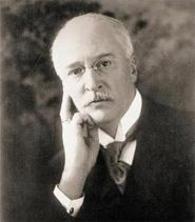
Today is National Biodiesel Day! The Iowa Biodiesel Board is asking Iowans to reflect on the contribution the biodiesel industry is making to Iowa and to the nation. March rudolf-diesel_394645698109109557518 is National Biodiesel Day because it is Rudolf Diesel’s birthday, the man who invented the engine that bears his name. He ran early models on peanut oil, and was a visionary for the renewable fuel that would one day be called biodiesel.

In a 1912 speech, Diesel said: “The use of vegetable oils for engine fuels may seem insignificant today, but such oils may become, in the course of time, as important as petroleum and the coal tar products of the present time.”

Iowa has been leading the way with 12 biodiesel plants that produced 184 million gallons of biodiesel in 2012. This accounts for about 17 percent of all U.S. biodiesel.

“With biodiesel, Iowans are leading an agricultural revolution that is making a meaningful difference in our nation’s energy security and helping our economy rebound,” said Randy Olson, executive director of the Iowa Biodiesel Board. “We truly are at the forefront of innovative American agriculture driving American energy independence.”

Recent economic studies show in 2012, Iowa biodiesel supported nearly 5,000 jobs in the state, contributed nearly $400 million to the state’s GDP and generated $236.8 million of household income. Biodiesel also benefits consumers in other ways. According to a study measuring the impact of the Iowa biodiesel industry on the Iowa agricultural economy, corn, soybean, and livestock producers all benefit from biodiesel production. Demand for vegetable oils reduces soybean meal prices, to the benefit of Iowa’s livestock producers – and that ultimately benefits the consumer at the grocery store.

Want to show your support for biodiesel today or any day? Join the Biodiesel Backers!

Biodiesel, Biofuels

Precision Pays iPad mini Giveaway Contest Winner

Chuck Zimmerman

ipad-miniOver on our sister website, Precision Pays, the winner of the iPad mini Giveaway Contest has been picked via random selection. He’s Nick Leibold of New Hampton, IA. Nick farms about 600 acres of corn and 400 acres of soybeans.

Cindy visited with Nick by phone to let him know about his winning and to learn a little bit about how precision pays for his family farming operation. He says he’s been using precision ag in his farming operation for about ten years now including auto steer, yield monitor and row shutoffs on his planter. He says, “On the planter I’ll do a split variety and that way when I harvest I know which variety is which and I can compare strips across the field. I use it a lot for variety selection.” He uses it to farm more efficiently.

When it comes to his new iPad mini he says his dealer says he can hook up an iPad to help him record the different varieties he’s planting and then take it out to the field later when he’s scouting and find spots where he has been.

Nick is also very involved with the Iowa Corn Growers serving on the Iowa Corn Promotion Board. It’s important to him to see that those corn checkoff dollars are being put to good use.

Listen to Cindy visit with Nick here: Interview with Nick Leibold

What do you think of our first Precision Pays giveaway contest? Want to see more product giveaways? Here on AgWired? Chime in using comments and let us know.

Audio, Equipment, Farming, Precision Agriculture