The Little Things in Life

Melissa Sandfort

Nest1This week Aunt Jeanette writes:

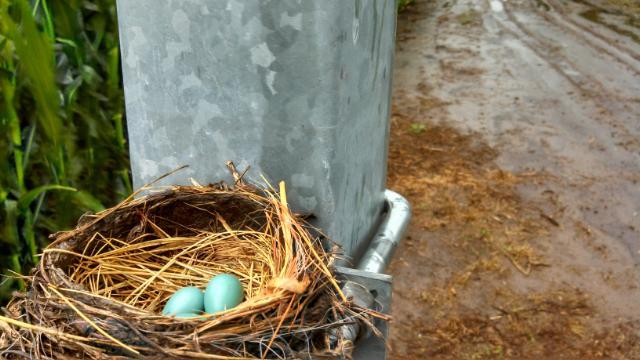
Some time ago Melissa wrote a story about pivot stops. We have quite a few of these structures and they are wonderful for keeping pivots out of trees, ditches, roads, or the neighbor’s fields. We also found out they are good places for a bird to set up housekeeping – or should I say ‘nestkeeping’!

During irrigating season, farmers have to find little things to keep them happy. Although we are fortunate to be able to irrigate our crops, being out in a cornfield when the temperature is 98 degrees, the heat index is 105 degrees, the humidity is 90 percent, and there is not a breath of air, just isn’t their idea of a good time.
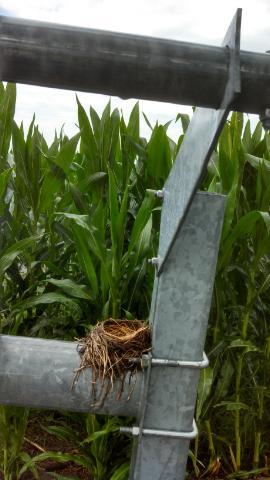
Nest2My husband, Dan, saw this robin’s nest on one of his pivot stops. He didn’t think the nest would survive, but he was able to watch the whole progression of a family of robins from three eggs to three baby robins. The robins have left the nest now, but the empty nest still sits on the pivot stop.

I think it gave him a little something to look forward to when he was irrigating on those miserably hot days.

And I know he smiled every time he saw it. He is just like that.

Until we walk again …

Uncategorized

Farm Foundation Publishes Farm Bill Perspectives

John Davis

farmfoundationlogo3You need information, especially when it comes to one of the most important pieces of legislation this Congress will consider: the Farm Bill. That’s why our friends at Farm Foundation, NFP and the National Center for Food and Agricultural Policy (NCFAP), have put together a series of essays by thought leaders in ag and rural America called Perspectives on the 2013 Farm Bill.

“Our intent is to enrich the public debate about the future of food and agricultural policy by providing ideas and perspectives from a diverse range of thought leaders,” according to Neil Conklin, President of Farm Foundation, NFP.

While Congress may finalize new farm bill legislation over the next few weeks, the debate will likely continue. “The role of the federal government in food, agriculture and rural communities will continue to be discussed and debated well into the future,” says Stan Johnson, Chairman of the Board of Trustees of NCFAP. “It is our goal to stimulate a continuing, dynamic conversation on the role and structure of food, agricultural and rural policies.”

And to give you more context, Farm Foundation has a 2013 Farm Bill Reading Room that gives stakeholders some varied viewpoints and options under discussion as Congress continues work on a successor to the 2008 farm bill. Articles are being put in three categories: reports on the politics shaping policies; organizational advocacy or viewpoints; and policy reference and analysis.

Ag Groups, Farm Bill, Farm Foundation

How Many Farm Apps Do You Use?

Talia Goes

Our latest ZimmPoll asked the question, “What use would you have for an Unmanned Aerial Vehicle?”

Our poll results:

· Crop analysis 25%
· Improve nutrient & crop protection efficiency 18%
· Just for fun! 18%
· Maximize yields 15%
· More efficient water use 7%
· Monitor livestock 8%
· Other 8%

So what do you think from the looks of the results? Are UAVs the next big technology “trend” for farmers who need to scout fields?

Our new ZimmPoll is now live and asks the question, ” How many ag-related apps do you have?” According to a recent Successful Farming survey, 28% of farmers polled “normally use apps to obtain information on agricultural products and/or services.” Are you one of the 28% and if so, how many different apps to you use? Let us know what you think.

ZimmPoll is sponsored by New Holland Agriculture.

ZimmPoll

Zimfo Bytes

Talia Goes

    Zimfo Bytes

  • The nation’s top experts in agricultural lending will gather in Minneapolis for the American Bankers Association National Agricultural Bankers Conference Nov. 10-13.
  • The American Veterinary Medical Association (AVMA) awards Link Welborn, DVM, DABVP, a graduate of University of Florida, the 2013 AVMA President’s Award.
  • According to a recent poll conducted by Ipsos Reid on behalf of BASF Canada Inc., nearly 100 per cent of Canadian farmers agree an environmentally-sustainable operation is important to them.
  • CNH Global N.V. announced that the shareholders of CNH Global N.V. met at an Extraordinary General Meeting and approved the merger between Fiat Industrial S.p.A. and CNH Global N.V. with and into a newly established company to be named CNH Industrial N.V.
Zimfo Bytes

BASF at Peanut Growers Conference

Cindy Zimmerman

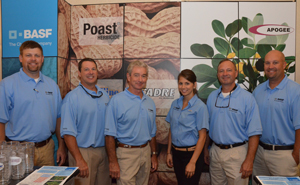
spgc13-basf-teamBASF has always been a big supporter of the Southern Peanut Growers Conference and so has Becker Underwood – but this year the two were a single team together.

With the acquisition of Becker Underwood, VAULT as a peanut inoculant is a very important product we’re looking forward to launching from the BASF platform,” said southeast BASF rep Chris Maurer (left). “We have some really exciting seed treatments but now also having the inoculants gives us another avenue on to the farm to help growers get the most out of every acre.”

Of course, BASF products like Headline and Cadre remain important products for peanut growers, but BASF is always looking ahead to new and innovative products in the pipeline.

“Innovation has always been a key part of BASF as a company,” Chris said. “We believe innovation is what keeps the company sustainable” and the farmers too! Interview with Chris Maurer, BASF

2013 SPGC Photo Album

Agribusiness, Audio, BASF, Peanuts, SPGC

Panera Portraying Farmers as Lazy?

Chuck Zimmerman

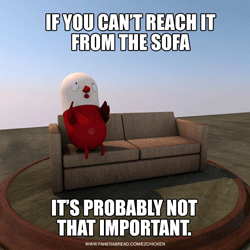
Panera EZChickenI’m echoing Dairy Carrie’s comment that Panera Bread has lost another customer. She explains things much better than I can.

This is the story of another company thinking they must portray their product as healthy while at the same time insinuating that other products are not. I have no doubt that there are Panera customers who want products like antibiotic free chicken. But they’re claiming it tastes better. Yeah. Right. But the kicker is the Panera EZChicken. It looks like a drug capsule in white and red to me. The images you’ll find like the one here seem to suggest that farmers that use antibiotics to raise chickens are lazy. I wonder how many of their customers will buy that. Probably a lot who are not well informed.

Give Dairy Carrie’s post a read and let me know what you think.

Farming, Food, Wackos

History & Future of World Trade Organization

Chuck Zimmerman

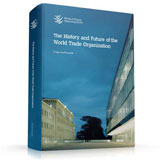
World Trade Organization History BookHere’s some light reading for you. How about the History and Future of the World Trade Organization. It is “a comprehensive account of the economic, political and legal issues surrounding the creation of the WTO and its evolution. Fully illustrated with colour and black-and-white photos dating back to the early days of trade negotiations, the publication reviews the WTO’s achievements as well as the challenges faced by the organization, and identifies the key questions that WTO members need to address in the future.”

The book describes the intellectual roots of the trading system, membership of the WTO and the growth of the Geneva trade community, trade negotiations and the development of coalitions among the membership, and the WTO’s relations with other international organizations and civil society. Also covered are the organization’s robust dispute settlement rules, the launch and evolution of the Doha Round, the rise of regional trade agreements, and the leadership and management of the WTO.

“The purpose of this work is to not only tell us about our past, but to explain our present and to inform our future,” said WTO Director-General Pascal Lamy.

Craig VanGrasstek, publisher of the Washington Trade Report and a trade consultant, is the author.

Listen to WTO Director-General Pascal Lamy talk about the book here: Comments from Pascal Lamy

Audio, International

GEOSYS Announces Field Profit Planner

Chuck Zimmerman

infoag-13-dave-westI learned all about GEOSYS during the 2013 InfoAg Conference by visiting with Dave West. The company just announced their Field Profit Planner, a comprehensive tool for farmers and their advisors who pursue high efficiency farming.

The new cloud-based GEOSYS Field Profit Planner service gives growers quick analyses of their individual fields while also providing insight into productivity across the entire farm. Unique to the GEOSYS platform, profit analysis for each field is included as part of the standard package. Each grower’s individual field costs and yields can be used to calculate returns on each field or variable rate technology (VRT) field zone. The data is displayed in an easy-to-use format.

Dave says GEOSYS uses the latest tools in agronomy so are enabled to make the best decisions for their operations.

“We’re not actually making those decisions for a grower. Our tools are meant to give the producer or decisionmaker the best information to make the best decisions,” he said, adding GEOSYS has been in business around the globe for 25 years. And over the past decade, they have put together a database on satellite imagery that is what Dave characterizes as the most effective tool for measuring variability in a field. That’s a lot of information at the fingertips of GEOSYS providers. “Being able to take that, build the algorithms to it and process it, and deliver visual tools that will act as either a substrate for a conventional solution or a precision ag, variable-rate solution, that’s where we play.”

Dave says GEOSYS’ information can tell a subscriber what’s going on in the soil, past performance, variables, and where to plant crops, just to name a few items. He added the data really helps producers who need to be able to anticipate and react to the variables in those fields. Dave said knowing what to do in the various parts of one field can significantly cut down on the costly inputs, such as fertilizer and seed. The company has an Apple-based app for mobile devices.

You can listen to my interview with Dave here: Interview with Dave Scott, GEOSYS

2013 InfoAg Conference Photo Album

Agribusiness, Audio, Precision Agriculture

Vilsack Questions House Farm Bill

Cindy Zimmerman

vilsack-ifbAt the Iowa Farm Bureau 2013 Economic Summit on Monday, Agriculture Secretary Tom Vilsack expressed some skepticism about the farm-only farm bill passed by the House.

“I’m not sure that what they’ve done up to this point is real or for show,” Vilsack told reporters after addressing the summit. He also wonders why the House leadership is delaying work on a conference committee until after they do something about nutrition. “Seems to me that conference process could begin now,” he said. “If we send a message that we’re just not ready to conference yet, it does raise the concern that what’s happened up to this point is not necessarily going to lead to a farm bill.”

Vilsack warned against yet another extension. “An extension basically acknowledges the failure to get things done,” said Vilsack. “If we don’t get it done now, the chances are that we won’t get it done.”

Vilsack address to IFB Economic Summit Vilsack press conference
Audio, Farm Bill, USDA

What China Approval of Monsanto Trait Means

Cindy Zimmerman

Monsanto officials are pleased with the recent import approval from China for the drought tolerance trait in Monsanto’s Genuity® DroughtGard® hybrids.

droughtgardAccording to Monsanto row crop launch lead, Sarah Pierce, the approval granted last month gives farmers who had purchased DroughtGard hybrids in 2013 more options. “(They) signed a stewardship agreement saying they would keep the grain domestic until we had all final import approvals,” she said. “With this announcement, it basically freed them of their obligations and they’re able to market their grain more broadly as they see fit.”

More than 250 farmers in the Western Great Plains planted DroughtGard Hybrids last year on their farms as a part of Monsanto’s Ground Breakers® program. “We really utilized their feedback and learned from their experiences to position this product most appropriately,” said Pierce, noting that the hybrid performed very well in last year’s dry conditions. “Last year on average our growers experienced a five bushel yield advantage over competitive products,” she explained. “What’s great about the DroughtGard hybrids are that while they perform well in water-limited conditions, they also maintain top end yield potential in years where we have normal weather conditions.”

The drought tolerance trait in Genuity DroughtGard Hybrid’s represents the first commercial offering of the company’s joint R&D collaboration with BASF on yield and stress technologies.
Interview with Sarah Pierce, Monsanto

Agribusiness, Audio, Farming