
Happy World Soil Day

Chuck Zimmerman

World Soil DayGot soil? Go outside and dig your fingers in it. It’s World Soil Day!

Here’s a message from USDA’s Natural Resources Conservation Service on how important healthy soil is and how using conservation practices like no-till can help farmers take better care of their land.

When soil is heavily tilled, the stalks from the previous crop are chopped, and the top several inches of soil structure are disturbed. Conventional thought suggests this fluffing action allows for better seed placement, but Ray Archuleta, NRCS conservation agronomist, said that no-till systems, especially when combined with cover crops, are better – and lead to healthier, more drought-resistant soil.

Archuleta, who works at the agency’s East National Technology Center in Greensboro, N.C., said no-till has significant financial benefits for producers, too.

“No-tillage can save thousands of dollars every year in fuel, labor and equipment maintenance,” Archuleta said. “The key is to let the soil organisms do the work.”

Here’s a message from the FAO and the Global Soil Partnership.

Ag Groups, Conservation, Farming, International, Soil, Video

Sittin’ on the Front Porch

Melissa Sandfort

There are two parts to today’s story. First, as a child my mother always left a daily “to do” chores list. For my brother, that usually consisted of what I called FUN things – burning the trash, raking the leaves (so you could jump in them, of course, and waste at least a few hours), picking up sticks – you’re getting the picture. All the while, I was left inside to dust, vacuum, do laundry and help with dinner. I guess mom didn’t know I was itching to get outside with the boys where I belonged. Girls need fresh air too. (That’s why my dusting never passed the white glove test – I was too busy skimping on cleaning so I could go outside!)

These chores were a little different than the things my grandfather had to help with when he was younger. On old farm houses, there were storm windows that needed changed out and something else I learned about from his most recent tale: glass cloth a.k.a. muslin that had to be hung over the porch screens during the winter.

Onto the second part of the story … and I’ll keep this part short. Ever misunderstood someone or walked in on the tail-end of a conversation and what you heard just didn’t compute? My grandfather recounts the experience of one traveling salesman, and a conversation he overheard while my great-grandfather was hanging the muslin.

Listen to Grandpa explain

Kind of reminds me of a father sitting on the front porch with a shotgun when the daughter’s date shows up!

Until we walk again …

Uncategorized

EPA Hearing on Biofuels to Draw Big Crowd

Cindy Zimmerman

epa-logoA huge turnout is expected Thursday at a public hearing on the Environmental Protection Agency’s proposed Renewable Fuel Standard volume obligations for 2014. Literally busloads of stakeholders, both opposed to and in favor of cutting the requirements, are attending the hearing at the Hyatt in Crystal City, Virginia.

Iowa Governor Terry Branstad will be attending with several Iowa livestock producers, farmers and renewable fuels leaders. Branstad fears the EPA proposal could lead to another farm crisis. “I was governor during the farm crisis of the ‘80s when land values dropped 63 percent,” he said during a conference call on Wednesday. “I know what can happen when you have an agriculture depression, and we don’t want to go back and revisit that.” Comments on RFS Proposal Negative Impacts

Also attending the hearing will be corn farmers from a dozen other states in addition to Iowa. “It’s great to see so many people willing to leave their farms at this time of year for an important opportunity to give the EPA a piece of their mind,” said National Corn Growers Association First Vice President Chip Bowling of Maryland.

National Turkey Federation president Joel Brandenberger will testify in favor of reducing biofuels requirements under the RFS citing “the forced diversion of corn to ethanol that reduced the available share of the feed supply for poultry and livestock from 55 percent to just less than 41 percent of the corn supply, causing market volatility and higher feed prices.” The turkey producers and the National Chicken Council will continue to work toward legislation in Congress to reform or repeal the RFS.

The hearing is scheduled to begin at 9:00 am Eastern time and “end when all parties present who wish to speak have had the opportunity to do so.” Domestic Fuel/AgWired reporter John Davis will be there to provide coverage here.

Audio, Corn, Ethanol, NCGA, Poultry

Enter to Win Bayer’s 2013 Cotton Belt Challenge

Jamie Johansen

Metallic_Cotton_Belt_LogoThe Cotton Belt Challenge is in its second year, and Bayer CropScience is encouraging FiberMax and Stoneville cotton growers to enter to win great prizes. Growers with the highest yields and highest overall loan values in 12 regions will be recognized for both irrigated and dryland cotton. In addition to regional awards, there will be two grand prize drawings for a custom 4WD Bad Boy Buggies Ambush vehicle.

“FiberMax and Stoneville cotton varieties have the germplasm and trait technologies to help growers produce profitable cotton yields and fiber quality,” said Jeff Brehmer, U.S. product manager for FiberMax and Stoneville cotton. “Cotton production varies across the United States, depending on weather, irrigation, soil type, pest pressure and other factors. We want to recognize successful cotton production in diverse regional scenarios, and the Bayer CropScience Cotton Belt Challenge gives growers a chance to be rewarded by region for producing high-yielding and high-quality cotton.”

Growers enter by filling out an official entry form and submitting their gin receipts. All regional irrigated and dryland winners in the yield and fiber quality categories will receive 10,000 Innovation Plus™ points – a $500 value.

To qualify, growers must submit their yield and quality results from a minimum of 50 acres and verify their production through gin receipts. Yield is based on ginned lint yield, and quality is based on USDA loan value. If any portion of a field is irrigated, then the entry must be in the irrigated category.

Agribusiness, Bayer, Cotton

Lowering Biofuels Targets Could Hurt Farmers

Cindy Zimmerman

Protect the RFSRepresentatives from state government, the agriculture community, and the ethanol industry all say the Environmental Protection Agency’s proposed 2014 Renewable Fuel Standard (RFS) biofuels requirements would have a negative impact on agriculture and rural economies.

During a telephone press discussion today about the proposal Iowa Governor Terry Branstad said he was proud of his state’s leadership in biofuels production and he believes lowering the volume obligations would be detrimental for jobs and land values in rural America. “I’m concerned that this would be devastating to what has been a robust economic recovery” in the agricultural heartland of America, said Branstad. “I think the president’s made a terrible mistake caving in to Big Oil on this issue.” The governor launched a new website in response to the EPA proposal – ProtectTheRFS.com – which is collects commenting from citizens about the proposed changes and sending them to the EPA.

american-farm-bureau-logoAmerican Farm Bureau economist Matt Erickson noted that the proposal has already led to lower futures prices for corn, which could mean 2014 will see prices below the cost of production. “Looking at USDA’s cost of production forecast, the breakeven for corn for 2014 is forecasted to be over $4 a bushel,” Erickson said, explaining that if it drops much lower than that, farmers will be losing money. “This would really be the first time we’d seen this on a national scale since 2005.”

Reducing America’s dependence on foreign oil was the primary objective of the RFS, but “revitalizing rural communities, boosting farm income and reducing farm program costs were also important policy objectives,” said Renewable Fuels Association president and CEO Bob Dinneen. “The RFS has certainly helped to do that and this proposal will reverse that policy as well.”

Listen to comments from Branstad, Erickson and Dinneen with questions from the media here: Comments on RFS Proposal Negative Impacts

AFBF, Audio, Ethanol, RFA

Zimfo Bytes

Talia Goes

    Zimfo Bytes

  • U.S. Department of Agriculture Food Safety and Inspection Service (FSIS) and USDA Office of Advocacy and Outreach (OAO) have selected broadhead to develop communications to raise awareness of both agencies’ services for the public.
  • American Agri-Women (AAW) elected its executive board and recognized outstanding contributors at its 38th annual convention held recently in Niagara Falls, N.Y. Sue McCrum of Mars Hill, Maine, will serve as president in 2014 and 2015.
  • Land O’Lakes, Inc. announced its acquisition of Geosys, a global technology firm that provides satellite imaging and insights to agribusiness.
  • The shareholders of Lincoln Land FS, Inc., headquartered in Jacksonville, Ill., and Two Rivers FS, Inc., headquartered in Rushville, Ill., have approved the merger of their two companies effective December 1, 2013.
Zimfo Bytes

Lincoln Land FS & Two Rivers FS Combine

Talia Goes

13910prairieland_275The shareholders of Lincoln Land FS, Inc., headquartered in Jacksonville, Ill., and Two Rivers FS, Inc., headquartered in Rushville, Ill., have approved the merger of their two companies effective December 1, 2013. The new company – Prairieland FS, Inc. — will be headquartered in Jacksonville. Keith Hufendick, formerly manager of Two Rivers FS is named chief executive officer; Matt Busby, formerly manager of Lincoln Land FS is named chief operating officer.

Joe Pickrell, Buffalo Ill, was named President of the newly-formed company; Chet Esther, Frederick Ill, is Vice President. The combined entities recorded $300 million in sales for the most recent fiscal year ended July 31, 2013.

Agribusiness, GROWMARK

Research, Promotion & Education at Pork Board

Jamie Johansen

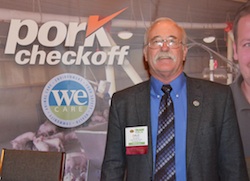
nafb-13-nafb-13-36The National Pork Board is the entity that conducts research, provides education and promotes the product. They were at the recent NAFB Convention and I caught up with them during the always busy, yet fun and exciting Trade Talk.

Dale Norton, Vice President of the National Pork Board, farms with his brother in Michigan and has been a part of the pork industry on the national level for about 15 years. Dale’s major role for the organization is to manage the money that comes in through the checkoff program. In an interview with me, Dale touches on Porcine Epidemic Diarrhea (PED), the research being done and the Pork Checkoff.

“There’s no safety issue with PED. Pork is perfectly safe. That’s one thing the public needs to know. For producers impacted it’s a real test to their economic stability. Those that have pigs that are between birth and 28 days and are affected are almost 100% fatal. It takes a period of time in the herd to create immunity. Part of what has happened with Pork Board is we have really made an expedited effort to put research together to help minimize the impact that it is going to have.”

The Pork Board has a We Care initiative that is in place to help educate the public and show that the producers truly care about their animals, their communities and the environment. They are also busy sharing recipes and proper cooking techniques. Dale says one of their catchphrases is ‘cook it like a steak.’ Seven minutes on each side gives you a good medium, juicy chop.

Marketing to the millennial generation is also key for the board. They recently released a free e-book called Cooking For Comfort. They are also very present online via social media. Check them out on Twitter, Facebook and Pinterest.

Listen to my complete interview with Dale here: Interview with Dale Norton

Checkout photos from NAFB Convention: 2013 NAFB Convention Photo Album

Ag Groups, Audio, NAFB, Pork

Canadian Farmers Have Record Year

Cindy Zimmerman

Canadian farmers harvested record crops this season, according to the latest report out today from Statistics Canada.

canadaProduction of most field crops increased this year in Canada compared with 2012 with both canola and wheat production reaching record levels. Canola production increased 29.5% from 2012 to a record 18.0 million tonnes with a record average yield of 40.0 bushels per acre, up 42.3% from 2012, which more than offset a 9.0% decline in harvested area. Farmers reported record wheat production of 37.5 million tonnes, a 38.0% increase from 2012. Both harvested area (+9.9%) and average yield (+25.4%) increased compared with 2012.

Barley production was up nearly 28% from 2012 to 10.2 million tonnes with a record yield of 71.7 bushels per acre. Corn and soybean production also set records, mostly due to increased acreage, with soybeans up 2.2% and corn up 8.7%.

mgex“To say the report is surprising is probably an understatement in terms of the magnitude of the increase,” commented analyst Bruce Burnett with the Canadian Wheat Board (CWB) on the Minneapolis Grain Exchange (MGEX) crop call for Canada this morning.

Listen to his analysis here: Commentary on Canada crop report with Bruce Burnett, CWB

Audio, Wheat

FedEx Delivers Early Christmas Present for Troops

Jamie Johansen

t4tlogoFedEx Corp. is spreading holiday cheer to America’s service members and their families this season with a special delivery of more than 17,000 live Christmas trees. For the past nine years, Trees for Troops has brought together FedEx, the Christmas SPIRIT Foundation and tree farmers from across the country to ship real Christmas trees to service members overseas and to military bases here in the U.S.

“FedEx team members often feel like we’re playing ‘Santa’ during the holiday season for so many of our customers, but the delivery of these Christmas trees to our men and women in uniform is one of our most treasured holiday traditions,” said Bill Logue, president and CEO, FedEx Freight. “The holidays are a tremendously busy time for FedEx, but we’re honored to be invited to mobilize our logistics network in support of the dedication of America’s servicemen and women.”

The initiative kicked off in Thorntown, Indiana where the Indiana Christmas Tree Growers Association donated Christmas trees. Their trees will be shipped to service members stationed in the Middle Eat via the FedEx Express hub in Indianapolis. Then FedEx Freight will hit the road to deliver trees to U.S. military bases. Many of the deliveries will also include special holiday festivities in which military families will pick-up their much anticipated Christmas trees. The National Christmas Tree Association is also doing their part in donating thousands of trees through their philanthropic branch. The public can also donate to help support this cause.

Trees for Troops is part of FedEx Special Delivery, a nationwide program that supports local organizations by donating transportation services and other assistance to help them fulfill their missions. Since it launched in 2005, FedEx has shipped more than 122,000 real Christmas trees to service members and their families – covering every branch of the military at more than 60 bases in 17 countries.

Conservation, Forestry