- Doctors, dietitians and scientists agree that seafood is one of the healthiest foods Americans can enjoy. The proteins, vitamins, minerals and omega-3 fatty acids in fish and shellfish greatly outweigh the risk of trace amounts of mercury. Recent research from The Institute of Medicine and Harvard School of Public Health confirms that eating fish, including canned tuna, is beneficial to all consumers — especially women and children. People who avoid eating fish because of mercury myths take the risk of missing out on health benefits that can include reduced risk of heart disease, diabetes, cancer, depression and Alzheimer’s disease. Mercury levels for most fish range from non-detectable to 0.5 parts per million (ppm). The 10 most popular commercial species have an average mercury concentration of 0.12 ppm or about eight times lower than the established U.S. Food and Drug Administration (FDA) threshold of 1 ppm. Canned tuna is far below the FDA mercury limit with an average of 0.12 parts per million (ppm) in canned light tuna and 0.35 ppm in canned albacore tuna.
- StollerUSA, a Houston-based company, has provided producers alternative solutions to important agricultural problems for more than 35 years. Jerry Stoller, president and CEO, founded StollerUSA in 1970. A notable agronomy expert, Stoller has been involved in international soil science research for more than 40 years and won the Ernst & Young Entrepreneur of the Year award in 1998. He became convinced that understanding and controlling a plant’s reaction to stress was an important key to unlocking each plant’s genetic potential. One innovative StollerUSA product, Bio-Forge™, an anti-oxidant with growth-enhancing properties, increases the yield potential of drought-stressed crops by affecting key genes associated with drought resistance. Flower Power™ is another example of StollerUSA’s ability to offer original solutions to common problems. Flower Power improves quality and increases yield by improving plant pollination.
- Producers who use no-till or strip-till practices in their farming operations now have until September 15 to sign up for the Chicago Climate Exchange (CCX) agricultural soil carbon offsets program. Decades of data have shown that no-till and strip-till practices sequester carbon in agricultural soils. Producers who meet the eligibility requirements receive credit for their practices. The amount of carbon sequestered varies by region, but land in the central Corn Belt typically receives credit for 0.6 of a ton of carbon per acre. Producers must commit to maintaining their conservation tillage practices for a minimum of five years.
LPC Gala Rally
I didn’t use a picture of the YMCA at the Ag Media Summit but I did post the video.
If you didn’t have any fun at the Ag Media Summit then you should stop by the rally for the Livestock Publications Council annual Gala.
It’s time to rally the troops for the LPC Gala and have an end of summer get together for friends of LPC! Mark your calendars Wednesday night, August 29th O’Dowd’s Irish Pub (ZONA ROSA) – private room. Time: right after work, 5:00ish
Come for dutch treat drinks and, if you wish, stay for dinner. This is an informal gathering to put our game plan together for the Gala and see all of our LPC friends before the crazy fall sale season starts.
Big Red WISS Now 24 Hours/Day
I don’t produce my weekly ZimmCast with a broadcast purpose in mind but that doesn’t mean that it doesn’t air somewhere. One of those somewhere’s is on the Big Red WISS AM 1100 in Berlin, WI.
They just announced that they’re now broadcasting 24 hours a day!
Hometown Broadcasting is pleased to announce that Big Red AM 1100 is now once again 24 hours with the advent of our translator W247AZ ….. 97.3 on the FM dial. 24 hours a day!
Zimfo Bites
- Garst Seed Company recently announced it is adding 47 new corn hybrids to its ’08 lineup, including hybrids with Agrisure® 3000GT — the first ever quad corn trait stack released by parent company Syngenta. Agrisure 3000GT offers a complete trait package, combining glyphosate and Liberty® herbicide tolerance with corn borer and rootworm resistance. It and other Agrisure® trait stacks are available in many Garst hybrids. Agrisure® CB/LL/RW — combining tolerance to Liberty (LL) herbicide with corn borer (CB) and rootworm (RW) resistance — has proven to exhibit higher yields than non-trait versions. In 2006 trials, Agrisure CB/LL/RW hybrids showed a 42-bushel yield advantage compared to the same genetics without RW or CB/LL traits. In addition to Agrisure traits, Garst will continue to offer growers the AgriEdge™ Corn program that combines premium genetics, traits and crop protection solutions to help maximize yields and profitability. The AgriEdge program gives growers the flexibility to choose which products work best on their farms. A wide range of crop solutions is available, but growers pay only for the technology they use. Syngenta reimburses them for the full value of the unused trait.
- IRON Solutions, publisher for used equipment values, announces today that Buhler Versatile® tractors will be added to the Agricultural Official Guide. Since their formation, IRON Solutions has been the recognized authority in the industry, providing gold standard equipment data through their Official Guides to dealers, lenders and insurance companies. IRON Solutions’ print and web products provide historical transaction data for used equipment and real-time new equipment pricing. These products help customers make purchasing decisions, determine fair transaction values, guide dealers’ trade-in valuations and support responsible equipment financing. The addition of Buhler Versatile® tractors will be made available in September 2007 with the Fall Quarter Agricultural Official Guide book and electronic publications.
- For 2008, NK is expanding its already diverse portfolio to include 23 new soybeans, all selected from extensive research at more than 800,000 soybean plots at eight Syngenta research centers throughout the United States. “This powerful soybean lineup provides growers with a broad range of options for the toughest disease, pest and weed issues that maximize yield performance in your fields,” says Jamie Leifker, NK marketing manager with Syngenta Seeds. The new additions include six salt excluder soybeans, which limit distribution of chloride to vital plant parts, improving performance in salty fields. Plus, six of the new soybeans have been designated Extra Edge™ High Protein soybeans, and five are Extra Edge High Oil soybeans. The Extra Edge soybean portfolio characterizes products that offer high levels of oil or protein, and meet recommendations from the United Soybean Board, which encourages growers to choose soybeans that fit processor needs.
Pfizer Research Dairy
Speaking of Pfizer Animal Health . . . One of the people I met at their media event at the veterinary medicine research and development farm was Bill Loveland. Bill manages their research dairy.
Pfizer has a state of the art dairy facility that allows them to handle up to 128 animals at a time. Bill says the facility opened in 2004 and since then they’ve pretty much been in continuous study mode doing about 35 studies on topics like mastitis, reformulations and residues. He says most of the studies last from 2 to 4 months and that he’s got a regular staff of 4 people although they bring in more if needed. He’s really proud of their work in transitional cow studies.
I interviewed Bill at the end of our tour of the facility and you can listen to that interview here: pfizer-vmrd-07-loveland.mp3
Or if you’d like you can download it here:
Bill Loveland Interview
Behind The Scenes at Pfizer Animal Health
How many companies allow journalists to go behind the scenes and see the whole process of how a product is conceived and brought to market? Not many but that’s what Pfizer Animal Health did last week. I attended their “Delivering Solutions Through Research and Innovation” media event to which they invited cattle publication editors like Holly Martin, High Plains Journal and Bob Strong, Feedlot Magazine, who you’ll hear from in this week’s program.
The coordinator for our event was Raegan Weber, Pfizer Marketing Communications Manager (pictured). Raegan was very helpful and agreed to let me do an interview while we were on tour to discuss why Pfizer did this and what they hoped to gain by it. I think you’ll be interested to hear her perspective and especially what it takes to make an event like this happen. As you can imagine security was a major concern and I think Pfizer handled it very well.
I believe this event helped me understand the company much better and definitely taught me a lot about a serious animal health problem that Pfizer has invested significantly in creating producer solutions for. Holly and Bob agreed and you’ll hear them say that they’re coming away from the event not only with material for a story but a perspective that will help them write about the subject and the company in a much more informed way.
I want to thank Raegan and everyone at Pfizer Animal Health for inviting me along. Thanks also to Kenna Rathai and Lacy Carroll at Martin Williams for all their assistance too.
The program ends with music from the Podsafe Music Network and Brobdingnagian Bards. The song is “Health To The Company.”
You can download and listen to the ZimmCast here:
ZimmCast 132 (22 min MP3)
Or listen to this week’s ZimmCast right now:
zimmcast132-8-13-07.mp3The ZimmCast is the official weekly podcast of AgWired which you can subscribe to using the link in our sidebar. You can also subscribe in iTunes
Syngenta Learning Centers in Iowa This Week
Guess where I’ll be learning this week? Try northern Iowa and the Syngenta Learning Centers Media Briefing and Demonstration Day. This is going to be an in-field discussion with hands-on demonstrations. Kind of reminds me of how I spent part of my day today. In 103 degree heat in a soybean field counting pods! I hope it’s cooler in Iowa.
I’ll begin posting from the event on Tuesday afternoon from Milford, IA. With Iowa growers facing new opportunities and challenges as the ethanol surge continues to impact corn prices and acreage this should be a timely event. Syngenta has designed their trials to take a local look at different corn-on-corn management practices, and they’ve assembled a team of third-party experts and area Syngenta team members to work with participants in the field.
These Syngenta Learning Centers are designed to explore management practices and learn what methods work best to boost profit potential under local conditions such as soil types, weather patterns and pest pressures.
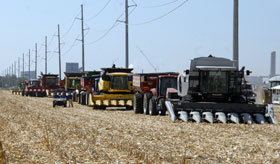
Yep, we’ll be out standing in our field again this week. Just like these folks were at an event earlier this season. Photo courtesy of Syngenta.
Some of the topics we’ll be covering include: “Farming for the 21st Century”, biofuels strategy, corn and soybeans management strategies and breaking the yield barrier with genetics and technology. I’ll see you there.
Hot Day At The Fair
It was a nice hot day in Missouri yesterday and I didn’t do any blogging. I did get some home duties caught up though like weeding and taking care of some plants around the house. I also got an extra bird feeder and a bird bath. They need a place to cool off too. I also did collect some blog content though.
Here’s Cindy and Laura McNamara at the MO State Fair. Cindy and I went to Sedalia to see Alice Cooper and Blue Oyster Cult. Laura is blogging the state fair and you should check out her work at The Fair Fan Blog. She’s becoming a very accomplished professional blogger and we’re really glad to have her writing for AgWired.
I’ve got to mention the Beef House since that’s where we ate before the concert. This place was packed as usual. I went for the full meal deal which is a steak with salad and baked potato.
The Beef House sits right next to the Beef Showcase which is sponsored by the Missouri Beef Industry Council, our first client when we started ZimmComm several years ago now. Fortunately they have air conditioning in these buildings or this guy wouldn’t have looked so comfortable working over a hot grill.
If you’re interested in what Alice Cooper looks like today then use this link to see one of my concert pictures.
Zimfo Bites
- In the second phase of the Royal Heritage Center project – Hall of History – Livestock Publications Heritage Center will be joining with the American Royal to showcase the evolution of livestock publishing through interactive displays in the Royal Museum. The fun and festivities will also celebrate the 2007 Inductees in to the Hall of Honor: Larry Atzenweiler – Hall of Fame Award and Stanley E. Stout – Headliner Award. The funds raised during the “Royal Gala” will be used for the ongoing improvement of the Livestock Publications Heritage Center at the American Royal in Kansas City, MO. Please mark your calendar for the Livestock Publication Council Royal Gala Fundraiser Friday, October, 19, 2007 at the American Royal Headquarters from 6 PM – 10 PM. The event will feature a silent auction, a live auction, entertainment and the 2007 Honoree Ceremony. Fundraiser Tickets are $75.00.
- Wyffels Hybrids, a regional seed corn company covering Illinois, Iowa, Southern Wisconsin and the Ohio River Valley, announces the promotion of Adam Ploog to Region Manager for the Northeast Iowa area. Ploog assumes the Region Manager position following three years serving as a district sales manager in the same region. In this position, he will oversee eight district sales managers and continue to work closely with local growers. “As a company, we are thrilled to be able to promote one of our own who has excelled within Wyffels,” said Brian Humphries, national sales manager for Wyffels Hybrids. “His extensive industry knowledge and proven leadership skills will continue to benefit our customers and the company as a whole.”
- On September 8, actress Emily Deschanel and Farm Sanctuary, the nation’s leading farm animal protection organization, will host a glamorous evening of entertainment and education, bringing together celebrity supporters, key legislators and animal advocates, in honor of farm animals and those leading the movement to protect them from abuse. The event will also raise funds for our coast-to-coast rescue and advocacy efforts to end factory farming abuses and provide safe refuge for farm animals in need. Honorary chairs for this event include Ellen DeGeneres, David Duchovny, and Forest and True Whitaker. Celebrity hosts will present numerous awards to civic, social and political leaders, who have taken a stand for farm animals.
Farm High Speed Internet Access Doubles
The latest Farm Computer Usage and Ownership report from USDA’s NASS was posted today with very little fanfare but I think it is very important to agricultural marketers! Following is the main summary of the report but there’s lots of data in there if you want to study and use it. I’m highlighting some key points in it for you.
High-speed Internet access methods, such as DSL, cable, satellite, and wireless, have become much more available to Internet users in the farm sector since 2005. The proportion of operators using DSL doubled in 2007, at 27 percent, compared with the 2005 level of 13 percent. Cable, satellite, and wireless were each reported as the primary access methods on 7 percent of those U.S. farms with Internet access; with satellite and wireless methods both at virtually double their 2005 levels. Dialup was again the most common method of accessing the Internet, with nearly half (47 percent) of U.S. farms still using it, down from 69 percent in 2005.
A total of 55 percent of U.S. farms now have Internet access, compared with 51 percent in 2005. Sixty-three percent of farms have access to a computer in 2007, compared with the 2005 level of 59 percent. The proportion of U.S. farms owning or leasing a computer in 2007, at 59 percent, is up slightly from 55 percent in 2005. Farms using computers for their farm business increased 3 percentage points from 2005 to 35 percent in 2007.
In 2007, 80 percent of U.S. farms with sales and government payments of $250,000 or more have access to a computer, 78 percent own or lease a computer, 66 percent are using a computer for their farm business, and 75 percent have Internet access. For farms with sales and government payments between $100,000 and $249,999, the figures are: 70 percent have access to a computer, 66 percent own or lease a computer, 51 percent are using a computer for their farm business, and 61 percent have Internet access. For farms with sales and government payments between $10,000 and $99,999, 62 percent reported having computer access, 57 percent own or lease a computer, 36 percent use a computer for their farm business, and 53 percent have Internet access.
For crop farms, 64 percent have computer access and 37 percent use a computer for their farm business in 2007, up 4 and 3 percentage points from 2005, respectively. Internet access for crop farms has increased to 56 percent in 2007, compared to 52 percent in 2005. For livestock farms, 62 percent have computer access and 55 percent have Internet access. The use of a computer for farm business has increased to 33 percent for livestock farms, up 3 points from 2005.