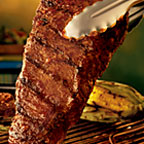
 The Catttleman’s Beef Promotion and Research Board urges consumers to “bring the beef” this Father’s Day. The Board says barbecues have been a Father’s Day tradition since its founding in 1972 when Richard Nixon signed the day into public law. Father’s Day is by nature “a prime time for cookout,” for the Board.
According to the U.S. Census Bureau, more than 74 million Americans participated in a barbecue last year. The census added that it’s “safe to assume” that many of them took place on Father’s Day. In many cases, dad is in charge of his own cookout, which often means burgers and steaks sizzling on the grill.
Although the summer grilling season hasn’t officially arrived, beef sales were up 2 percent in March (compared to 2006), totaling more than $1.4 billion, according to FreshLook Marketing. Following last year’s beef checkoff-funded grilling campaign, total beef dollar and pound sales were up three percent and six percent respectively. Grilling cuts made up 67 percent of beef dollar sales during the 2006 national grilling promotion.
“Father’s Day has been a significant holiday for the beef industry for many years,” said Don Stewart, vice chairman of the Joint Retail Committee. “Checkoff-funded promotional programs such as the Summer Grilling campaign have helped incrementally increase beef sales in the retail channel.”
The checkoff will fund an aggressive 2007 summer grilling campaign, reaching more than 100 million consumers through newspaper inserts and retail partnerships with A.1. ® Steak Sauce and Marinades, Samuel Adams® beer and Sutter Home® wine. A special Father’s Day promotion includes first-time partners, Wisconsin Milk Marketing Board (promoting Wisconsin Cheese) and Edwards® Frozen Pies.
The beef industry has long celebrated the links between Dads, beef and Father’s Day. Fifty-two years ago, the American National CowBelles (now the American National CattleWomen) launched a nationwide Beef for Father’s Day promotion that is still held in many communities across the United States. A signature gift to a new dad was a beef roast, weighing the same as the new baby. One of the group’s early promotional tag lines was, “Keep Pappy Happy with Beef.”

 It’s going to be a country music week here on AgWired starting Wednesday in Nashville. To get us in the mood this week’s ZimmCast ends with some country music.
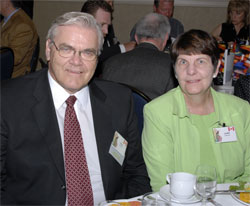 But moving from country to Canada, I finally got to meet AgWired contributing editor, Harry Siemens. We were both at the Alltech Symposium and recorded a short conversation for you. Harry has been doing the new media thing even longer than I have and he’s doing very well. You’ll hear his perspective on the use of the internet by Canadian farmers in our discussion.
 ZimmCast 122 (14 min MP3)
 The
The 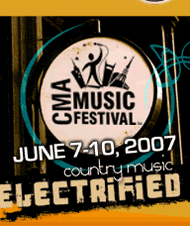 It’s been so nice to be home for more than a day. It’s amazing how much you can get done. I’ve been doing some around the home and computer work this weekend and not posting much. However that will change this week as I get to attend the
  USDA Rural Development spotlights its roll in homebuilding efforts this June, National Homeownership Month. Thomas Dorr is the Agriculture Under Secretary for Rural Development. He says programs sponsored by USDA Rural Development have enabled rural residents to have their own abode to call home.
 Listeners in Indiana who want to catch up on ag news now have two new affiliate radio stations to tune to in Fort Wayne, IN. Both 1250-AM and 102.9-FM are offering
 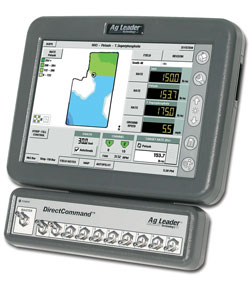 It’s precision farming with point-blank control. Ag Leader Technology Inc. is now offering DirectCommand™ for strip-till applicators. The manufacturer of precision farming equipment says the system meets all strip-till application needs through direct oversight for granular and liquid products.
 Here’s a podcast you might want to add to your iTunes/iPod about food. It’s the
 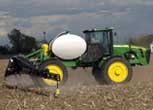 John Deere is calling the new 30 Series Self-Propelled Sprayers its new line-up of intelligent-application equipment. The 4730, 4830 and 4930 Series Self-Propelled Sprayers set new standards for John Deere in sprayer performance, versatility and productivity. The company says its new line of sprayers is also supported by John Deere Commercial Application Dealers (CAD) and the Application Support Dealer (ASD) network.