
 The more information I receive and read from the FAO, the more I’m disillusioned with the whole organization. I think there’s a lot of well-meaning people there but between them and the Organization for Economic Co-operation (OECD) I’m now more inclined to put them in the whacko classification. Take their “OECD-FAO Agricultural Outlook – 2007-2016” report that’s already being quoted and used by the people who want to bash the development of biofuels, most especially ethanol. The report devotes quite a bit of misguided text to the subject of biofuels. Additionally, they’ve issued a background paper from their 20th meeting of the Round Table on Sustainable Development, held at the OECD on September 11-12 titled, “Biofuels – is the cure worse than the disease?” (pdf). It states, “The conclusion must be that the potential of the current technologies of choice — ethanol and biodiesel — to deliver a major contribution to the energy demands of the transport sector without compromising food prices and the environment is very limited.”
I’ve been to FAO headquarters and have followed them over the years. The United States is one of the biggest financial contributors to it but in my experience the organization seems to often go out of its way to criticize our country. I have no desire to visit OECD headquarters. Guess where they’re located. This latest report consists of a serious amount of wild speculation using assumptions. For example, look at this section from the Outlook report:
This Outlook does not analyse the developments in the biofuels sector, but treats biofuel production through implicit and exogenous assumptions in a number of countries. In particular these include the US, the EU, Canada and China, while ethanol production in Brazil is an explicit part of the sugar baseline.
US
The US is assumed to substantially increase its ethanol production, which predominantly is based on domestic maize. Ethanol output and corresponding maize use is assumed to grow by almost 50% in2007, and while growth rates are assumed to decline thereafter, US ethanol production is still assumed to double between 2006 and 2016 (Figure1.2). This expansion would exceed the requirements stated in the Renewable Fuel Standard (RFS) by far. In consequence, maize use for fuel production, which has doubled from2003, would increase from some 55Mt or one-fifth of maize production in 2006 to 110Mt or 32% at the end of the projection period.
Bio-diesel production, in contrast, is assumed to remain relatively limited in the US, due to lower profitability caused by high feedstock costs. Soya oil use for bio-diesel production is expected to reach 2Mt in2007 and to further increase to 2.3Mt in2011, with no growth assumed for the remaining projection years.
You’ve got to love those “exogenous assumptions.” This makes me think back to one of my favorite college teachers, Mr. Frank Counts. He hammered into our heads that to assume is to make an “ass” of “u” and “me.” This whole report is based on assumptions rather than what I would consider credible science but since it’s such a liberal group the whackos with an anti-ethanol agenda are already quoting it like it’s gospel.
Take this twit who writes for ReportonBusiness.com who states, “A small army of scientists and environmentalists has warned for years that ethanol, especially of the corn-based variety so popular in North America, is, at best, misleading advertising, at worst, a crime against nature and taxpayers alike.” Army? More like a group of whackos with an agenda who cater to people like this guy.
 In just a couple days Cindy and I will be winging our way to Japan and the IFAJ Congress 2007. What a week for ZimmComm New Media. Cindy’s in Brussels now as you’ve probably read and I’m back from Canada. Actually I got back last night and went up to Des Moines today to host the first in a video series project we’re working on. More on that in coming weeks. So we’re racking up some agrimiles lately and it’s not going to slow down any time soon.
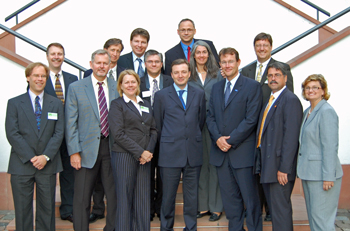 You have to admit, this is a darn good looking group. We do clean up well. Along with myself, the seven other journalists on the trip and our BASF communications manager hosts are pictured BASF Ag Products division president Michael Heinz, with group VP for strategic marketing of ag products Emmanual Butstraen to his left and group VP North America Ag Products Markus Heldt to his left. Top middle is Peter Eckes, Senior VP for Global R&D. I already posted an interview with Michael and will feature interviews with the others here in future posts.
 That title comes straight from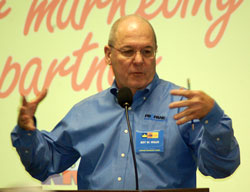
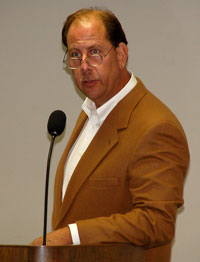
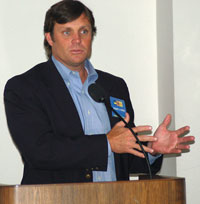 Some of the latest propane technology pairs propane with solar power to offer hybrid electricity generation systems. Stuart Weidie, Chairman of the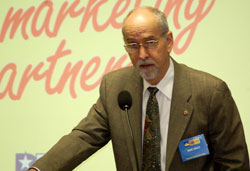
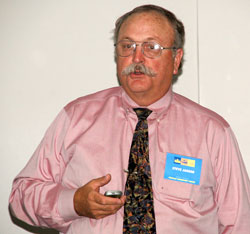 He said the pick-up burned to the ground while there was no escape of gas from the bus. He added that all the children riding the bus exited safely without any instance of injury or death. Dan said industry leaders joke about the safest place to put a propane gas tank in a motor vehicle: “make it the bumper.” He said 12,000 vehicles run on propane fuel in Texas.
 Chuck has already
 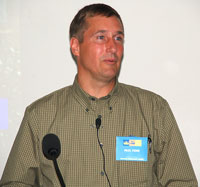 Paul Funk is one of the experts at the 2007 Propane Technology Forum who has taken all the talk about innovative propane research a step further. Paul is a scientist with the USDA-Southwestern Cotton Ginning Research Laboratory. He is among the first to put heat defoliation of cotton with propane into practice. Paul and I discussed what he’s encountered out in the field.