
 All it takes to find out what kind of soils and elements are found in a plot of land is just a bit of electric charge. Veris Technologies has developed a method for determining soil ratios using electricity:
“What we’re looking at here is using AC voltage or very low voltage injecting it into the soil with two electrodes,” Paul Drummond said. “Then, we’re actually measuring the voltage with another pair and the conductivity is actually driven by the sand, silt, clay content of the soil. So the heavy clays are highly conductive, silts are in the mid-range and sands are very poor conductors.”
Paul says the electric-shocking instrument will take readings every second and will read the conductivity of each particular location. This, he says, offers the farmer information on the relative sand, silt or clay differential or texture within the particular area of the field. Paul says farmers can then use this information to “generate a yield potential map and ultimately an input map based on those soil differential zones.”
Paul says soil conductivity is an old technology that dates back to mining exploration in the 1920s, but Veris is the first to use the technology for agricultural applications. Paul adds that the agricultural climate today is ripe for the development and adaption of such precision ag technologies:
“In the last few months we’ve seen inputs just rise dramatically, and if you’re going to stay competitive in this environment you’re really going to have to pinpoint your inputs and really minimize your expense on areas that aren’t very productive,” Paul said. “It’s really the time for precision ag to really become a reality.”
I interviewed Paul about Veris’ electric soil mapping technology. You can listen to my interview with Paul here:
paul-drummond-preag-08.mp3


 and
and 
 I finally got to meet the creator and founder of
  Name a business task. Any business task. Picture it in your mind. Got it?
 Two of the BASF team members on location at the Farm Progress Show are (l-r) Gary Schmitz, Midwest Regional Tech Manager and Nick Fassler, Tech Manager for Plant Health. Headline is still making headlines so I spoke to them together about how the product has been developing in the corn and soybean markets.
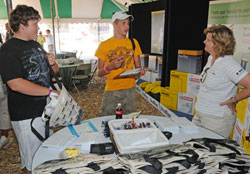 I asked Gary how crops look in his territory. He says it’s been a trying year for midwest growers but that in areas that didn’t get flooded out, “the crops are actually looking pretty good right now.” It’s been a wet season and Gary says that means more disease which is just what a product like Headline is made for. He says that the weather provides growers an opportunity to maximize their yields with Headline.
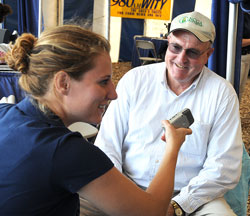 There’s a lot the
  Ag equipment has been running on biodiesel during the Farm Progress Show for a number of years, but this year is the first year machinery will be operating on a B20 blend at the show.
 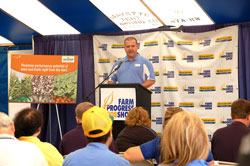 The Monsanto press conference is just over and I recorded it on AgWired Live TV so you can watch it below. Randy Barker, Monsanto’s Global Strategy Lead for Seed Treatments, spoke before a crowd of journalists and farmers about the launch of Monsanto’s new Acceleron brand seed treatment. Monsanto says Acceleron helps maximize potential for crop performance from the very start, at planting. Acceleron products are designed for use with soybean, corn and cotton and boast early season protection from farming hazards, such as diseases and insects.
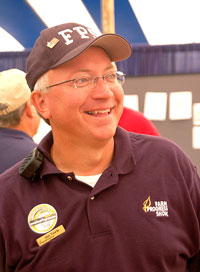 It feels more like fall and not late August this morning at the Farm Progress Show. And, that’s a good thing. Farm Progress is hoping the beautiful, mild weather will draw more participants to this year’s show in Boone, Iowa. Don Tourte, National Sales Director for Farm Progress Companies says participants will have more to see this year. The exhibition site is the largest in Farm Progress history witha five percent growth from last year’s record exhibition area.