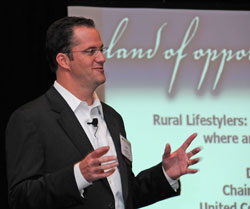
Panel discussions at the World Food Prize Norman Borlaug Symposium in Des Moines are called “conversations” and one on Wednesday focused on the “Promises and Challenges of Next-Generation Science and Technology.”
Among the presenters was Brazil’s former minister of agriculture Roberto Rodrigues, co-chair of the International Biofuels Commission who made a very compelling case that both food and fuel production can co-exist peacefully in other countries as they do in Brazil.
“Absolutely we are going to improve new technologies and we are able to feed humankind and produce biofuels all together,” Roberto said, adding that it is a “myth” that production of sugarcane for ethanol is reducing the production of food in Brazil. “This year we have a record grain production, but we also have record sugarcane production, record meat production and record production of dairy products -so there is no competition between sugarcane and food in Brazil and we can apply that in African, other Latin American and Asian countries.”
Listen to Roberto’s comments here:
wfp-08-roberto.MP3
You can also download the audio with this link: Roberto Rodrigues remarks at World Food Prize (mp3)
Another speaker on the same panel was Pioneer Hi-Bred International president Paul Schickler who talked about all the improvements in seed technology and how it has increased production. He took the first question to the panel, which was “How optimistic are you that the world can reduce hunger by half by 2015?”
Schickler stated that he was very confident that goal could be reached, simply on the basis of increased food production, using hybrid corn as an example. “If you look back throughout the development of hybrid corn, productivity has improved at about one and a half percent per year,” he said. “As we look to the future, we think we can double that, and that has already started to show up in the last 8-10 years through the use of biotechnology, plant genetics and improved agronomic practices.” That would mean corn yields in the United States could hit 210 bushels an acre in ten years, and what that means is increased sustainability because more food can be produced on less acreage.
Listen to Paul’s answer to that question here:
wfp-08-schickler.MP3
You can also download the audio with this link: Paul Schickler at World Food Prize (mp3)


The amount of water that goes into growing the corn that goes into ethanol has been a big topic of conversation between those for and against production of the green fuel. That’s why it is a topic of conversation at the Farm Foundation’s Transition to a Bioeconomy: Environmental and Rural Impacts Conference in St. Louis this week. This gathering of government officials, academics and industry leaders is designed to take on the tough questions facing Rural America as it moves to a bioeconomy.
One of the people in the ethanol/water discussion is Noel Gollehon, a senior economist with the USDA’s Natural Resources Conservation Service. He says the amount of irrigated corn is particularly concerning.
Today has been “Blog Action Day” and the theme this year is poverty. Coincidentally, that is the basic theme here in Des Moines at the
This year’s winners are former U.S. Senators George McGovern and Bob Dole, who are responsible for legislation creating an international school-feeding program which has provided meals to feed more than 22 million children in 41 countries. They are pictured here during a dialogue held at the event with 2003 World Food Prize winner Catherine Bertini, former executive director of the World Food Program.
Meet John Davis in case you haven’t. I meant to let you know earlier that he’s covering the Farm Foundation’s Transition to a Bio Economy: Environmental and Rural Impacts Conference in St. Louis this week while Cindy is in Des Moines at the World Food Prize Symposium and I’m at Sunbelt Ag Expo.
I got an overview of Sunbelt Ag Expo today. By overview I mean from the control tower for this airport which was formerly a military airfield. I climbed up and took a few photos early today.
Even though the word “crisis” is being used liberally here at the
Conway stressed the need to address why we want to produce biofuels and the urgency to move quickly into second and even third generation biofuels – such as cellulosic ethanol from switchgrass and biodiesel from algae. “Maybe we should have a new World Food Prize on this,” Conway said. “In which we transform the world from one dependent on fossil fuels for energy and production of chemicals, into one that depends on plants as a basic source of our economy.”
One of the key speakers during this session was USDA’s Under Secretary for Rural Development Thomas Dorr, who talked about how we need to move forward and be aggressive… even in light of the recent stock market turbulence.
When it comes to farm show food booths, one that’s getting a lot of business at Sunbelt Ag Expo is Roasted Corn.
This is Justin Cremer, director of communications for the World Food Prize, at the door of the press room. Not too many media types here yet – more will be on hand for the bigger events, like the Laureate’s Forum tonight and the actual presentation of the World Food Prize on Thursday.
One person who is here is Susan Carter – the newest member of USDA’s broadcast team. She took over the spot vacated by the legendary Brenda Curtis when she retired early this year. Susan has been on the job since May and while she is smiling in this photo, she has been experiencing some of the usual on the road headaches – flight delays and cancellations, internet problems and computer issues. Bless her heart – and she is still smiling.
The World Food Prize Norman E. Borlaug International Symposium is getting underway here in Des Moines with a couple of side seminars early this morning. The opening ceremony takes place at 1 pm central time.
One of this morning’s seminars was hosted by USDA’s Foreign Agriculture Service, and since we didn’t have a speaker program for that event, I was surprised to walk in the room and see one of this year’s laureates, Hon. George McGovern at the podium. Wish I had known, I would have gotten a recorder on the podium because he had some very interesting remarks about the history of USDA and his role with Bob Dole in expanding and strengthening the school feeding program on a global basis. One of his comments was that he sees the role of USDA growing in the future to help feed a growing population. McGovern will be speaking at a forum this evening with Sen. Dole.