 This is your Happy New Year ZimmCast. In it you’ll hear my thoughts on this year’s growth in online communications, especially in agriculture. Agriblogging and Farm Podcasting have exploded and we’re thankful to not only be a part of the conversation but help others along the way.
Last week was a milestone for me with ZimmCast 200. Over the course of the year I’ve spoken with an outstanding lineup of industry leaders. This year’s programs contain interviews with Craig Huffhines, Glen Klippenstein, Robert Williams, Dave Downing, John Walter, Ushhi Raser, Mimi Ricketts, Shauna Hermel, Dan Smaldone, Bob Callanan, Gene Hemphill, Cory Cart, Greg Webb, Rosemary Schimek, Lindsay Hill, Joel Jaeger, Gretchen Hoffman, Sarah Olson, Ray Gilmer, Michael Peterson, Nathan Fields, Jeremy Lutgen, Scott Fleetwood, Steve Halbrook, Steve Taylor, Mark Hardy, Kenna Rathai, Randy Griggs, Wesley Powell, Rob Cook, Tom Dorr, Erin Holt, Mark Jewell, Darwin Melnyk, Daryn McBeth, Chuck Gamble, Gary Schultz, Greg Ehm, Stephanie Gamble, P. Allen Smith, Dennis Docherty, Ev Griner, Rebecca Brightwell, Mark Kornblau, Dan Duffy, Eric Hodson, Amber Shirley, Craig Lindholm, Adrian Blake, Andrew Moore and Ron Lang. How’s that for an interview list? And that’s just for this weekly program. I don’t have the time to list all the people who have been interviewed here on AgWired during the year.
 The growth in agriblogging and farm podcasting has had a very positive impact on us. Just within the ZimmComm world we’re managing 24 blogs, 5 of them our own. We’re managing content on a regular basis on 6 of our client’s sites. We’ve also designed and built 6 new blog sites this year. We’re also producing and managing 8 podcasts, 4 of which are our own. Of course if you define podcast as an audio file you can click on to listen to and/or download to your computer then there are hundreds just on AgWired not counting all the other blogs and postings we’ve done this year. We once again spent well over 200 days on the road bringing you news and information about what’s new in world of agribusiness and pre-bookings for 2009 are strong. I’m sure Cindy or I will see you somewhere soon. Until then we wish you a very happy new year.
The program this week ends with music from the Podsafe Music Network. This one is called “Blog Like Its The End Of The World” from Tom Smith. I hope you enjoy it and thank you for listening.
You can download and listen to the ZimmCast here:  ZimmCast 201 (18 min MP3)
Or listen to this week’s ZimmCast right now:No Interview - ZimmCast 201
The ZimmCast is the official weekly podcast of AgWired which you can subscribe to using the link in our sidebar. You can also subscribe in iTunes


 We’re coming off the slowest two weeks in ag news of the year (do you agree?). I’ve just got a feeling that things will pick up a lot starting next week. In the meantime you might want to spend a few minutes finding out who’s talking about you or your products online. You know I strongly advocate “joining the conversation.” Check out
 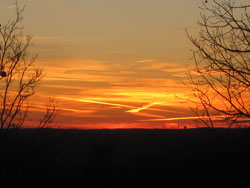 I don’t think we’re going to have as pretty a sunset tonight as last night. This was the view just before Cindy and I went to enjoy a New Year’s Eve dinner.
 Now, I’m an avid reader of blogs, and one of my favorites is