
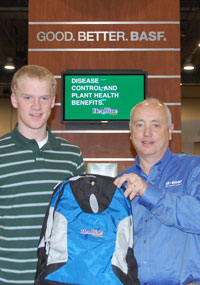
 Cindy took this picture of Hugh Whaley, (l) Broadhead+Co and Barry Nelson, John Deere, during the Commodity Classic trade show. That gives you an updated look at Hugh since I used an old one in the story about his moving to Broadhead+Co.
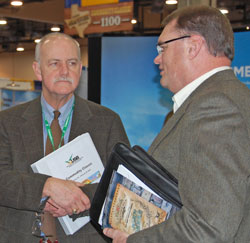 As things slowed down today I got to sit down and visit with Hugh about his new position. It made for a good Commodity Classic week ZimmCast. Hugh is a very good friend and I’m glad for this opportunity he has. He’s be working on obtaining, managing and working with farmer driven organizations, not for profit groups, agricultural associations as well as governmental organizations. This fits right in with the kind of work that he’s been doing which includes working with the United Soybean Board and other checkoff groups.
Hugh says he’s going to continue his involvement in organizations like NAMA, NAFB and others so we’ll be seeing him around still. One of his first duties will be working on an existing Broadhead+Co account, the California Almond Board.
You can download and listen to the ZimmCast here:  ZimmCast 209 (9 min MP3)
Or listen to this week’s ZimmCast right now:Interview with Hugh Whaley - ZimmCast 209
The ZimmCast is the official weekly podcast of AgWired which you can subscribe to using the link in our sidebar. You can also subscribe in iTunes
2009 Commodity Classic Photo Album
AgWired coverage of the 2009 Commodity Classic
is sponsored by:  and
and 
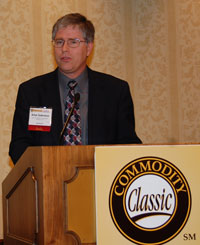 BASF hosted a panel at the conference to examine how today’s technology can help manage disease in wheat and cereals to meet the growing global demand for grain. The panel featured analyst Arlan Suderman of
  After Suderman’s comments, BASF technical experts on plant disease, Drs. Gary Fellows and Gary Schmitz, talked about how BASF products can help increase global production of wheat and other cereal grains by controlling the most aggressive diseases that affect those crops.
 Trish Lynn (r) and the
 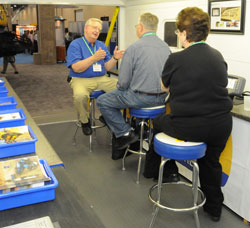 You could go to school and learn about precision land management in the New Holland booth at this year’s Commodity Classic. Mike Harvey was teaching when I stopped by. He says the mobile teaching trailer provides a place for growers to see their monitors and even operate a simulator.
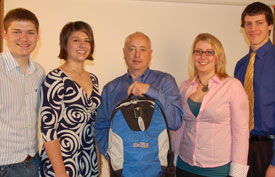 BASF, the American Soybean Association (ASA) and the National Corn Growers Association (NCGA) announced this year’s scholarship winners for both organizations at the 2009 Commodity Classic. The scholarships are awarded to tomorrow’s agricultural leaders pursuing a degree in an industry-related field.
  Adam also presented the 2009-2010 Secure Optimal Yield (SOY) Scholarship, managed by the ASA and sponsored by BASF, to Brent Larson, a high-school senior from Canby, Minnesota, who plans to major in agronomy and minor in agricultural economics and agricultural marketing at South Dakota State University.
 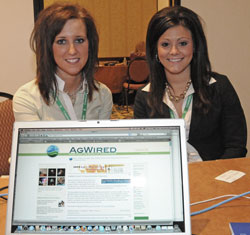 This afternoon I finally got to meet the
  Growing up on a cattle ranch was tough at times, but looking back now, I realize that it gave me a sense of responsibility and a hard work ethic that transfers into the other things I do in life. More importantly, living on a farm gave me a passion for this industry that would be hard to walk away from. I don’t think there is a better place to be than agriculture, and I’m excited to start my career working for America’s food producers.
 I will be graduating from South Dakota State University in May, and hopefully, I will be ranching with my parents and working as a freelance writer once I hit the “real world.” When I’m not outside helping with cattle chores, I hope to get a lot of writing and photography work done. As I embark on my career as an agricultural journalist, I have decided I need to invest in a few pieces of equipment. On my wish list (based solely on need, of course…) is a new laptop computer, an audio recorder, a wide angle lens for my Canon and video editing software.
  Here’s an example of how the stimulus is stimulating. I’m betting there will be other groups formed to help spend that money. I’m not saying this is a bad thing necessarily. Someone sure needs to provide advice to the government officials who are going to be making spending decisions.
 As the world population explodes, producing food, feed, fuel, and fiber in a sustainable manner throughout the world will be paramount to success. “We’re adding three China’s in our children’s lifetime,” said Marty Matlock, Director of the Center for Agriculture and Rural Sustainability at the University of Arkansas. “Today, the U.S. is top of its game globally.”
 “This tool will hope us demonstrate how the U.S. measures up when talking about sustainability,” said Doug Goehring, who grows corn, soybeans and wheat in North Dakota. “This tool helps a grower re-affirm how sustainable he is. The feedback is vitally important.”