
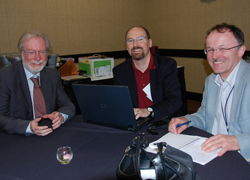
 Last week’s World Agricultural Forum World Ag Congress attracted a great crop of journalists, both locally and internationally. Pictured here interviewing keynote speaker Paul Collier (left) are two leaders of the International Federation of Agricultural Journalists (IFAJ) – current president Mike Wilson with Farm Futures magazine and senior vice president Markus Rediger of Switzerland’s LID Agricultural Information Center.
Read Mike’s feature on Paul Collier here.
Collier is a professor of economics at Oxford University and author of a book on global poverty, “The Bottom Billion”. He contends that there are three major policy changes that can be made by nations that would alleviate hunger in the poorest countries. One is biofuels subsidies. “I’m not against biofuels, I’m against subsidies for biofuels,” Paul says.
Not sure I agree with him on that one, but I do agree with his second premise that the ban on genetically modified crops in Europe and Africa should be lifted. “Europe shot itself in the foot and in the process it shot Africa in the heart because Africa really needs to adapt to climatic deterioration and a rising population and genetic modification of crops is potentially a godsend,” said Collier.
The third policy mistake Collier notes is the over emphasis in Africa on “peasant farming” and the resistance to commercial agriculture. “This has tended to be imposed on African by the agenda of some NGOs and development agencies who have a romantic attachment to the vanished peasant lifestyle,” something he says is very self-serving, “trying to impose our fantasies on the poorest people on Earth.”
You can listen to my interview with Paul Collier here: waf-09-bottom-billion.mp3
Flickr Photo Album for World Ag Forum
AgWired coverage of the 2009 World Agricultural Forum World Congress is sponsored by:
 .
.
 I missed the Association for Downloadable Media’s webcast titled, “The Podcast Consumer Revealed.” The session was conducted by Tom Webster, Edison Research. The audience for podcasting just keeps growing. The main reasons people watch or listen to podcasts is so they can do so whenever and wherever they want. Here are some key points from the session.
 A few months ago, I signed up for a half-marathon with my sister, Courtney. To boost our motivation, we joined
  This was my first half marathon, and I was proud to hear my name called as I crossed the finish line, announcing that I was running in support of beef. My jersey proudly said, “Beef, it’s what’s for dinner,” and it earned me quite a few comments and cheers throughout the race. Although my muscles were sore from the intensity of the race, my heart was proud of myself for finishing the race within my goal time.
  It looks like
  Woodruff Sweitzer will partner with BIVI to develop strategic plans, advertising, sales materials and collateral for major swine vaccines (Ingelvac CircoFLEX®, Ingelvac MycoFLEX®, Ingelvac® PRRS and Enterisol® Ileitis). Beginning in July 2009, True Media will manage the media planning and buying, which is focused primarily on Web and professional trade publications.
 The
The 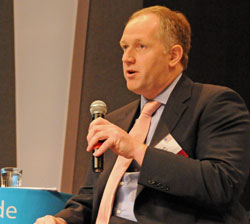 Our first panelist to tackle this question was Lutz Goedde, Deputy Director, Agricultural Development, Bill and Melinda Gates Foundation. He says the Foundation he works for looks at sustainability “through a very different lens compared to many other organizations.” He then proceeded to say that there are a billion people in the world who live on under a dollar a day and described what that is like. He says that agriculture is the primary means for most of them to get food and earn a living. He says they follow the Bill and Melinda sustainability philosophy that “every person on the planet has the right to live a healthy and productive life.” Next he says that there are normally three dimensions to sustainability which are economic, social and environmental.
 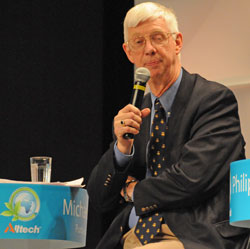 Next up was Dr. Michael Boehlje, Professor, Dept. of Agricultural Economics and the Center for Food and Agricultural Business, Purdue University. He said we could look at sustainability from a traditional farm management standpoint of carrying capacity that recognizes current and future capacity on a global basis and deals with absorbing waste in terms of the economic or production activity you’re involved in. He says that although government is involved in this issue, it will be consumers who “will be the ultimate in terms of whether in fact sustainability practices are adopted and those who adopt them are compensated for them.”
 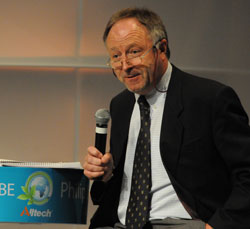 Finally we heard an answer to this question from Philip Wilkinson, Order of the British Empire, Executive Director, 2 Sisters Food Group. He said that the definition he would use is the one used by the United Nations but since that has already been brought up by earlier speakers he composed a slightly different one. He says, “A sustainable agricultural system is one which maximizes production by increases in yield while minimizing environmental impact and does not compromise animal welfare.” He says farmers are the logical custodians of the land who can accomplish this. He also quoted a former United Kingdom Minister who summed it us as, “Don’t cheat your children.”
 Calling all communications professionals. What is one of the most difficult challenges we face? Developing campaigns that will garnering consumer support and product adoption. An example of just how difficult this can be is the corn-ethanol industry. Consumer support has been dwindling for months and this has in part, been driving by media hostility and biased reporting.