
At the World Food Prize Forum in Des Moines on Thursday, Microsoft founder and philanthropist Bill Gates spoke out in support of biotechnology to help feed the world.
“We have to develop crops, including new inputs to go with them that can grow in a drought,” Gates said. “We have to have crops that can survive a flood, that can resist pests and new diseases. We need higher yields on the same land, despite more difficult weather. And we will never get there without a continuous and urgent, science-based search to increase productivity, especially focused on the needs of small farms in the developing world.”
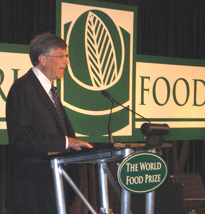 Gates took environmentalists to task for having an idealistic attitude that jeopardizes the ability of developing countries to grow enough food. “They have tried to restrict the spread of biotechnology into sub-Saharan Africa without regard to how much hunger and poverty might be reduced by it.”
While Gates said that major breakthroughs in the fight against hunger and poverty are now within reach, he cautioned that progress toward alleviating global hunger is “endangered by an ideological wedge that threatens to split the movement in two.” On one side, he said, there are groups that support technological solutions to increase agricultural productivity without proper regard to environmental and sustainability concerns. On the other, there are those who react negatively to any emphasis on productivity.
“It’s a false choice, and it’s dangerous for the field,” Gates said. “It blocks important advances. It breeds hostility among people who need to work together. And it makes it hard to launch a comprehensive program to help poor farmers. The fact is, we need both productivity and sustainability—and there is no reason we can’t have both.”
Let’s put this in the Blog Action Day Climate Change category under the topic of Food Production. We can have both – productivity and long term sustainability. In fact, we already do have both here in the United States. The majority of our nation’s farms are models of both productivity and sustainability for the world. We are using less land, less fertilizer, and less energy to produce more food than ever before. If developing nations are able to utilize biotech crops, we can and will be able to feed the billion people across the globe who are suffering from malnutrition, as well as the increasing global population. I’m not a big fan of Bill Gates, but I have to applaud him today for standing up to radical environmentalists who want us to move backward instead of forward.
 It’s
It’s  How do you become new media experts? Participate in conferences like BlogWorld and New Media Expo. That’s why I’m here with Carly and Robert our webmaster. In fact, Robert is in this photo somewhere. The Mac in the front row on the left is mine.
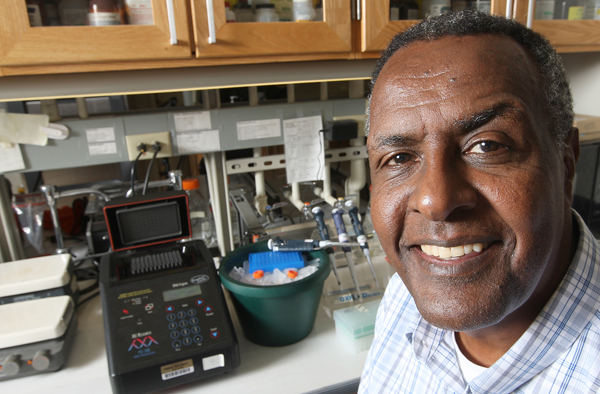 Gebisa Ejeta, Purdue University Distinguished Professor of Agronomy plant breeder and geneticist, will receive the
  How do you feed, clothe and fuel a world population that is expected to climb to 9 billion people by 2040? That is the challenge the folks at the Farm Foundation set out about a year ago to address six major drivers impacting agriculture’s ability to provide food, feed, fiber and fuel to a growing world. Those six areas are: global financial markets and recession; global food security; global energy security; climate change; competition for natural resources and global economic development.
  Farmers from around the globe gathered in Des Moines this week to participate in the 2009 Global Farmer-to-Farmer Roundtable, which is held in conjunction with the World Food Prize and hosted by
  This year’s honoree is Jim McCarthy, a farm manager from Ireland whose agricultural interests span three continents – Europe, South America and North America. He says it is frustrating that he is unable to use biotechnology-based crops in his farming operation in Ireland, but can in other areas. “The environmental benefit of GM (genetically modified) crops is staggering,” he said, as he made comparisons between the farm operations he’s involved with in Ireland and Argentina. He says wildlife numbers are much higher in the South America farm operation because fewer pesticides are used because of Bt traits in the crops. “We’re not using huge amounts of organophosphates, so the food chain is not being interrupted for the wildlife,” he said.
  The
The  Helping livestock and poultry producers develop and implement plans to limit their environmental impact is the goal of a program called