The VP of Statistics, Technical and Safety Services for the Association of Equipment Manufacturers (AEM) is Darrin Drollinger. He addressed the Agricultural Equipment Technology Conference (AETC) which is conducted by the American Society of Agriculture and Biological Engineers (ASABE) being held in conjunction with AG CONNECT Expo. In his comments he talks about AEM and their new show.
I think we had a great crowd for the opening ceremony of the first ever AG CONNECT Expo. The Chapin Theater here at the Convention Center is a beautiful facility.
Our emcee for the program was Doug DeVries, John Deere. He welcomed everyone and introduced two of his competitors, Martin Richenhagen, AGCO and Jim Walker, Case IH who also made welcoming remarks. I recorded their remarks which you can listen to and download below:
AG CONNECT Expo is officially underway. The opening ceremonies featured the winners of the Agvocating for Agriculture awards seen on stage with the committee members who put the show together.
To lead the crowd out to the opening reception, Gary MacDonald, MacDon Industries, played the bagpipes. Enjoy him on YouTube:
Thank you to everyone who watched the live stream of the opening ceremonies from the first ever AG CONNECT Expo. My iPhone streamed live for about an hour and a half. Feel free to post any comments/feedback if you watched.
I had to use the convention center wireless and let’s just say it was not fast. That’s a key to a good live stream.
Photos have been updated from the opening ceremonies.
Chad Yagow, John Deere, (r) already has his picture on AgWired but he gets another one. At the AETC luncheon today he was presented with the AETC MVP award. Yes, that’s a baseball bat. I guess that’s so he can keep conference attendees in line.
More photos have been uploaded to the photo album so please keep checking it as the show gets underway officially this afternoon.
Despite weather challenges in 2009, American farmers produced record corn and soybean crops.
According to USDA’s crop report out this morning, U.S. corn for grain production is estimated at a record 13.2 billion bushels, up 2 percent from the November 1 forecast, and 1 percent above the previous record of 13.0 billion bushels set in 2007. U.S. grain yield is also estimated at a record level for 2009, at 165.2 bushels per acre. This is up 2.3 bushels from the November forecast and 4.9 bushels above the previous record of 160.3 bushels per acre set in 2004.
Soybean production in 2009 totaled 3.36 billion bushels, up 1 percent from the November 1 forecast and up 13 percent from 2008. U.S. production is the largest on record. The average yield per acre is estimated at a record high 44.0 bushels, 0.7 bushel above the November 1 forecast and 4.3 bushels above last year’s yield. Harvested area is up 2 percent from 2008 to a record 76.4 million acres.
A dairy farmer who is a YouTube hit with his original “Water ‘n Poo” song is the new chairman of the American Farm Bureau Federation Young Farmers and Ranchers Committee.
Will Gilmer of Alabama was elected as by the committee as chairperson for 2010 and will take over those duties in February to serve for one year.
Gilmer owns and operates Gilmer Dairy Farm, which includes a herd of 450 Holstein cows, heifers and calves, as well as more than 500 acres of pasture and forage crop production.
In addition to his daily farming duties, Gilmer maintains a Web site, www.gilmerdairy.com, along with The Dairyman’s Blog, in an effort to reach out to the public about modern farming practices. Gilmer also is active on the micro-blogging Web site Twitter under @gilmerdairy.
Farm broadcaster Meghan Grebner with WIRL in Peoria interviewed Will for her noon show yesterday and you can listen to that interview below the video.
And if you have never heard or seen Will’s funny YouTube hit about nutrient management – viewed over 9,000 times – here it is. Heck, even if you have seen it – worth watching again so you can be singing “Water ‘n Poo” all day long!
I spoke to Chad about the conference while a range of educational sessions are taking place this morning. I’ll be attending their luncheon later. Chad says the AETC brings together people in the ASABE membership involved with the power machinery industry. They have lots of professional development classes that range from hydraulic systems to moving biomass logistics. He says that ASABE and AEM have always worked together through their standards programs and that’s why they viewed the opportunity to locate their conference here as a way to grow closer organizationally. They plan to co-locate with AG CONNECT next year in Atlanta too.
The longest serving agriculture commissioner in the nation was honored by the American Farm Bureau Federation (AFBF) at the annual meeting in Seattle on Monday.
AFBF president Bob Stallman presented the Distinguished Service to Agriculture Award to Tommy Irvin who has served as Georgia’s commissioner of agriculture since 1969. Irvin has 51 years in public service. He served in the Georgia House of Representatives for 10 years as a member of the Agriculture, Education and Appropriations Committees and has served as Georgia’s commissioner of agriculture for 41 years, the longest consecutive years of service by any State agriculture commissioner in the United States.

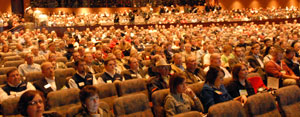 I think we had a great crowd for the opening ceremony of the first ever AG CONNECT Expo. The Chapin Theater here at the Convention Center is a beautiful facility.
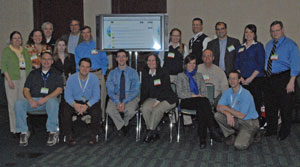 We had a great tweetup here at AG CONNECT Expo tonight. Thanks to AGCO for sponsoring it.
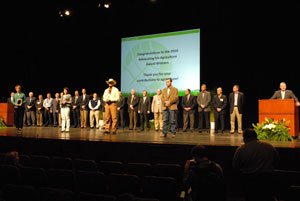 AG CONNECT Expo is officially underway. The opening ceremonies featured the winners of the Agvocating for Agriculture awards seen on stage with the committee members who put the show together.
 Thank you to everyone who watched the live stream of the opening ceremonies from the first ever AG CONNECT Expo. My iPhone streamed live for about an hour and a half. Feel free to post any comments/feedback if you watched.
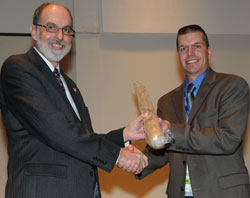 Chad Yagow, John Deere, (r) already has his picture on AgWired but he gets another one. At the AETC luncheon today he was presented with the AETC MVP award. Yes, that’s a baseball bat. I guess that’s so he can keep conference attendees in line.
 According to U
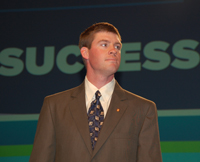 Will Gilmer of Alabama was elected as by the committee as chairperson for 2010 and will take over those duties in February to serve for one year.
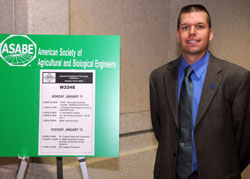 One of the events taking place in conjunction with
 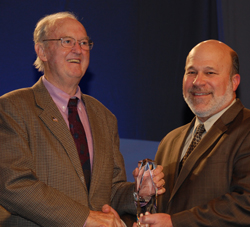 AFBF president Bob Stallman presented the Distinguished Service to Agriculture Award to Tommy Irvin who has served as Georgia’s commissioner of agriculture since 1969. Irvin has 51 years in public service. He served in the Georgia House of Representatives for 10 years as a member of the Agriculture, Education and Appropriations Committees and has served as Georgia’s commissioner of agriculture for 41 years, the longest consecutive years of service by any State agriculture commissioner in the United States.