
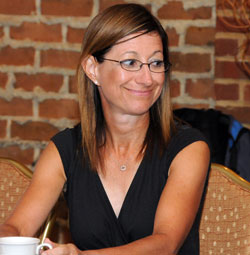
 Representing The Fertilizer Institute on the Conservation in Action Tour was Kathy Mathers, V.P. of Public Affairs. I spoke to Kathy during the Conservation Technology Information Center board meeting that followed the tour to
Nutrient stewardship is on the top of the list for TFI according to Kathy. She says they’re promoting the 4R Nutrient Stewardship System which means using the right fertilizer product at the right rate, right time and in the right place. She says they get involved with CTIC to interact with other stake holders in agriculture. She thought the tour was a “home run.” Kathy Mathers Interview
Conservation In Action Tour 2010 Photo Album
AgWired coverage of the Conservation In Action Tour is made
possible by  and the
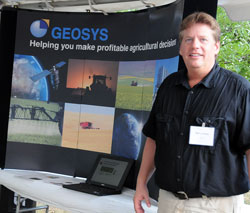 Precision ag was highlighted at the Nutrient Use Efficiency Expo during the Conservation in Action Tour by a company called Geosys represented by Don Lampker. Don says Geosys is a relatively small technology supply company. He says they do a lot with satellite imagery and have a product called
 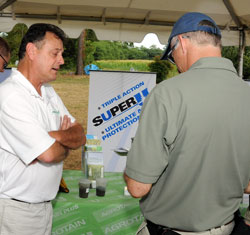 During the Nutrient Use Efficiency Expo on the Conservation in Action Tour our sponsor,
 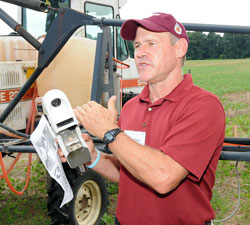 Paul Davis farms in New Kent County, VA and drives a truck with a bumper sticker that says, “Never-Till.” His farm was a stop on the Conservation in Action Tour. He’s been in continuous no-till since 1999.
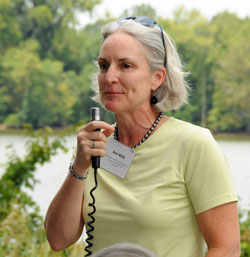 The Deputy Undersecretary for Natural Resources and Environment, USDA, is Ann Mills. Ann oversees the Natural Resources Conservation Service. During lunch on the Conservation in Action Tour she spoke to us about several initiatives under her oversight. She talked about her goals of getting 100 percent participation from Chesapeake Bay area land owners to help with the watershed cleanup efforts. She acknowledged farmers work on this and told people during the tour how much she was learning about the practices they employ. I think this shows how important it is to invite government officials out to the farm. If they’re going to regulate you it would be nice if they actually knew what you do!
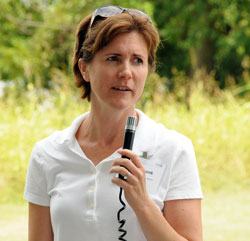 The Conservation in Action Tour provides an opportunity for farmers to see how other farmers are implementing good conservation practices but it also allows policy makers a chance to learn more about this area. One of our tour participants who spoke to us at our lunch stop was Kelly Shenk, EPA. She works in the Chesapeake Bay Program office.
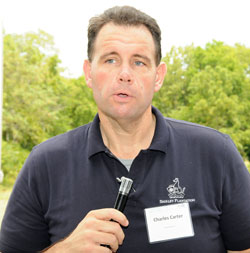 The first plantation in Virginia was Shirley Plantation, established in 1613. This was the lunch stop for the Conservation in Action Tour. Tourism and education play a big part in the family business today.
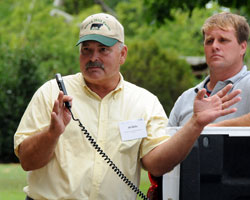 While the Conservation in Action Tour was parked under the trees in the shade at one stop, we heard from local farmer, J.N. Mills. Pictured behind him is Eric Randolph, another local farmer we also heard from.