His Royal Highness, Prince of Sustainability

Cindy Zimmerman

In addition to meeting with President Obama, His Royal Highness The Prince of Wales gave the keynote address at “The Future of Food” conference at Georgetown University, sponsored by the Washington Post.
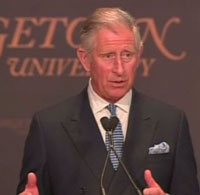
Since the prince has “tried to farm as sustainably as possible for some twenty-six years” he was about the closest to an actual farmer that the conference had on the agenda (see Chuck’s previous post). On the Royal Website, there is a page about the Prince’s farm which is “a completely organic system” he developed “to demonstrate the environmental and commercial benefits.” Among the farm’s produce is organic mutton. “The Prince is enthusiastic about restoring mutton (meat from a two-year-old sheep), to the dinner tables of the nation after speaking to struggling sheep farmers who found they could no longer get a decent price for older ewes. To this end, The Prince launched the Mutton Renaissance campaign.” I am not making that up.

So, HRH believes that we can feed nine billion people on this planet with a food system that is “not dependent upon the use of chemical pesticides, fungicides and insecticides; nor, for that matter, upon artificial fertilizers and growth-promoters or G.M.” and he provided His Royal Vision of a “sustainable food production” system during his address in Georgetown.

“For me, it has to be a form of agriculture that does not exceed the carrying capacity of its local ecosystem and which recognizes that the soil is the planet’s most vital renewable resource,” he said, adding that “genuinely sustainable farming maintains the resilience of the entire ecosystem by encouraging a rich level of biodiversity in the soil, in its water supply and in the wildlife – the birds, insects and bees that maintain the health of the whole system. Sustainable farming also recognizes the importance to the soil of planting trees; of protecting and enhancing water-catchment systems; of mitigating, rather than adding to, climate change. To do this it must be a mixed approach. One where animal waste is recycled and organic waste is composted to build the soil’s fertility. One where antibiotics are only used on animals to treat illnesses, not deployed in prophylactic doses to prevent them; and where those animals are fed on grass-based regimes as Nature intended.”
Read the whole speech here.

Environment, Sustainability, Wackos

Full Day At Animal Agriculture Alliance Stakeholders Summit

Chuck Zimmerman

Animal Agriculture Alliance Stakeholders SummitDay one of the Animal Agriculture Alliance Stakeholders Summit is coming to an end. We’ve got a reception with silent auction to support the organization’s intern program and I’m sure I’ll collect a couple more interviews. We’ll begin again in the morning so you can count on more from here then.

In the meantime check out photos from today’s sessions: Animal Ag Alliance Stakeholders Summit Photo Album

Ag Groups, Animal Agriculture

Cattle Farmer And Social Media Expert

Chuck Zimmerman

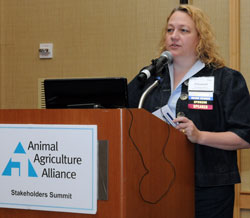
Debbie Lyons-BlytheCattle rancher Debbie Lyons-Blythe talked social media at the Animal Agriculture Alliance Stakeholders Summit. We follow each other on Twitter. Find her @DebbieLB. She was here to encourage people not to be afraid of social media and make some suggestions on how to use it to advocate for agriculture. She starting blogging and considers her blog, Life On a Kansas Cattle Ranch, the center of her social media universe with Facebook and Twitter being some of the planets revolving around that center. She does think there is fear out in the country to use these mechanisms but believes more and more farmers are starting to use social media.
You can listen to my interview with Debbie here: Debbie Lyons-Blythe Interview

Animal Ag Alliance Stakeholders Summit Photo Album

Ag Groups, Animal Agriculture, Audio, Social Networking

College Aggies Online Awards Announced

Chuck Zimmerman

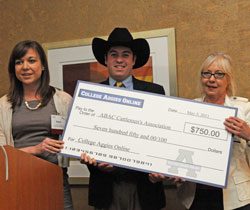
Jacob NyhuisThe winner of the College Aggies Online scholarship competition is Abraham Baldwin Agricultural College, represented at the Animal Agriculture Alliance Stakeholders Summit by Jacob Nyhuis. In the photo Jacob is accepting the school’s $750 award. The award also included his costs to travel to the Summit. I interviewed him after the presentation and you can hear him talk about participating in the program below.

College Aggies Online is a joint program between the Animal Agriculture Alliance and the American National CattleWomen, Inc. The goal is to help college students utilize social media tools to share agriculture’s story. The program was started last fall and has attracted 600 college students from more than 50 universities

Members have earned points by posting blogs, photos and videos related to agriculture and by participating in Aggie Homework agriculture advocacy challenges via Twitter, Facebook, and e-mail.

With 765 total points, the individual high score went to Jessie McClellan of the Casper College Ag Club in Wyoming. She will receive a $250 scholarship. Jacob Nyguis of Abraham Baldwin Agricultural College in Georgia came in second place with 655 points and will be awarded $100.

Members of Abraham Baldwin Agricultural College’s Cattlemen’s Club formed the top-scoring club with 3,030 points. The group will receive a $750 scholarship and a trip to Washington, D.C. for one representative to attend the Alliance’s Stakeholders Summit in April. Casper College’s Ag Club came in second place with 2,525 points and will receive $300. Other high-scoring schools included Pennsylvania State University, Western Kentucky University, and the University of Missouri.

You can listen to my interview with Jacob here: Jacob Nyhuis Interview

Animal Ag Alliance Stakeholders Summit Photo Album

Ag Groups, Animal Agriculture, Audio, Social Networking

Nebraskans Believe Farmers Take Care of Animals

Chuck Zimmerman

Sen. Tom CarlsonProtecting and growing agriculture amidst the activist conflict was the topic of the first panel discussion at the Animal Agriculture Alliance Stakeholders Summit. Nebraska Senator Tom Carlson was a panelist and he made it very clear that animal rights activists are not welcome in his state. He says that when these groups come into a state, they don’t know the state and they try to paint all of agriculture with a broad brush. The fact is that farmers love their animals and take very good care of them. He uses an anecdote of how during a winter blizzard farmers were out in the severe weather taking care of their livestock and HSUS was no where to be seen. He also pointed to research that found that ninety percent of people in Nebraska believe the livestock industry is important and ninety four percent trust farmers to take humane care of their animals!
The Senator believes the mission of the Church is number one and the mission to raise food to feed people follows and is a noble mission. He says activists just want to stop killing animals for food. They really aren’t in favor of the humane treatment of animals for food. He says this conference helps bring out how important it is for different agricultural interests to come together in the face of a common threat.

You can listen to my interview with Sen. Carlson here: Sen. Tom Carlson Interview

Animal Ag Alliance Stakeholders Summit Photo Album

Animal Activists, Animal Agriculture, Animal Health, Audio

Government Regulations Top Of Farmers Minds

Chuck Zimmerman

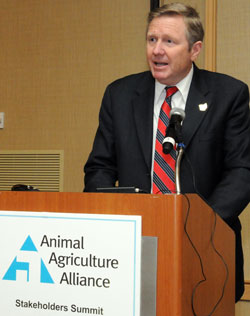
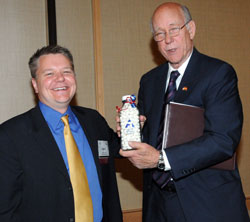
Sen. Pat RobertsKansas Senator Pat Roberts, ranking member, Senate Agriculture Committee, addressed the Animal Agriculture Alliance Stakeholders Summit. He spoke to a number of issues that included the farm bill and burdensome and troubling government regulations. Sen. Roberts is seen here receiving some cowboy cookie mix from our moderator, Jason Shoultz, America’s Heartland.

I’ll add some audio from his remarks later since I’ve got that recorder in use. However, I did get to ask him one question in the hall on his way out. I asked about anything animal agriculture interests should know when it comes to farm bill discussions and how things were going with efforts to curb unnecessary regulations from the EPA. He says that talking to farmers and ranchers around the country right now they don’t even bring the farm bill up. They’re most interested in regulations which he says they’re dealing with bill by bill. He thinks it’s premature to discuss the farm bill until hearings are held around the country and they determine a “number.”

You can listen to comments from Sen. Roberts here: Sen. Pat Roberts Interview

Listen to Sen. Roberts full comments here: Sen. Pat Roberts Full Remarks

Animal Ag Alliance Stakeholders Summit Photo Album

Ag Groups, Animal Agriculture, Audio

Martin|Williams Adds Kinze Manufacturing to Client Roster

Melissa Sandfort

Iowa-based Kinze Manufacturing, a leading agricultural equipment manufacturer, has selected Martin Williams, Inc. to create a new integrated branding and selling effort encompassing brand strategy, engagement strategy, social media, event marketing, advertising and public relations.

The win adds to Martin Williams’ roster of business and global corporate clients, which includes Cargill, Syngenta, Pfizer and Raymond James. Kinze is one of the largest,
privately-held, agri-business companies in the United States, specializing in high-tech equipment for planting and hauling grain.

Agencies

Speaking Up For Animal Agriculture

Chuck Zimmerman

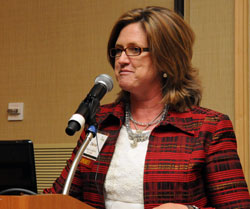
Dr. Elizabeth ParkerThe past Chair of the Animal Agriculture Alliance is Dr. Elizabeth Parker, Chief Veterinarian, National Cattlemen’s Beef Association. Dr. Parker welcomed us all to the Stakeholders Summit of the Animal Agriculture Alliance and I caught up with her on our morning break.
Dr. Parker says that when she took over as Chair for the Animal Agriculture Alliance her goal was to help further develop the groundswell efforts of both individual farmers and farm organizations to tell their story and not let others do it for them. She says it’s a big challenge to become more of a “voice.” But she’s seeing more and more of what I call agvocating going on at the state level now. She points to the NCBA Masters of Beef Advocacy program as an example. She uses a great family example of how social media has an impact on what people know, or think they know, about where their food comes from. Social media is on the program here by the way.

You can listen to my interview with Dr. Parker here: Dr. Elizabeth Parker Interview

Animal Ag Alliance Stakeholders Summit Photo Album

Ag Groups, Animal Agriculture, Audio, Beef, NCBA

The Sickle Mower

Melissa Sandfort

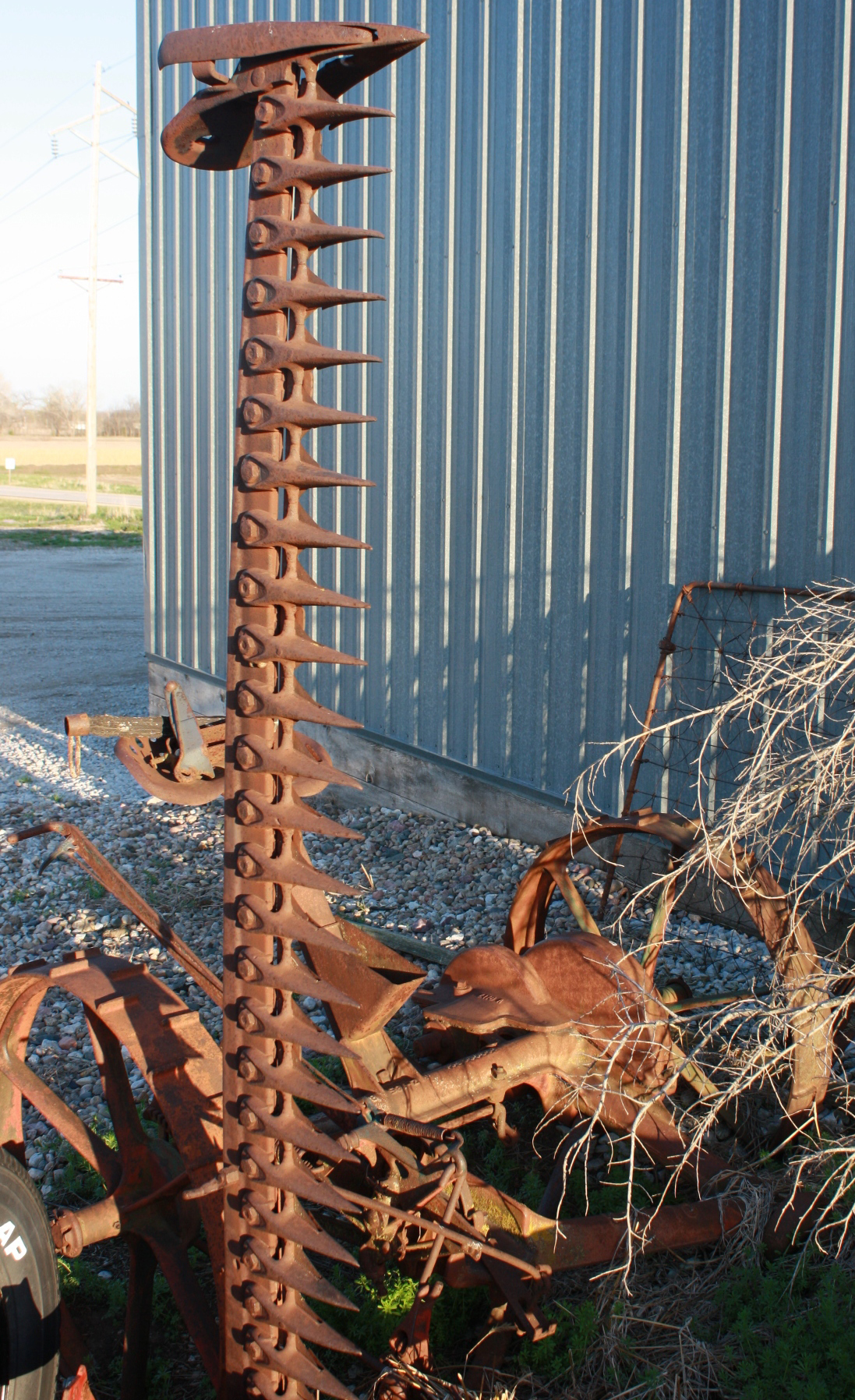
Careful where you go burning grass or haphazardly cutting weeds because you never know what might be hiding amongst the rubbish. Along with the spike tooth disk, I found this sickle mower for mowing hay, grass or weeds. (Looks like it needed to be used right where it was sitting!) The operator sat on the seat to drive the horses that pulled the mower.

A short history on this mower:
Sickle mowers have a long bar on which is mounted fingers with stationary guardplates. In a channel on the bar there is a reciprocating sickle with very sharp sickle sections (triangular blades). The sickle bar is driven back and forth along the channel. The grass is cut between the sharp edges of the sickle sections and the finger-plates (this action can be likened to an electric hair clipper).

The bar rides on the ground, supported on a skid at the inner end, and it can be tilted to adjust the height of the cut. A spring-loaded board at the outer end of the bar guides the cut hay away from the uncut hay. The so-formed channel, between cut and uncut material, allows the mower skid to ride in the channel and cut only uncut grass cleanly on the next swath. These were the first successful horse-drawn mowers on farms and the general principles still guide the design of modern mowers.

Source: Wikipedia.(Where else?)

Today, we use large hay and forage disc mowers, built for compact tractors or full-size operations. If you want big, they got big. This modest sickle mower got its start around 1914 and is anything but big, but it got the job done.

Until we walk again …

Uncategorized

Animal Agriculture Alliance Stakeholders Summit

Chuck Zimmerman

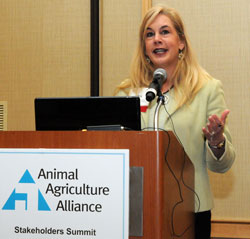
Kay Johnson SmithThe tenth Stakeholders Summit of the Animal Agriculture Alliance is underway in Arlington, VA. The Executive Vice President is Kay Johnson Smith who welcomed us just a little while ago.

I spoke with Kay before we got started to learn more about what the Alliance does and get a preview of the program here. She says the AAA is a national umbrella organization that works to connect all stakeholders across the animal agriculture food chain to educate the public and media about the importance of the industry and to protect our ability to raise food in the United States. The Stakeholders Summit provides an opportunity to bring everyone together to make connections and listen to educational presentations. I’ll be conducting interviews with many of them, including farmer participants which will be posted during the next several days.

You can listen to my interview with Kay here: Kay Johnson Smith Interview

Photos from the the Summit: Animal Ag Alliance Stakeholders Summit Photo Album

Ag Groups, Animal Agriculture, Audio