The sponsor for the news center at the Cattle Industry Summer Conference is Merial. We really appreciate their support of the ag media who cover the conference. Here are some of the things you’ll find new from the company.
Merial is putting the spotlight on parasite control through a bold new program called “EPRINEX Kills It.” Because economic losses from parasite infections of cattle can be significant,1 effective parasite control is vital to the health of a herd and the profitability of an operation. In fact, of all the animal health practices used to increase production, treating beef cows for parasites gives the greatest economic return – up to $201 per head.
To set its parasite control messaging apart and emphasize product performance, Merial put a humorous twist on the features of its IVOMEC EPRINEX product.
Here’s one of the videos that Merial produced for the campaign.
Merial has also just introduced a new product – ZACTRAN®.
ZACTRAN® (gamithromycin), a new antimicrobial from Merial, provides producers with a rapid-response weapon in the battle against BRD.1 It can be used for control of BRD in high-risk cattle or as a first-pull treatment of sick cattle.
“BRD causes between $800 to $900 million annually in economic losses from death, reduced feed efficiency and treatment costs.3 Given the significant impact of BRD, producers need cattle to respond quickly to treatment,” says Bruce Nosky, DVM, Manager, Merial’s Large Animal Veterinary Services. “In field studies, cattle treated with ZACTRAN showed a rapid improvement in BRD clinical signs.1 More than three- quarters of the cattle with a fever had a significant decrease in temperature within 24 hours.4 And the majority of those cattle treated with ZACTRAN remained healthy throughout the 10-day study.”
2011 Cattle Industry Summer Conference Photo Album
 AgCareers president Eric Spell says they had over 145 attendees on Monday and today about 190 are at the 9th annual event to discuss recruitment and retention of talent in the agribusiness industry. “Some companies are sending 3, 4 or even 5 attendees,” Eric says. “We do have 90 employers represented, which is by far the most we’ve ever had.”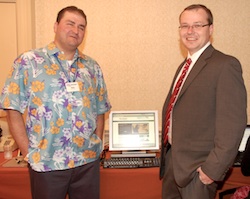
 At the opening of the
 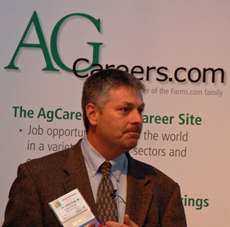 “From an external perspective, not a lot of surprises,” Gray says. “The economic environment we’re in and the uncertainty associated with that and what’s happening with farmers” were most important. On the internal side, Gray says he was surprised by the importance the CEOs placed on marketing functions. “I suspect that’s a reflection of the changing nature of their customer base as farmers are becoming more differentiated, larger and more sophisticated.”
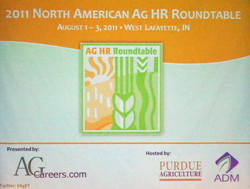 When we talk about having the resources to feed the world in the future, most of the time we’re thinking land and water, but having adequate human resources is equally, if not more, important.
 “Really the long term prospects for this industry are so bright, dealing with a growing population and increased need for food,” Dean Akridge said. “At the same time, it’s an industry that’s buffeted by tremendous change. So, this idea of how we manage for today, yet keep our eyes on tomorrow is really a fundamental issue as we prepare talent for the next generation.”

 Measuring the return on investment of social media is a big challenge. We deal with the question of “how to” all the time. More importantly though is answering the question of what your goal is with social media. This topic was on the agenda at the Agricultural Media Summit.