
BASF Stresses Doing More With Less

Cindy Zimmerman

Sustainability is an overused term, according to Nevin McDougall, Senior VP for BASF Crop Protection, North America.

“Getting more productivity, more efficiency, with less impact on our resources and our environment – that’s what it’s all about,” Nevin told me at the conclusion of the 2012 BASF Agricultural Solutions Media Summit in Chicago last week.

Nevin was very pleased with the discussion at the summit focused on innovation. “We delved into key topics and had first hand experience from people involved in the value chain that have a true perspective on what it means to move agriculture to a different point in its evolution,” he said.

Listen to my interview with Nevin here. BASF's Nevin McDougall

I talked to Nevin during the summit “high point,” so to speak, at the top of Willis Tower. I just got the photos yesterday that were taken on the Skydeck Ledge of the tower, which was really so fun.

This picture is me with members of the fabulous BASF communications team – Pat, Nadine, Daniel and Kristen – towering over the city of Chicago at night. Thanks to all of you for a very informational and fun event.

Check out photos from the summit here – Photos from BASF Ag Media Summit

Audio, BASF, Sustainability

Zimfo Bytes

Melissa Sandfort

    Zimfo Bytes

    You Twive & AgChat Foundation Received

    Chuck Zimmerman

    Thank you to everyone who helped out the AgChat Foundation during yesterday’s Twive and Receive event. We raised $6,830 and placed 12th out of the hundreds of charities that participated. I guess I should have titled this “You Twave & AgChat Foundation Received?” We had 78 Twivers for an average donation of $88.

    In case you couldn’t help out now keep the AgChat Foundation in mind for the future. You can still make a donation! Want a reason to donate? Check out this video of farmer and AgChat Foundation board member Tim Zweber.

    After completing your donation the fearless leader of the board, Darin Grimm, Kansas farmer, provided a personal thank you which I’m sharing here.

    Social Networking, Video

    Help Feed the World with GROWMARK Cookbook

    Cindy Zimmerman

    GROWMARK employees have created a cookbook to help a group focused on feeding the world.

    In celebration of the International Year of Cooperatives, GROWMARK has announced that proceeds from sales of a new cookbook will go to Farmers Feeding the World, an industry-wide campaign to rally North American agriculture in the war against hunger.

    GROWMARK System employees and friends submitted more than 1,000 tried-and-true recipes in a variety of categories: Appetizers and Beverages, Soups and Salads, Vegetables and Side Dishes, Main Dishes, Breads and Rolls, Desserts, Cookies and Candy, and This and That. The finished books will be three-ring binder style with an included easel and delivered in time for holiday giving.

    The cookbooks are just $20.00 each and all proceeds above printing and shipping costs will be donated to “Farmers Feeding the World.” Orders will be accepted through July 20.

    Click here to get an order form.

    GROWMARK

    Few Ag Names on Dot Domain List

    Cindy Zimmerman

    There’s no dots for agriculture, corn, or cows on the list of nearly 2000 new generic top-level domain (or gTLD) name applications announced yesterday by the Internet Corporation for Assigned Names and Numbers (ICANN).

    There’s .beer but not .beef, there’s .porn but not .pork, there’s .soy but not .soybean. There is .farm on the list, by one of several companies that paid $185,000 per name to apply for multiple generic domains, and Farmers Insurance has applied for .farmers. DuPont and New Holland both applied to have dot domains, but Pioneer was requested by a Japanese company and there is no .JohnDeere on the list. No .BASF or .Monsanto or .Syngenta, either.

    The application window for the gTLDs opened in January and closed on May 30. The full list of nearly 2,000 applications, including duplicates for popular names like .app and .blog, was revealed yesterday starting a 60-day public comment period to allow anyone to object to the domain being awarded. Introducing the list on Wednesday, ICANN chief Rod Beckstrom said, “The internet is about to change forever.” Well, maybe by sometime next year. All the applications need to be reviewed, and multiple applications for the same name need to go through an arbitration process. The winners will get the chance to pay $25,000 a year to keep the domain extension and do whatever they want with it.

    See the entire application list here.

    Internet

    2012 IFAJ Congress Full

    Chuck Zimmerman

    If you were waiting to make reservations for the 2012 International Federation of Agricultural Journalists Congress then you waited too long. It’s full! I’m looking forward to a trip to Sweden later this year thanks to our good friends at Pioneer Hi-Bred.

    The Swedish Congress is now completely full. All the available rooms at the congress hotel Sånga-Säby are booked and there is unfortunately not possible to take any more registrations. Those who are registered for the congress will be the very first guests at the new hotel building. It has its official opening on August 13th.

    We’re going to have free wifi at our hotel. That is a good thing. Wish they all had it free.

    IFAJ

    President Exec Order To Speed Up Broadband Dev

    Chuck Zimmerman

    Today President Obama will sign a new executive order to make broadband construction cheaper and easier according to the White House. This would mean more people in more places can join the AgWired community!

    The Executive Order (EO) will require the Departments of Agriculture, Commerce, Defense, Interior, Transportation, and Veterans Affairs as well as the US Postal Service to offer carriers a single approach to leasing Federal assets for broadband deployment. The EO also requires that available Federal assets and the requirements for leasing be provided on departmental websites, and it will require public tracking of regional broadband deployment projects via the Federal Infrastructure Projects Dashboard (permits.performance.gov). In addition, the Executive Order will direct departments to help carriers time their broadband deployment activities to periods when streets are already under construction—an approach that can reduce network deployment costs along Federal roadways by up to 90 percent.

    You can find a fact sheet on this here (pdf).

    Internet

    Soft and Plush

    Melissa Sandfort

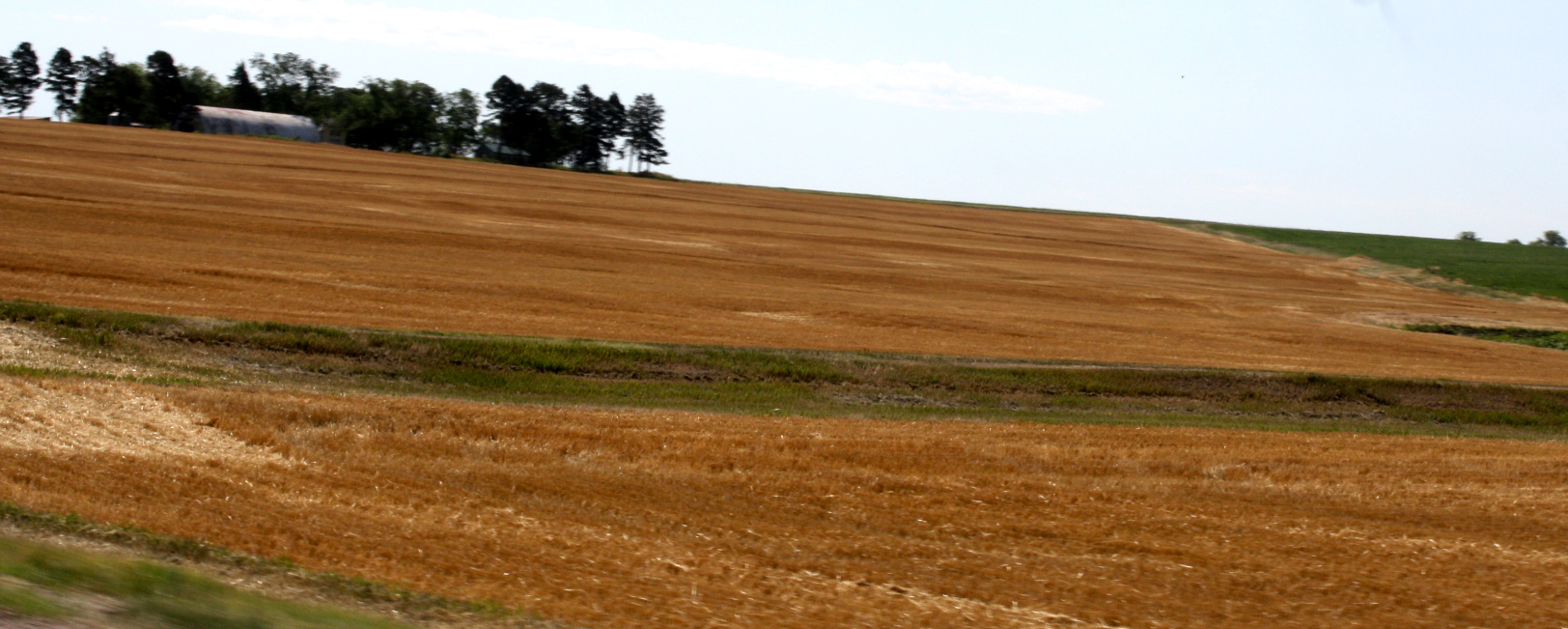
    This week, one of our neighbors combined his wheat fields and this is the stubble that’s left. From the road it looks like butter. Or yellow cotton candy. Like running my fingers through a little chick’s peach fuzz.

    It’s wheat stubble though, so I’m sure it’s not soft and plush.

    I wanted to write about wheat because in our area, 99 percent of the field are corn and soybeans and it’s nice to see a different color. In western Kansas though where my husband’s family farms, wheat is most common. That’s why finding a month to get married was hard – when my family was in harvest, his dad was spraying and when his dad was harvesting, mine was planting.

    I’ve interviewed a lot of farmers in the past five years and it’s fun hearing about the diversity of crops, even within our own state. I’ve talked to corn, soybean, wheat, sunflower, popcorn, dry edible bean, grass seed and sorghum growers – and that’s just here in Nebraska. Again, that’s what I love about spring/summer … the colors and contrast of agriculture. It’s much prettier than looking at houses that sit 25 feet apart and drab office buildings.

    Until we walk again …

    Uncategorized

    Looking at the Future of Farmers

    John Davis

    How the world’s farmers will handle feeding the projected 9 billion people the earth is expected to have by 2050 … and where those farmers to feed that hoard will come from … was the subject of a presentation to the BASF Agricultural Solutions Media Summit in Chicago last week.

    Christophe Pelletier, futurist and president of Happy Future Group, told the agricultural journalists gathered for the event that while technologically we should be able to produce enough food, many more questions remain… including who will own the farms of the future, will farmers be able to afford to buy their own farms, and what will be the average age of farmers 40 years in the future?

    “Average age of farmers [today] is 58. [In 2050], are we going to say the average age of U.S. farmers is 90-something? Who are going to be the farmers of the future? How can we attract new people? I think that is one of the big challenges, because in the end we need food, so someone needs to produce it.”

    Pelletier said if we can’t attract as many people to the profession, then we’ll need to rely on robotics more and more … something he points is already coming to fruition in the vast array of precision-guided tools available today. He added that while some would like a one-size-fits-all solution for all of agriculture, we need to take a pragmatic approach and take the best methods learned from the best farmers and apply them to what a particular area of the world needs. And he concluded by telling the group that suppliers will also need to be more flexible and more responsive to the changing needs of their farmer clients.

    “I think the magic phrase in the future is not so much, ‘I have a new product and you should try it;’ it’s going to be ‘What can I do for you.'”

    Listen to more of what Pelletier had to say here:
    Christophe Pelletier, futurist and president of Happy Future Group

    Photos from BASF Ag Media Summit
    Audio, BASF, Food

    Split Vote on Corn Sugar vs. HFCS

    Chuck Zimmerman

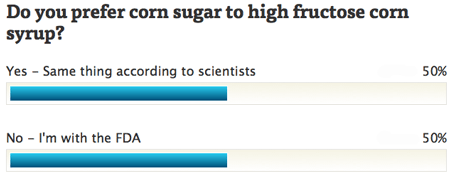
    Our latest ZimmPoll asked the question, “Do you prefer corn sugar to high fructose corn syrup?” In what is a first for our poll, the response was split evenly! See the chart below.

    Recently the FDA denied a request from the Corn Refiners Association to allow food labels to use the term corn sugar instead of high fructose corn syrup. Nutritionally, there is no difference in regular table sugar and HFCS so I don’t see why FDA ruled like they did. Their reasoning had to do with their definition of sugar as a crystalline solid. This is basically a public relations war over words since the “problem” with either cane or corn sugar is how much someone consumes. Nothing wrong with cane sugar or corn sugar, regardless what you call it, in my opinion. I like them both. Apparently consumers like HFCS better according to this story. What do you think?

    Our new ZimmPoll is now live and asks the question, “Does your business have an interest in Pinterest?” This online pinboard is now being used by political campaigns to target key demographics. Even President Obama’s wife is using it! Seems like there might be some good reason for agribusinesses, farm and food groups to start pinning away. What do you think?

    ZimmPoll is sponsored by Rhea+Kaiser, a full-service advertising/public relations agency.

    Corn, Food, Social Networking, ZimmPoll