Producers See Performance, Flexibility of Anthem

John Davis

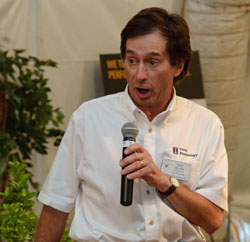
Not only are the folks at FMC anxious to see the release this fall by the EPA of the herbicide Anthem, but if the reaction at the recent Anthem Field Plot Tour in Ames, Iowa is any indication, so are the producers who showed up at the tour. Dean Getting, Retail Marketing Manager for FMC, said people were able to see a comparison with industry standards on rates and efficacy of Anthem. “Everyone, I think, walked away with encouraged hearts that this will help in their arsenal,” adding in an interview with Chuck that Anthem is an additional tool for producers to use.

Getting said Anthem’s biggest asset might be its flexibility. “They can put it on in the fall. They can put it on in the spring. They can incorporate it. They can use it pre[-emergent]; they can use it post,” and opens up windows of opportunity when farmers might have to go to plan b.

Listen to Chuck’s interview with Randy here: Interview with Dean Getting, Retail Marketing Manager for FMC

You can find photos from the event here: FMC Anthem Field Plot Tour Photos
Agribusiness, Audio, FMC

Most Believe U.S. Crops are in Trouble

Melissa Sandfort

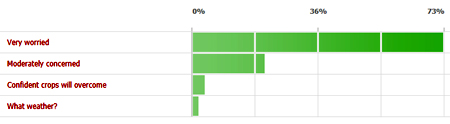
Our latest ZimmPoll asked the question, “How worried are you about the weather impact on crops this summer?”

Our poll results: Seventy-four percent said very worried; twenty-one percent said moderately concerned; four percent said they’re confident the crops will overcome and two percent said “what weather?”.

Our new ZimmPoll is now live and asks the question, “Should nutrition programs be split out of the Farm Bill?” With all the controversy surrounding cuts in the Supplemental Nutrition Assistance Program (SNAP), better known as food stamps, there has also been talk that the bill could be split. What do you think – should nutrition be separate from agriculture?

ZimmPoll is sponsored by Rhea+Kaiser, a full-service advertising/public relations agency.

ZimmPoll

Zimfo Bytes

Melissa Sandfort

    Zimfo Bytes

  • Minneapolis-based advertising and marketing agency Broadhead has tapped Greg Wetzel as its new chief creative officer.
  • USDA is proposing to increase membership on the United Soybean Board from 69 to 70 members to reflect changes in production levels that have occurred since the board was last reapportioned in 2009. Comments may be posted online and must be received by Sept. 10.
  • FMC Corporation recently announced the appointments of Bethwyn Todd as director and Steve Fasano as strategic marketing and business development manager of FMC Professional Solutions.
  • The U.S. Grains Council is pleased to welcome back Kimberly Karst as the new director of global programs.
    Zimfo Bytes

    Below: 300-Bushel Corn is No Accident

    John Davis

    Getting 300 bushels an acre out of corn takes careful planning and doesn’t happen by accident. That was the message from Dr. Fred Below of the University of Illinois gave to those attending the Wyffels Hybrids Corn Strategies event in Vincent, Iowa heard this year. “[Farmers] have to select the best hybrids; they have to feed those hybrids with the right nutrients when they need them. They have to follow through and commit to it,” Below told Chuck during an interview right before his remarks.

    Below admits that years like this one certainly make it more challenging to get those big yields, but good managed crops do help producers get around these challenges. And he said that getting the right hybrid is the most important first step. Below added that the strategy will need to change from feeding the soil to feeding the plant, and farmers will need to make more use of more technologies. “Biotechnology, application technology and fertilizer technology. And we’re going to have to marry all those together to try and close the yield gap between the potential that is there and what we are actually achieving.”

    Don’t forget, the Wyffels Hybrids Corn Strategies team is setting up today, July 18th on Nicholas Farms near Litchfield, Illinois.

    Listen to Chuck’s interview with Fred here: Interview with Dr. Fred Below, University of Illinois

    2012 Wyffels Hybrids Corn Strategies Photo Album

    Agribusiness, Audio, Corn

    Ag Lender Sees Value of Conservation Tour

    John Davis

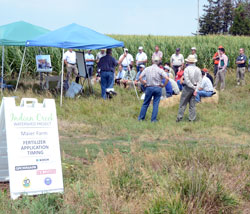
    Who better than a person who makes long-term investments in the land, an ag lender, to offer an evaluation of the long-term conservation efforts on display at the recent Indian Creek Watershed Project Field Tour? “It’s a wonderful thing. It’s trying to let others know that farmers are being very responsible stewards of the land,” Gary Bressner, an ag lender at the State Bank of Graymont and one of the local organizers of the tour, told Chuck during an interview. Bressner said farmers are natural conservationists because of their long-term investment in the land.

    He continued that the tour is helping producers learn about new technology that helps them cut down on the amount of chemicals needed to farm and how to prevent the loss of those enhancements into the watershed. Bressner also said that he was impressed with the wide variety of attendees to the tour, including farmers, folks from Washington, D.C., trade organization representatives, and many others. “It’s really nice to see the interaction between all of them.”

    Listen to Chuck’s interview with Gary here: Interview with Gary Bressner, ag lender and tour organizer

    2012 Indian Creek Watershed Project Field Tour Photo Album

    AgWired coverage of the CTIC Indian Creek Watershed Field Tour is sponsored by AGROTAIN
    Agribusiness, Audio, Conservation, CTIC, Farming

    Corn Growers Heading to Hill With Message

    Cindy Zimmerman

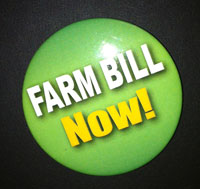
    Corn growers are heading to Capitol Hill this week with a message – they want a farm bill NOW!

    “All of the NCGA corn farmers, 127 delegates are in Washington DC, and we’re going to present our message that we want a farm bill now,” said National Corn Growers Association president Garry Niemeyer of Illinois. “And hopefully we’re going to get a rain as well.”

    The farmers on the Hill are also talking about the drought, according to Garry. “We still don’t know what the final yields will be and that makes a lot of people nervous,” he said. “We’re very concerned about what the future holds for demand destruction because of the higher prices of corn as well.”

    With the clear example of what weather can do to a crop, Niemeyer says getting a farm bill passed is more important now than ever. “Our highest priority is crop insurance,” he said. “That’s the reason it’s so essential and you’ll see on the corn growers on the Hill wearing this pin that says “Farm Bill Now.”

    Listen my interview with Garry here: NCGA president Garry Niemeyer

    Audio, Corn, NCGA

    Like Prima Tech and Share To Win Boots

    Chuck Zimmerman

    If it ever rains again in Iowa you might need a good pair of boots for the Farm Progress Show coming up. I learned the hard way to bring ’em with me. Here’s a chance to win a free pair.

    Just like Prima Tech on their Facebook page and share.

    To celebrate the launch of our new boots we are giving away a pair to one of our Facebook friends. Winners will be drawn July 25th from all Shares and ‘Prima’ Likers! Winner’s name will be posted on the Prima Tech Facebook page on July 26th.

    To win all you need to do is share this photo and like our Prima Tech USA page! Remember to like our page and not just the photo.

    Agribusiness

    Getting to Know BASF’s Nevin McDougall

    Cindy Zimmerman

    Nevin McDougall has been the Senior Vice President, Crop Protection for BASF North America for three years now and his face should be familiar to many in agriculture who have attended Commodity Classic during that time, but he has actually been with BASF since the American Cyanamid acquisition. “Really, with legacy company, I’ve been with BASF for 19-20 years,” he said.

    He grew up on a family farm in Canada and has roots in agriculture. “So being involved in agriculture is very comfortable, very natural. I can relate with our customers and what they are trying to achieve, so for me it’s a very good fit,” said McDougall who loves what BASF is doing right now to help farmers. “There’s always something fun to talk about. We have new products, new services we’re offering to growers to do a better job on their own operations,” he said. “My joy and thrill has been working with customers and trying to deliver better solutions than we ever have before.”

    Even though BASF, The Chemical Company, is much more than agriculture but McDougall says it is a very important part of the company. “If you look at the amount of research dollars that go into agriculture, we’re talking upwards of $600 million on an annual basis, so it’s a significant commitment to agriculture and innovation in agriculture.”

    McDougall is particularly pleased with Headline and the Kixor franchise and is excited about all the more products in the pipeline that add value for growers. “We’re here for the long term,” he said.

    Learn more about Nevin and BASF in this interview: BASF VP Nevin McDougall

    Audio, BASF

    Corn Crop is in Worst Condition Since 1988

    Cindy Zimmerman

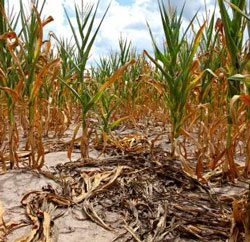
    Drought conditions in the Midwest are “almost historic” with 38 percent of the nation’s corn crop now rated poor to very poor, according to USDA Meteorologist Brad Rippey.

    “That 38% represents the highest amount of U.S. corn rated poor to very poor since the end of the 1988 growing season,” said Rippey. “We now see in 13 of the 18 major production states in the U.S., at least one quarter of the corn crop rated poor to very poor.” Leading the pack in low ratings are Kentucky at 77%, Missouri 72%, and Indiana 71% poor to very poor according to the latest USDA crop progress report. At least half the soybean crop in those states is also rated poor or worse.

    Rippey says both of the crops are progressing along faster than normal in the hot, dry weather, which is a very bad thing right now.

    Corn, Soybean, USDA, Weather

    International FarmSight

    Chuck Zimmerman

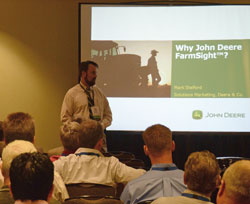
    Attendees at the International Conference on Precision Agriculture got the full overview of the John Deere FarmSight strategy from Mark Stelford who does Solutions Marketing in the Intelligent Solutions Group. I visited with Mark afterward.

    Mark says that when you look at some of the megatrends in agriculture and outside the industry like demand for food, fiber and fuel between now and 2050 it has really helped John Deere understand what the company needs to do to help drive efficiencies to the producer. So FarmSight is the strategy that helps drive them to the products they are creating. Those are driven by three pillars that include machine optimization, logistics optimization and agronomic decision support. In his comments here Mark says he emphasized John Deere sitting at the table with other companies via AgGateway to create data standards to increase the efficiency of data movement.

    Listen to my interview with Mark here: Interview with Mark Stelford

    11th International Conference on Precision Agriculture Photo Album

    AgWired coverage of the International Conference on Precision Agriculture is sponsored by John Deere
    Ag Groups, Agribusiness, John Deere, Precision Agriculture