EcoTek Highlights Young Scientists at USB Event

John Davis

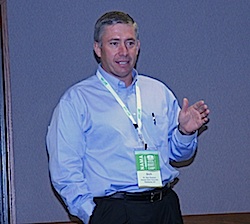
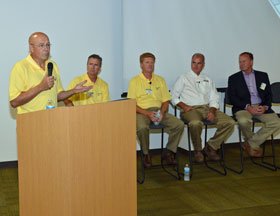
A group of young scientists got to show off what they have learned in their lab during the recent USB Biobased Products Stakeholders Workshop in Dearborn, Michigan. “My focus is on innovation and how to use science as a way of improving society,” explained Keith Young, the founder of EcoTek Lab… a Detroit-based program for students from 2nd grade through high school. Young started the project back in 2005 and has 30 students in his current program with connections to 1,500 more through partner schools.

Young says they are working on projects as varied as bio-plastics to biofuels to growing stem cells in the laboratory. Ecotek starts with an understanding of international policy, focusing on the United Nation’s Millennium Goals. “There’s those eight goals the world has to solve by 2015, and one of those goals deals with sustainability,” adding that he brought the students to this USB event so they better understand the time it takes and the payoff at the end of research. “It makes it easier for me to explain the benefits and opportunities down the road.”

Young also points out that the Ecotek program has a practical side of making sure the students understand that there is a tie to value creation. “Making sure they understand innovation really ensures that they understand that value creation is necessary and is tied to the sciences. The more you know, the more you control.”

You can hear more of Cindy’s interview with Keith here: Keith Young, Founder of Ecotek Lab

And you can see a video of the students’ bio-plastic and here some of them explain how it works here: Ecotek Lab Students Explaining Bio-plastic

Check out the photo album below and the SoyBiobased.org website as well.

2012 USB Biobased Products Stakeholders Workshop Photos

Audio, Soybean, USB, Video

Swedish Beef Cattle Farm – Stenhammar Estate

Chuck Zimmerman

During the 2012 IFAJ Congress we split up into eight different tour groups. My group (Meat Wagon) visited Stenhammar Estate, a beef cattle farm run by the Swedish King Carl XVI Gustaf. He was not available but his farm manager, Anders Frederiksson was. Anders gave us a tour around the old and new barns and talked about the farm. I captured some of that on video. Our lunch was a BBQ with hamburgers, pork chops, steak and sausage! Yep, that’s a meal fit for a tour group called The Meat Wagon!

2012 IFAJ Congress Photo Album

AgWired coverage of the 2012 IFAJ Congress is sponsored by DuPont Pioneer
IFAJ, International, Media, Video

Looking Ahead With IFAJ

Chuck Zimmerman

ZimmCast 362Wow. The 2012 IFAJ Congress was fantastic as usual. I recommend that any American ag journalists take advantage of this opportunity to make good contacts internationally while expanding your horizons.

In this week’s program you’ll hear from new IFAJ President Marcus Rediger, Managing Editor, Agricultural Information Center in Switzerland. Here’s Marcus passing the IFAJ flag forward to Argentina which will be the site of the 2013 IFAJ Congress.

Marcus and I spoke prior to the closing banquet on Saturday night in Stockholm. He gives us a look ahead for IFAJ during his term.

Next in this week’s program you’ll hear from Maria Mosquera, one of the organizers of the 2013 IFAJ Congress. We’re going to start out in Buenos Aires and then move to Rosario and that’s about all I know except that it will be BIG. The dates are September 1-5 so get it on your calendar.

Listen to this week’s ZimmCast here: Looking Ahead With IFAJ

Thanks to our ZimmCast sponsors, GROWMARK, locally owned, globally strong and Monsanto, Roundup Ready Plus, for their support.

The ZimmCast is the official weekly podcast of AgWired. Subscribe so you can listen when and where you want. Just go to our Subscribe page.

2012 IFAJ Congress Photo Album

AgWired coverage of the 2012 IFAJ Congress is sponsored by DuPont Pioneer
Audio, IFAJ, ZimmCast

Zimfo Bytes

Melissa Sandfort

    Zimfo Bytes

  • The Farm Progress Show, Monsanto and the Howard G. Buffett Foundation have teamed up to help feed Iowa’s hungry with the America’s Farmers Food Drive.
  • Dow AgroSciences announced the launch of POWERCORE™ in Argentina to control major pests in corn.
  • Register now to attend the NAMA 2012 Smart Marketing Trends webinar, Sept. 13 at 2 pm EST.
  • The Louisiana Farm Bureau Radio Network is merging its farm broadcasting operations with the Louisiana Radio Network’s agrinews division, creating one of the largest farm radio networks in the South.
    Zimfo Bytes

    Ford Works with USB to Develop Soy-based Materials

    John Davis

    Ford Motor Company is working with the United Soybean Board to help research, develop and implement soybean-based materials into their products to take the place of petroleum-based materials and improve the sustainability footprint of their operations. At the recent USB Biobased Products Stakeholders Workshop in Dearborn, Michigan, Deb Mielewski, Technical Leader of Plastics Research at Ford, talked about the development of biobased foam being used in every Ford vehicle manufactured in North America. “Automotive foam has to have fantastic compression. It has to rebound back in the field for 15 years under heat and humidity,” she explained.

    Mielewski credits Ford’s work with the USB that started about 10 years ago that has helped the company perfect the foam and make other products, including many of the plastics in vehicles, from soybeans. “We have received [about] seven grants from the USB, so it’s been a really strong partnership,” she says. And she’s been pleasantly surprised by how much the board has helped in some of the issues during development. “When we had technical issues, we would come to the table with USB representatives, and they knew more about their crop, [so] they could help us get past those technical hurdles.”

    During the workshop, U.S. Secretary of Agriculture Tom Vilsack and Sen. Debbie Stabenow (D-MI) even got the chance to make some of the soy-based foam. “That was the first time we actually had someone else make the foam, so we were really excited about it,” Mielewski said.

    You can hear more of Cindy’s interview with Deb here: Deb Mielewski, Technical Leader of Plastics Research at Ford

    Check out the photo album below and the SoyBiobased.org website as well.

    2012 USB Biobased Products Stakeholders Workshop Photos

    Audio, Soybean, USB

    FAPRI Looks at Farm Bills’ Differences, Impacts

    John Davis

    A new analysis of the two Farm Bills out there … the Agriculture Reform, Food and Jobs Act of 2012 that passed the full Senate in June and the House’s Federal Agriculture Reform and Risk Management Act of 2012, which made it out of the House Ag Committee last month … shows some similar impacts of the two bills, especially when it comes to direct and counter-cyclical payments. Pat Westhoff, Director, Food and Agricultural Policy Research Institute (FAPRI), which did the report, says both bills mark a fundamental change away from those payments that were tied to historical yields on farms. “Instead, the new policies would create policies that would make payments only tied to what farmers tried to produce in a given year,” adding that they would also be tied to market conditions. “A very different world that what we’ve been used to.”

    Westhoff says the elimination of those payments means less predictability in payments. “You may get a very large payment if you have a drop in prices or yields, but there may be other years where you get nothing at all,” he said. Even though things could change by the time the House bill is brought before the full chamber and both versions are worked out in committee, the end of direct payments is likely a done deal. “It may or may not happen for 2013, but I do think it is likely that we’ll see the end of direct payments in the not-too-distant future.” He added that while it might not mean that much for corn and soybean growers, other crops, such as peanuts and rice, could see a bigger impact.

    The report also highlights the importance supplemental insurance coverage will play. “That’s something that’s in both the House and Senate bills,” Westhoff says. “We found what you assume about participation in that possible new program is incredibly important in trying to estimate what it will mean for taxpayers and farmers. That’s one that’s been kind of a sleeper out there that may become front and center of the farm policy debate in the next few weeks.”

    Listen to my conversation with Pat here: Pat Westhoff, Director of FAPRI Read FAPRI’s report here.

    Audio, Corn, Farm Bill, Insurance, Peanuts, Soybean, USDA

    2012 IFAJ Congress Ends

    Chuck Zimmerman

    The 2012 IFAJ Congress has ended in Stockholm with the closing banquet in the Stockholm City Hall, site of the Nobel Prize banquet. We dined in the Golden Room. Congratulations to the Swedish Congress Committee for all their hard work and the enjoyment of seeing and experiencing their country.

    I have a lot more to share in coming days with some interviews and video clips from the Congress. My last photos are uploading right now and I encourage everyone to enjoy and share. I’ll be headed back to ZimmComm World Headquarters early tomorrow for an all day trip. See you from there.

    2012 IFAJ Congress Photo Album

    AgWired coverage of the 2012 IFAJ Congress is sponsored by DuPont Pioneer
    IFAJ

    Know the Enemy – Palmer Pigweed

    Cindy Zimmerman

    It’s not just pigweed, it’s Palmer amaranth pigweed, and it was all over the Bayer CropScience Respect the Rotation plot tour in Collinsville, Illinois – towering over corn and soybeans and most other weeds.

    Waterhemp is also a member of the pigweed family that might be more familiar to growers in the Midwest and both are developing resistance to glyphosate. Southern Illinois University weed specialist Bryan Young says resistant waterhemp in the region has been doubling every year for the past three years. “At one point we had ten percent of retailers surveyed said it was a problem in their territory, the next year it was 20%,” he said. “This past fall it was 40% and this fall I’m expecting that will be even higher.”

    The Palmer pigweed is more aggressive than waterhemp and has already taken over fields in the south, starting just from one little weed. The Respect the Rotation message for farmers in the Midwest is to keep that from happening by rotating modes of action for herbicides, as well as crops themselves.

    Listen to my interview with Bryan from the Bayer field day and watch the video below where he explains how to identify Palmer amaranth. Bryan Young interview

    See pictures from the field day in Collinsville in the Bayer CropScience Respect the Rotation photo album.

    Audio, Bayer, Crop Protection, Video, weed management

    IFAJ Tour Day

    Chuck Zimmerman

    It’s tour day number one at the 2012 IFAJ Congress. I’m on tour bus #4, now known as “The Meat Wagon.” We visited Stenhammar Estate, a beef cattle farm run by the Swedish King Carl XVI Gustaf. Here’s our group posing with Helios of Mattarp, a champion bull. We had lunch with the Minister of Rural Affairs, Eskil Erlandsson and were served meat, meat and more meat!

    On the bus returning to our hotel we sampled some snaps and practiced some drinking songs for some sort of competition tonight. Not sure what that’s all about. However, our group did our best to get ready. In fact, I recorded some of it.

    You can listen to The Whole Goes here: IFAJ Meat Wagon Song Practice

    Now after a nice swim in the lake here at Sanga Saby it’s time for supper.

    2012 IFAJ Congress Photo Album

    AgWired coverage of the 2012 IFAJ Congress is sponsored by DuPont Pioneer
    Audio, IFAJ

    Companies to Make Bio-based Diaper Absorbent

    John Davis

    BASF, Cargill and Novozymes sign an agreement to develop technologies to produce acrylic acid … a super absorbent material primarily used in baby diapers … from renewable raw materials. Usually, the materials are made of crude oil products.

    “The cooperation combines BASF’s global market strength and innovation power with the excellent know-how and competencies of Novozymes and Cargill who are global leaders in their respective industry segments. Together we are uniquely positioned to more sustainably meet market and society needs”, said Michael Heinz, Member of the Board of Executive Directors of BASF SE.

    “BASF and Cargill are global leaders in their industries and we are very excited to partner with them,” says Novozymes CEO Steen Riisgaard. “By offering bio-based alternatives to fossil-based products we will take a big step towards a more sustainable economy.”

    “Cargill is pleased to bring its global expertise in sourcing renewable feedstocks and large-scale fermentation to this collaborative project”, said Chris Mallett, Cargill Corporate Vice President of research and development.

    The global market for acrylic acid is estimated to be more than $11 billion annually.

    BASF