Pinot, Pigs & Poets Chef Competition

Talia Goes

Pinot, Pigs & PoetsThe Nebraska Pork Producers Association is excited about expanding their continued sponsorship of this year’s Pinot, Pigs & Poets event at Happy Hollow Club on June 6, 2013 at 6 p.m. The philanthropic event will feature premium Pinot Noir wines, cutting-edge pork dishes and entertainment provided by slam poets from the Nebraska Writers Collective.

The Nebraska Pork Producers Association has been a sponsor of Pinot, Pigs & Poets since the event’s inception in 2010. In 2013, they are enhancing their sponsorship by involving the Taste of Elegance competition. The top chef will win a trip to the 2014 Pork Summit at the Greystone Campus of the Culinary Institute of America in St. Helena, California.

All proceeds from Pinot, Pigs & Poets support the Completely KIDS organization and their weekend and after-school food programs for Omaha children in need at local schools and shelters. Completely KIDS serves over 2,000 children in its after-school programs and provides over 30,000 meals a year. Last year Pinot, Pigs & Poets raised over $140,000 for these programs.

Agribusiness, Events, Pork

Celebrity Media Attention

Talia Goes

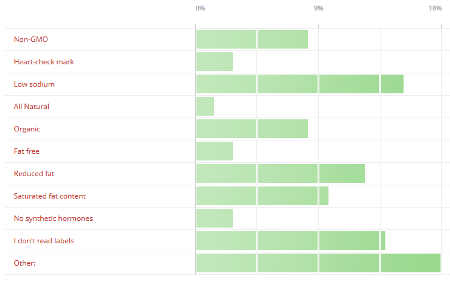
Our latest ZimmPoll asked the question, “What is the #1 thing you look for on a food label?”

Our poll results: Nineteen percent said other, sixteen percent said Low Sodium, fourteen percent Don’t Read Labels, thirteen percent said Reduced Fat, ten percent said Saturated Fat Content, and we had a tie at nine percent saying Non-GMO and Organic. Three percent said Heart-check Mark, Fat Free, and No Synthetic Hormones and one percent said All Natural. The majority of our viewers chose Other. Based on responses, “other” constituted calories, carbohydrates, and ingredients. Evidently our viewing audience has a different outlook than the audience being interviewed by media about the “big debates” such as antibiotics, hormones, and non-GMO foods.

Untitled

Our new ZimmPoll is now live and asks the question, “Does celebrity media attention sway your purchasing/listening/watching decisions? (e.g. Carrie Underwood supporting HSUS)?” Recently in Tennessee, Carrie Underwood has been a big voice for HSUS by publicly pressuring the Governor to veto a bill that would possibly end undercover investigations of animal abuse in the state. Carrie has used Twitter to its fullest, tweeting “@BillHaslam It’s not all about big business. Please look out for the little guys! Show TN that you have a heart…#NoAgGag”. She goes on to explain to questioners and agvocates that she is not against agriculture just against animal abuse. Would you not purchase a ticket to a Carrie Underwood concert based on her recent rant? Let us know.

ZimmPoll is sponsored by New Holland Agriculture.

ZimmPoll

USDA Renews Dairy Energy MOU

Cindy Zimmerman

usda-logoAgriculture Secretary Vilsack today renewed a historic agreement with U.S. dairy producers to accelerate the adoption of innovative waste-to-energy projects and energy efficiency improvements on U.S. dairy farms, both of which help producers diversify revenues and reduce utility expenses on their operations. The pact extends a Memorandum of Understanding signed in Copenhagen, Denmark, in 2009.

“Through this renewed commitment, USDA and the Innovation Center for U.S. Dairy will continue research that helps dairy farmers improve the sustainability of their operations,” Vilsack said. “This vital research also will support the dairy industry as it works to reach its long-term goal of reducing greenhouse gas emissions by 25 percent by 2020.”

InnoCenter_2C_Logo.jpgThe Secretary signed the agreement this afternoon at the White House and was joined by representatives of the Innovation Center for U.S. Dairy and Dairy Management, including Thomas P. Gallagher, CEO of the center. One objective of the MOU is to increase the construction of anaerobic digesters and explore innovative ways to use products previously considered waste streams from dairy production, processing and handling.

USDA support for agricultural and waste-to-energy research has played a key role in the agreement’s success to date. Since signing the MOU, USDA has made nearly 180 awards that helped finance the development, construction, and biogas production of anaerobic digester systems with Rural Development programs, such as the Rural Energy for America Program (REAP), Bioenergy Program for Advanced Biofuels, Business and Industry Guaranteed Loan Program, Value Added Producer Grants, amongst others. These systems capture methane and produce renewable energy for on-farm use and sale onto the electric grid. Additionally, during this period, USDA awarded approximately 140 REAP loans and grants to help dairy farmers develop other types of renewable energy and energy efficiency systems at their operations.

The Secretary was joined on a conference call to make the announcement by The Innovation Center for U.S. Dairy CEO Tom Gallagher and Doug Young, a farmer from NY who has benefited from this MOU.

USDA/Dairy MOU press call

Audio, Dairy, Energy, USDA

Some Agriculture Heart Humor

Chuck Zimmerman

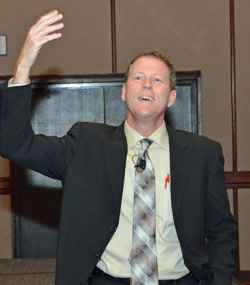
Damian Mason“Humor for the Heart of Agriculture” was just what we needed to conclude the 2013 Agri-Marketing Conference. To give it to us we listened to Agriculture’s Professional Funny Man, Damian Mason. Damian also conducted a breakout session titled, “Agriculture: Trends, Topics and Tomorrow.” You see, he’s more than just funny, he can get a little serious too since he has an ag economics degree and farms in Indiana on 200 acres.

Although Damian is not a college professor he is qualified to talk about trends since his line of work has made him a “professional observer of people, trends and things that are going on.” His outlook for agriculture is “bountiful” but with more and more regulation. He says that one issue in agriculture is the fact that by making a little bit of money lately it has put a target on the industry’s back. He says no one was going to pester us ten or twenty years ago. He also predicts that land values will decrease.

Listen to my interview with Damian here: Interview with Damian Mason

2013 Agri-Marketing Conference Photo Album

Ag Groups, Audio, NAMA

Chicken Issues in the News

Jamie Johansen

13cms-86-editedThe US Poultry & Egg Association served as another sponsor of the Chicken Media Summit, held in north eastern North Carolina last week. Members of the media were welcomed with warm, sunny skies as members of the poultry industry took us under their wings to share a little of their passion for the chicken community.

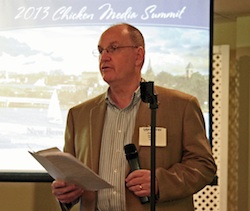
After a wonderful meal at Persimmons Waterfront Restaurant in New Bern, NC, I sat down with John Starkey. John is president for USPOULTRY and served as moderator for the second panel on Issues in the News. During that panel experts discussed poultry welfare, modernization of plants, labeling and the role vets play in modern poultry production. I asked John to address some of these issues.

“I think that is probably one of the reasons transparency has become important to us. We’ve let the animal rights activists define us in a way that isn’t very favorable. The truth is a lot different and we want to be able to show that. I guess that’s reactionary, but on the other hand it’s trying to get out ahead of it, so the next time you or another member of the media hears a report or story you have something to balance that perspective with.”

“Well really what we are doing is trying to catch up with the rest of the world. We are out there in the marketplace trying to compete with Europe and Brazil. They run their operations at a much higher line speed than we do. If we are going to compete, if we are going to continue to export and contribute to a positive trade balance in ag, which is one of the few sectors that has a positive trade balance, then we need to be competitive. These higher speed systems have been demonstrated safe by both consumer and employee in Europe and in Latin American countries. We don’t see a reason why we can’t move forward with them. Understanding we have responsibility to food and employee safety, but again the data clearly shows those can be maintained at these higher speeds.”

Listen to my interview with John here: John Starkey

Check out photos from the event here: 2013 Chicken Media Summit Photo Album

Audio, Chicken Media Summit, Food, Poultry

Zimfo Bytes

Talia Goes

Zimfo Bytes

VAULT HP Fixes More Nitrogen for Soybeans

John Davis

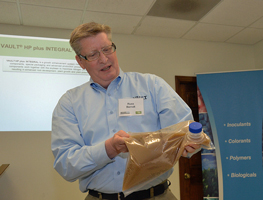
becker-berndtOne of the biggest concerns for any ag operation is getting the most out of your inputs. During the recent tour of BASF‘s newly acquired Becker Underwood St.Joseph, Mo. seed facility, Russ Berndt, product manager for legumes and northern crops for Becker Underwood, talked about the symbiotic relationship soybeans have with the living organism rhizobia, a soil bacteria that fixes nitrogen for soybean plants. While the rhizobia are naturally occurring, they’re not always the right kind for soybeans to get the most out of the nitrogen relationship. That’s where Becker Underwood’s VAULT HP and its compounds come in.

“One of them is a compound that stimulates the rhizobia so that they send signals to the plant to produce more [nitrogen-producing] nodules sites,” adding that another component is INTEGRAL, a biological fungicide that gives more protection for the plants. Russ says that while inoculant technology is not necessarily new, VAULT HP’s approach differs from the old days of the dusty black powders. Liquid concentrations allow more rhizobia to be in each treatment. “It’s now very convenient. Growers can have it put on their seed when they’re getting other seed treatments put on. They’re put on at a very low rate so the treater can put on multiple products. And the concentrations are high so the grower is getting a high count rhizobia along with all the other components of VAULT HP,” he says.

Russ goes on to say that not only are growers ensured a maximum nodulation on those roots with a surefire nitrogen fixer, they get a living biological in INTERGRAL that grows on the roots surface to provide protection throughout the season. It all adds up to a better bottom line.

“What we see as far as return on investment is growers are going to get a 5-to-1 or better return half the time and over 70 percent of the time, get at least a 2-to-1 return.”

Listen to Cindy’s interview with Russ here: Russ Berndt, Becker Underwood product manager for legumes

Becker Underwood media tour photo album

Audio, BASF, Farming, Seed, Soybean

Emerson Heading Rural Electric Coop Association

John Davis

JoAnnEmersonFormer Congresswoman Jo Ann Emerson is now heading the National Rural Electric Cooperative Association (NRECA). The group welcomed Emerson’s wealth of experience in both the legislative and association management arenas, serving nine terms in Congress from rural Southeast Missouri and working for the National Restaurant Association and the American Insurance Association before her legislative career.

“I am so honored to be working for this dynamic association and for the more than 900 cooperatives that belong to NRECA,” says Emerson. “I am inspired by the difference these cooperatives are making in their communities every single day. I look forward to working with the great staff at NRECA to develop innovative programs to support and advocate for our members and the 42 million electric consumers they serve.”

During her tenure in the U.S. House, Emerson served on the House Appropriations Committee and she chaired the Subcommittee on Financial Services and General Government Appropriations, with oversight of the U.S. Treasury, the Internal Revenue Service and various independent government agencies, including the U.S. Securities and Exchange Commission, the Federal Communications Commission, the General Services Administration and the Small Business Administration.

Emerson has been recognized for her work on energy issues, including being awarded the NRECA Distinguished Service Award. The NRECA represents more than 900 private, not-for-profit, consumer-owned electric cooperatives, which provide service to 42 million people in 47 states.

Energy

Farmer to Head Wells Fargo Food & Agribusiness

John Davis

RYraceburu1A man who has deep ties to farming has been tapped as head of Wells Fargo’s National Food & Agribusiness Division. This company news release says Rob C. Yraceburu, a fourth-generation family farmer who holds both a bachelor’s in agricultural business and a master’s in agricultural economics from California State University Fresno, will lead the group’s expansion to untapped markets in the Midwest and East:

Yraceburu takes on the new role after leading Wells Fargo Commercial Banking operations in Southern California since 2008. Before that, he served from 1999 as regional manager in Bakersfield, Calif., where he doubled Wells Fargo lending to agriculture in less than a decade. In that same period, he also increased the bank’s market share to become the leading financer of agribusiness in surrounding Kern County, one of the most-productive agricultural counties in the U.S. In all, Yraceburu worked over 25 years in several finance positions for the company in California’s Central Valley, a huge agriculture region where over 400 crops are produced.

“Wells Fargo has been committed to the U.S. food and agriculture industry through numerous economic cycles,” said Perry Pelos, the head of Wells Fargo Commercial Banking. “Rob and his team will leverage Wells Fargo’s national reach and financial strength to grow our support of an industry that is vital for every single person in America.”

Yraceburu believes they’ll have a great opportunity for Wells Fargo to grow its food and agriculture business in the Midwest and particularly in the East.

Agribusiness

USFRA Food Dialogues Talks BIO

Cindy Zimmerman

The U.S. Farmers & Ranchers Alliance (USFRA) held a Food Dialogues event in Chicago on Monday in conjunction with the 2013 BIO International Convention to address “The Straight Story on Biotech in Agriculture: The Media and its Impact on Consumers.”

Moderated by CNBC Senior Analyst and Financial Industry Expert Ron Insana, the event featured opening remarks from Congressman Rodney Davis (R-IL) and Robert Flider, acting director of the Illinois Dept. of Agriculture. Panelists included:

• Dr. Bob Goldberg, UCLA plant molecular biologist
• Emily Anthes, journalist and author, Frankenstein’s Cat
• Jerry Slocum, Mississippi soybean farmer
• Melinda Hemmelgarn, M.S., R.D., freelance writer, speaker, columnist and radio host, Food Sleuth
• Michael Olson, Producer/Host, Food Chain Radio
• Pam Johnson, Iowa corn farmer
• Steve Smith, Chairman, SaveOurCrops.Org

An interesting discussion of different viewpoints – you can watch it here:

Agribusiness, USFRA, Video