
 It’s a Happy Holidays message from our friends at GROWMARK.
Have a very Merry Christmas and a prosperous New Year.
From your friends at GROWMARK
Thank you GROWMARK.
It’s a Happy Holidays message from our friends at GROWMARK.
Have a very Merry Christmas and a prosperous New Year.
From your friends at GROWMARK
Thank you GROWMARK.
 The time has come to winterize your equipment from the fall months of harvesting, tillage and fall application. As the season comes to an end, it’s important to take care of your investments, whether it is harvested crops, machinery or your precision equipment. Here are some helpful hints from Ag Leader’s tech support team:
Harsh temperatures can lead to problems if the necessary precautions are not taken to keep your monitor in working order. Cleaning the touch screen of your display should be the first step you take in preparing for winter. When dust accumulates on the display it can cause damage to the touch screen. If you have a dirty screen, we recommend cleaning the screen by blowing the screen off using non-direct air. Also, you can use Windex or an electronic cleaner with a soft, non-abrasive cloth to wipe down the display screen. Most importantly, remember to never spray the screen directly with cleaner but instead spray the cloth used in your cleaning process. Finally, remove the display from the vehicle. The preferred place to store a display would be inside the house, in a dry location. A heated shop is also acceptable. Displays can be stored in a large Ziploc bag, or any other sealed container. We recommend this because it will keep unwanted moisture from causing damage to the display.
 Customers using yield monitoring systems, require a couple more steps before being completely ready for winter. Begin by cleaning out your EMU (Elevator Mount Unit) on your clean grain elevator. Pull out the two retaining pins located at the bottom of the EMU and thoroughly clean out the chamber inside remembering to check for any obstructions in front of the proximity switch.
Removing the flow sensor mounted at the top of the clean grain elevator and placing it in a sealable container is strongly recommended. The reason we suggest this step is due to a soft protective potting material used on the load cell of your flow sensor which can be easily damaged by rodents. Rodent damage happens to flow sensors more than you think, so don’t let them get to the flow sensor. You should also run through the cabling located on your combine as suggested earlier to identify any issues you may have.

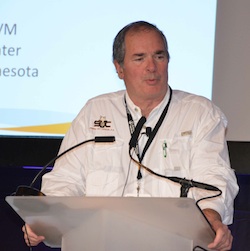 Boehringer Ingelheim provided the opportunity for the big questions to be asked about the PRRS virus during their recent PRRS Seminar in Chicago. Swine Vet Center’s, Dr. Tim Loula, shared his insight into effective PRRS protocols and how to better utilize ARC programs.
Dr. Loula said that the current vaccination for PRRS could be better, but right now it’s all producers have. His suggestion to this dilemma is a simple mandatory vaccination program nationwide. He also shared that starting local is key and thats the producers and veterinarians. Then it can extend to institutions and the allied industry.
“I made a point in my presentation that we need to be bigger, bolder and have some kind of enforcement mechanism. Maybe the producers themselves vote that they are going to do this on a national level if we are going to see any kind of minimization of the effects of PRRS.”
Listen to my complete interview with Tim here: Interview with Dr. Tim Loula, Swine Vet Center
Here are photos from the event:2013 BIVI PRSS ARC&E Seminar Photo Album
The second general session of ASTA CSS and Seed Expo focused on seed treatments and pollinator health.
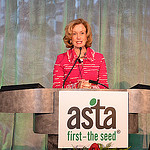 Laurie Adams with Pollinator Partnership discussed the Corn Dust Research Consortium, with a focus on some of the reasons we are seeing a loss in pollinators. With competing pressures for productivity in agriculture and for protection of pollinators like bees and butterflies, the actions of the seed trade have a significant impact on the future. Laurie discussed how sustainability for both high-yield landscapes and ecologically nurturing habitat can be achieved.
You can listen to Laurie’s remarks here Laurie Adams, Pollinator Partnership
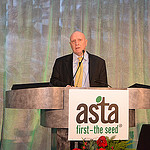 Dr. Iain Kelly with Bayer CropScience focused on seed treatment and pollinator health. Declining pollinator health is currently attracting considerable scientific and media interest. A recent report summarizing the conclusions of USDA’s National Stakeholders Conference on Honey Bee Health outlined the various factors contributing to the decline, noting that the parasitic Varroa mite remains the single most detrimental pest of honey bees. Kelly discussed efforts by industry stakeholders to improve bee health, including assessing and minimizing any potential risks from seed treatment.
You can listen to Dr. Kelly’s remarks here Dr. Iain Kelly, Bayer CropScience
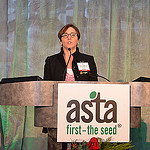 Jane DeMarchi with ASTA discussed the new Guide to Seed Treatment Stewardship being rolled out in 2014. The Guide has been enthusiastically endorsed by the National Corn Growers Association, the American Farm Bureau Federation and the American Soybean Association, and has been shared with both EPA and USDA. As seed treatment technology advances, more resources are developed and the needs of the seed and crop production value chain evolve, Jane says the Guide will be updated to ensure the latest in seed treatment management information for seed companies and growers.
You can listen to Jane’s remarks as well as audio for the video they are using to promote Guide to Seed Treatment Stewardship here: Jane DeMarchi, ASTA
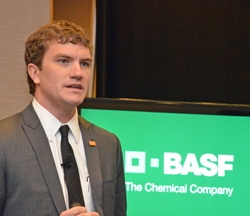 At the ASTA CSS 2013 and Seed Expo this week we had the opportunity to learn more about BASF’s Advanced Seed Enhancement platform which includes a number of important products that can accomplish increased emergence and help farmers get more from every acre.
Those products include Vault HP plus Integral for soybeans, Stamina F3 for cereals, and Flo Rite Plantability Polymers, according to BASF Technical Market Specialist Justin Clark. Listen to him talk about each one here: Interview with Justin Clark, BASF
Justin also gave us a very simple visual demonstration to show the difference that Flo Rite Plantability Polymers make with seed – check it out.
 You can always bet on BASF Crop Protection to have a great presence at any trade show and they turned their exhibit at the ASTA CSS 2013 and Seed Expo into a Vegas-themed casino, complete with the Prince of Poker.
Scotty Nguyen, one of the 2013 inductees into the World Poker Hall of Fame, shared tips and tricks with attendees at the conference to the enjoyment of all. Scotty is also a philanthropist in his native Vietnam where he sends a portion of his winnings to take care of the homeless and those less fortunate. He’s been in Las Vegas for the better part of three decades making a living at playing a card game.
Listen to my interview with Scotty here: Interview with Prince of Poker, Scotty Nguyen
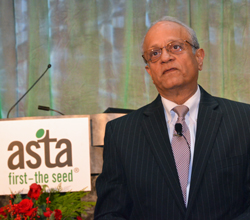 The Director of USDA’s National Institute of Food & Agriculture Sonny Ramaswamy gave a presentation on “Setting the Table for a Hotter, Flatter, More Crowded Earth” during the opening general session at the ASTA CSS 2013 on Thursday with a focus on how public sector research and private sector support need to work together to feed our growing population.
Ramaswamy discussed what he calls the “wicked problems” – the societal challenges facing the world, ranging from population to poverty. “The reason I call them wicked problems is you may have the most fantastic technology available to you but you’re not able to deploy those technologies because mere humans become involved in this and we cannot seem to agree,” he said.
Listen to my interview for a short summary and his 50 minute presentation for more details:
Interview with Sonny Ramaswamy, USDA-NIFA
ASTA CSS presentation by Sonny Ramaswamy, USDA-NIFA
 Our latest ZimmPoll asked the question, “Do you plan to make any year-end equipment purchases?”
Our poll results:
· No. Not this year: 35%
· Yes – Planting equipment: 18%
· Yes – Sprayers: 12%
· Yes – GPS/guidance: 12%
· Yes – Hay equipment: 6%
· Yes – Harvest equipment: 6%
· Yes – Tillage: 6%
· Yes – Other: 6%
Looks like most of the farmers out there are either up-to-date on equipment or satisfied with what they have. Are things like Farm Bill uncertainty holding you back?
Our new ZimmPoll is now live and asks the question, “Which winter farm shows/events are you planning to attend?” Are you planning to get out of the house to browse new products and services this fall and winter or wait and see what spring brings? Let us know!
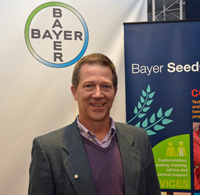 Corn and soybean growers in the Midwest face varying challenges every year, depending on weather, pests and diseases. Visitors to ASTA CSS 2013 and Seed Expo this year were able to see many of the tools offered by Bayer CropScience to address those challenges.
According to Brad May, strategic business lead for seed growth, some of their highlights at the expo this year include new seed treatment technology, new technology coming online in 2015, and an overview of their Bayer SeedGrowth Centers. Brad says the ASTA event is “the ultimate of expos” with the major decision makers in the seed industry in attendance, which is why they are one of the organization’s strategic partners. Bayer will be capping off its presence at the Seed Expo and conference this evening with a reception featuring country music artist Jerrod Niemann.
Listen to my interview with Brad here: Interview with Bayer CropScience, Brad May
2013 ASTA CSS & Seed Expo Photo Album
.