Nufarm Takes on Trees, Nuts, Vines and Veggies

Chuck Zimmerman

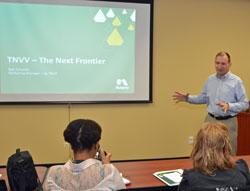
Rob SchwehrDuring Nufarm’s recent farm media tour, Rob Schwehr, took time to highlight one of the newest expansion areas the company has taken on.

Rob is the Marketing Manager for the tree, nut, vine and vegetable (TNVV) segment of Nufarm. He shares in an interview why the company pursued this new endeavor and what we can see coming down the pipeline.

“Nufarm has historically been known as a herbicide company. Over the past few years we have looked into expanding our portfolio and have added insecticides and fungicides. Now with our antibiotics, copper we are trying to consolidate our portfolio and grow the segment of the business that is targeted around the TNVV crops.”

The growth in those segments is what has led Nufarm to expand in these non-traditional areas. They are looking to launch a new product in their copper portfolio as well as other exciting things growers can look forward to seeing in the coming year.

You can listen to my interview with Rob here: Interview with Rob Schwehr
2013 Nufarm North America Headquarters Photo Album

Agribusiness, Audio, Nufarm, Vegetables

ASTA CSS Offers Grain Markets Outlook

Cindy Zimmerman

asta-css-basseOnce again this year at the ASTA CSS 2013, for the third year in a row now, AgResource Company president Dan Basse looked at the year in review for grain markets and gave his outlook for the future.

While there are bright spots, Dan’s overall outlook for the year ahead is pretty sobering, saying the good times may have come to an end for corn. “A year ago we had corn prices above $7 with flirtations to eight,” he said. “We’re now looking at Chicago markets with corn prices near four. We think the best we can do at least for the next 6-9 months is maybe getting back to something like four and a half.”

Basse points out that the United States only needs to produce a corn crop of 13 billion bushels to meet demand. “That’s the big concern for the US farmer down the road,” he said.

On kind of a bright side, Dan expects North America to be “energy self-sufficient by 2020” but that is largely due to fracking to reach new deposits of crude oil and natural gas rather than biofuels. “Ethanol, which was deemed to be the savior from Mideast oil, is no longer going to have that spot at the table,” he said, adding that the industry has “reached its zenith.”

Basse covered a number of important topics in his presentation, including whether the bull market in ag commodities is coming to an end, the mature biofuels industry, pressure on farmers to plant less corn, the high cost of production for U.S. farmers, and – of course – the farm bill.

Listen to my interview for the condensed version and his 30 minute presentation for more details:
Interview with Dan Basse, AgResource ASTA CSS presentation by Dan Basse, AgResource

2013 ASTA CSS & Seed Expo Photo Album

ASTA, Audio, Corn, Grains, Markets

Happy Holidays from MGEX

Chuck Zimmerman

Happy Holidays from MGEXIt’s that time of year again. Happy Holidays time.

It’s now an AgWired tradition to share some of the many wonderful messages we receive. So let’s start with the Minneapolis Grain Exchange.

Wishing you health and happiness this Holiday Season and prosperity in the New Year.

All the best to you, your family, and your organization,

Mark G. Bagan
Jesse Marie Green
Layne Carlson
James Facente
Blake Tiedeman

MGEX

Agribusiness

PRRS Research At It’s Finest

Jamie Johansen

BI-PRRS-13-47-editedThe PRRS virus is nothing new to swine producers across the country and has been around for years. But that doesn’t mean research has ceased. During Boehringer Ingelheim’s PRRS Seminar in Chicago, Dr. Scott Dee, director of research at Pipestone Vet Clinic, shared with his peers the research he has conducted regarding the PRRS virus found in the air surrounding farms.

“We are a strong believer of air-filtration to prevent airborne virus introduction to farms. It’s an expensive proposition. One of our goals was can we prove that there is indeed virus in the air outside our farms. And if we can, how often is it there, what quantity is present and how many different varieties of viruses are circulating around our farms.”

Pipestone conducted a study last fall and found that the frequency of the air-born virus was very high. The quantity of viable virus in the air was also high, as well as the diversity of virus types around the farm was high. With this finding, Dr. Dee talked about two options that farmers can take to help combat PRRS in their barns. The first is air-filtration, which he further discusses in my interview with him, and vaccination at weaned-to-finish operations.

Listen to my interview with Scott here: Interview with Dr. Scott Dee, Pipestone Vet Clinic

Here are photos from the event:2013 BIVI PRSS ARC&E Seminar Photo Album

Agribusiness, Animal Health, Boehringer Ingelheim, Research, Swine

Pass the Turnips, Please!

Melissa Sandfort

turnipThis week Aunt Jeanette writes:

Dan and I helped one of our hired farm hands move some cattle the other day. As we were driving home, I remembered that I had promised you an update on our cover crop that was planted after the corn and soybeans died.

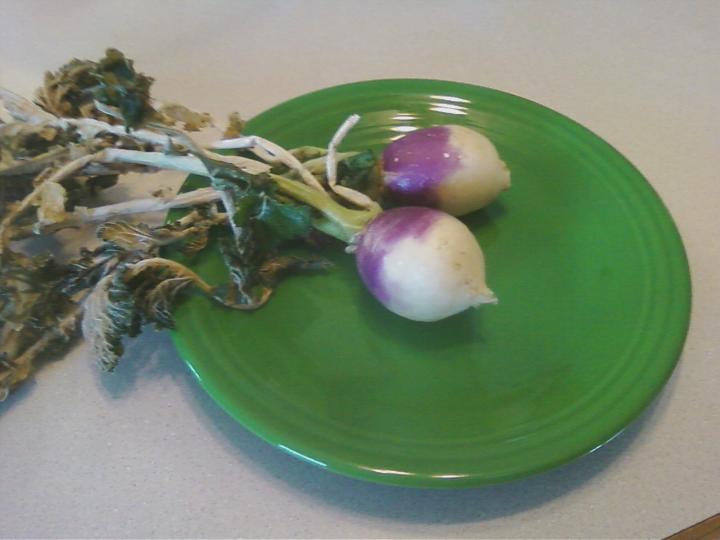
Even though the ground is frozen now, we were still able to find some turnips we could dig. We weren’t so lucky with the radishes as they were too long and broke off. Although the turnips are rather withered now, the crop turned out exceptionally good. The best part for me was seeing green, living plants where there had been brown, stripped, broken off, dead corn and soybean plants.

It was also kind of fun watching the cattle munch on the food this cover crop provided. They seemed quite content and happy to have something to eat.

I suppose you are also wondering if I cooked some turnips for Dan and tried to slip them by him, passing them off as mashed potatoes? No, I didn’t. After all, he is the one that helped me dig them so he knew they were in the house. However, he also knows I have an ornery side and maybe he had better be careful when I make mashed potatoes!

Until we walk again …

Uncategorized

Zimfo Bytes

Talia Goes

    Zimfo Bytes

  • Farmtrade LLC, announced that it will be changing the XSAg.com name to Farmtrade.com in the Summer of 2014.
  • The Alliance for a Green Revolution in Africa announced a five-year project that seeks to increase incomes of smallholder farmers through the creation of an enabling policy environment in Africa.
  • Alan Holm of Sleepy Eye, Minn., has been elected to a three-year term on the board of CHS Inc., the nation’s leading farmer-owned cooperative and a global energy, grains and foods company.
  • DMA Solutions, Inc. has created the 2014 Produce Marketer’s Master Calendar featuring important and helpful dates that produce marketers need to know as they plan their event and communications strategies for the New Year.
Zimfo Bytes

BASF on Cutting Edge of Seed Enhancement

Cindy Zimmerman

asta-css-basf-neilThe just released CropLife Foundation report shows just how important seed treatment is becoming for agricultural production and today at the ASTA CSS 2013 and Seed Expo we heard how BASF Crop Protection has moved to the forefront of seed enhancement to help farmers get the most out of every acre.

“Seed enhancement is one of the fastest growing segments of the industry,” said Neil Bentley, director of marketing for the BASF U.S. Crop Protection business. “Seed is one of the most expensive investments that a farmer makes each year. We want to make sure that’s maximized.”

Thanks to the integration of Becker Underwood into the BASF family over the past year, BASF’s Advanced Seed Enhancement platform includes a number of important products that can accomplish increased emergence and help farmers get more from every acre. “Those products include Vault HP + Integral in soybeans and Stamina F3 for cereals,” said Neil. “We also have Flo Rite Plantability Polymers, a very interesting technology that can help a grower maximize the amount of active ingredient that stays on a seed and also helps seeds flow better through planters.”

Neil pointed out that just a 5% stand loss on 3,000 acres of soybeans could cost a farmer nearly $85,000 in a growing season so anything they can do to help growers minimize that loss means more from every acre.

Listen to my interview with Neil here: Interview with Neil Bentley, BASF

2013 ASTA CSS & Seed Expo Photo Album

ASTA, Audio, BASF, Seed

Monsanto Novozymes Bioag Alliance

Chuck Zimmerman

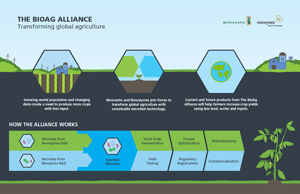
The Bioag AllianceMonsanto and Novozymes jointly announced a “long-term strategic alliance to transform research and commercialization of sustainable microbial products that will provide a new platform of solutions for growers around the world.”

The BioAg Alliance will allow the companies to leverage employees, technologies and commercial assets in the companies’ agricultural biologicals portfolios. The BioAg Alliance is unique in the industry, bringing together Novozymes’ commercial BioAg operations and capabilities within microbial discovery, development and production with Monsanto’s microbial discovery, advanced biology, field testing and commercial capabilities. The result will be a comprehensive research, development and commercial collaboration to help farmers globally meet the challenge of producing more with less in a sustainable way – for the benefit of agriculture, consumers, the environment and society at large.

“As the world population grows at tremendous pace over the next decades, we need to significantly increase the output from our land without increasing the pressure on the environment,” says Peder Holk Nielsen, CEO of Novozymes. “Today, we forge a game-changing alliance with the potential to transform global agriculture. The combined capabilities of Novozymes and Monsanto create an innovation powerhouse with a unique opportunity and approach to unleash the transformational opportunity in naturally derived microbial solutions in agriculture.”

“Monsanto, Novozymes and the farmer customers we serve share a need to meet growing demand in a sustainable way, and investing in the research and development of agricultural biological technologies like microbials is another step in that direction and a natural extension of our core business,” says Robb Fraley, Ph.D., Chief Technology Officer of Monsanto. “Just as Monsanto has done with leadership investments in our precision agriculture platform, we see this collaboration as being the same type of catalyst for taking our biologicals work from a technology to a full-fledged platform that represents the next layer of opportunity for growers to drive yield and productivity while helping the preservation of finite natural resources in our precious planet.”

The companies held a press call in which you can listen to here: Monsanto/Novozymes Bioag Alliance Call

Agribusiness, Audio, Biotech

Application of PRRS Control Protocols

Jamie Johansen

BI-PRRS-13-64-editedThe recent Boehringer Ingelheim PRRS Seminar in Chicago, IL, brought swine animal health experts from around the world together to discuss research studies and compare and contrast notes on the PRRS virus.

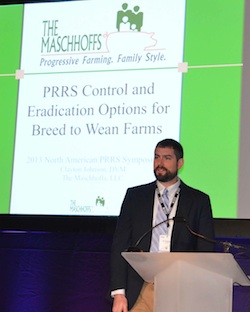
I spoke with Dr. Clayton Johnson after his presentation on the application of PRRS control protocols. Dr. Johnson is the Director of Health at The Maschhoffs.

“We were fortunate to get exposed to a lot of the good work that was coming out of the University of Minnesota last year in the time to negative pig study. That work allowed us to make make some estimates about what prior immunity was worth on our sow farms. Sow farms that had been exposed to PRRS and particularly sow farms in high pig density areas where they typically get exposed to PRRS on a regular basis. What is that prior immunity worth knowing they are likely to be exposed despite our best bio security methods. What we found through Daniels (Dr. Daniel Linhares, PIC/Agroceres) work was that the prior immunity could be quantified in the terms of weaned pig output out of that sow farm in the face of the next PRRS break. That weaned pig output was distractingly higher on farms with prior immunity compared to farms that were naive to prior immunity.”

Dr. Johnson also hit on the load, close and expose strategy they take in PRRS management, compared current performance vs. historical performance and their research into bringing the immunity to gilt development farms.

Listen to my interview with Clayton here: Interview with Dr. Clayton Johnson, The Maschhoffs

Here are photos from the event:2013 BIVI PRSS ARC&E Seminar Photo Album

Agribusiness, Animal Health, Audio, Boehringer Ingelheim, Swine

Meet ASTA’s New Director of Communications

Leah Guffey

J Walters PhotoAfter managing communications for the National Corn Growers Association (NCGA) for the last five years, Janice Walters is now the lead communicator for the seed industry.

As the brand new director of communications for the American Seed Trade Association (ASTA), Janice is working closely with President and CEO Andy LaVigne to promote the seed industry’s regulatory and legislative positions, as well as its many initiatives to support seed education and research, careers in the seed industry, and the quality management, movement and stewardship of seed.

During ASTA CSS 2013 and Seed Expo, I caught up with Janice to talk about her new role and, more personally, her two bundles of joy at home. Janice is originally from Galesburg, Illinois but she and her husband now live outside of Washington, D.C. with their 8-month-old twin boys.

Listen to my interview with Janice here: Interview with Janice Walters, ASTA

2013 ASTA CSS & Seed Expo Photo Album

ASTA, Audio, Corn, Seed