
Alliance to Feed the Future’s Communicator of the Year

Jamie Johansen

Screen Shot 2014-12-11 at 8.40.19 AMThe Alliance to Feed the Future has announced that Diana Prichard is the second recipient of its Communicator of the Year Award. The award, given in collaboration this year with the American Meat Institute, recognizes effective and innovative new voices that are enhancing the public dialogue about modern food production through multi-channel communications, including social media.

Prichard, a farmer and mom who owns a small farrow-to-finish hog operation in the heart of Michigan’s farm country, was bestowed the honor on December 10th at the 16th Farm Journal Forum at the Loews Madison Hotel in Washington, D.C.

Growing up in rural Mid-Michigan, Prichard is now a first-generation hog farmer, as well as a freelance writer, photographer, speaker, and filmmaker.

Prichard says that her interest in communicating about agriculture stems from her own experiences building a farm. “When you’re selling products directly to consumers, you have this constant line of communication open with them about what messages they’re getting about food. From the very earliest days, people were asking us to guide them. I always felt like I had a responsibility to provide answers that were true to the best of my ability. I turned to writing to distill what I was learning in farming simply because it was the most natural for me.”

Prichard adds, “Most people in the farming industry were born farmers and are learning to become communicators. I was born a communicator and am learning to become a farmer. For reasons that often allude even me, I’ve been accepted and welcomed to the farming community as if I were always here. To me, that acceptance, like this award, really speaks to the premium the agriculture industry places on open dialogue.”


Read More

Ag Groups

Tax Break Poll Results

Jamie Johansen

New Holland ZimmPollOur latest ZimmPoll asked the question, “How should Congress handle tax breaks?”

Congress is once again considering a package of tax breaks for businesses and individuals that include everything from section 179 deductions to renewable energy tax credits. An overwhelming majority believe a flat tax is the answer. Will Congress think the same? Making tax breaks permanent and not allowing them at all tied for second place in our poll. Still looks like many are all over the board on what they think should be done.

Here are the poll results:

  • Make them permanent – 18%
  • One year at a time – 10%
  • Keep letting them expire & renew – 3%
  • Don’t allow any – 18%
  • Two words – FLAT TAX – 43%
  • Don’t know – 5%
  • Don’t care – 3%

Our new ZimmPoll is now live and asks the question, What’s the biggest challenge for the seed industry?

The seed industry gathered in Chicago for the annual seed expo and research symposium for corn, soybeans and sorghum and many issues were discussed. Since all of agriculture depends in some way on seed, the long term survival of that industry impacts everything from food and feed, to fuel and fiber, to flowers. What do you see as the biggest issues for the future of the seed industry?

ZimmPoll

The View From Here

Melissa Sandfort

imageToday Aunt Jeanette writes:

Several weeks ago Dan was at a board meeting in San Antonio, Texas. He sent a text to me while he was on the San Antonio River Walk. It was a gorgeous day there. Unfortunately, our weather had changed – it was cold and WINDY! As the texts went back and forth between us, he asked how I was planning to spend my day. Sadly, I said I was going to buy a treadmill because I just couldn’t walk outside in the windy, uncertain winter weather conditions and I couldn’t stand not walking at all.

That is exactly what I did that very afternoon. Although the treadmill sat in the box for a few days until our youngest son had time to assemble it, it is now up and running. Or I should say walking! I put it in one of our sons’ old bedrooms upstairs with a view of our trees, driveway, and bins. Although it isn’t the same as walking outside, at least I can see out the window and let my imagination take over.

I have also discovered I can do other things while I walk on the treadmill. I caught up on all the magazines that were neglected during harvest. More importantly, I found that I could read books! That makes walking on the treadmill much more enjoyable. Sometimes I don’t even realize how long or how far I have walked.

It really is the best of both worlds. I can choose to watch the sun rise or the sun set. I can choose to read magazines or a novel. I can watch the activity in the yard. Or I can make lists, and write stories, songs, and poems in my head – all from the comfort of my warm, wind-free home!

(Editor’s note: See, I told you how important WALKING was to me and Aunt Jeanette!)

Until we walk again …

Uncategorized

System Based PRRS Control

Jamie Johansen

bivi-prrs-14-157-editedAs veterinarians and researchers gathered for the 20th North American PRRS Symposium they heard from many speakers who shared insights into the virus. One was Dr. John Kolb who is a professional services veterinarian working in the key account section of Boehringer Ingelheim. He talked about the application of a system-based PRRS control methodology which provides a systematic approach for control of PRRS in a region keeping cost in mind and also providing documented, repeatable value to producers.

The control project consisted of three large-scale sow farms in different geographical locations and each showing signs of severe reduction of production. Dr. Kolb shared more about the pool of methods and materials used in control project in an interview. But all herds basically used the same loading and closing of sow farms, vaccination of replacement gilts and all weaned pigs with different protocols.

“It was routine checking of the system. Until you test, you don’t really know what’s going on,” said Dr. Kolb. “It was about focusing on the teams at different levels: the sow farm team, the nursery team and finishing teams. Helping them to understand how PRRs virus would act in their population and the things that they could do to change that.”

The results proved the methodology worked. All farms demonstrated significant improvements in average daily gain and mortality. Utilizing herd closure and modified-live vaccines can mitigate the infection and improve health and performance.

Listen to my complete interview with Dr. Kolb to hear the key lessons learned from the PRRS control project here: Interview with Dr. John Kolb, Boehringer Ingelheim

Find all the photos from the event here: 2014 BIVI PRRS Seminar Photo Album

Agribusiness, Animal Health, Audio, Boehringer Ingelheim, Swine

ASTA CSS Focus on Pollinators

Leah Guffey

15990831572_d0d54838d2_mThere has been an increasing focus on pollinators lately, but the Pollinator Partnership has been working on pollinator health issues for the past 18 years with a diverse set of partners.

Partnership executive director Laurie Davies Adams was on a panel focused on keeping pollinators safe during ASTA CSS in Chicago this week providing an update on the organization’s latest activities. “This is an issue that concerns all of us,” said Adams. “It’s critical to food production, food security, food sustainability, but also ecosystems … we need to work together on this.”

Adams says the partnership formed the Corn Dust Research Consortium with stakeholder groups to focus specifically on research in corn and honeybees and develop management techniques for the industry. In it’s second year now, she says they have already come up with 37 different recommendations for different groups from farmers and ranchers to chemical companies.

Learn more in this interview: Interview with Laurie Davies Adams, Pollinator Partnership
2014 ASTA CSS & Seed Expo photo album

Coverage of CSS 2014 and Seed Expo brought to you by
Coverage of CSS 2014 and Seed Expo brought to you by the American Seed Trade Association and Coverage of CSS 2014 and Seed Expo brought to you by BASF Ag Products
Ag Groups, ASTA, Audio, Bees, pollinators, Seed

Ag Broadcasting Legend Trobak Passes

John Davis

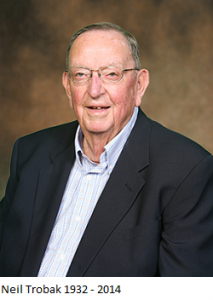
trobak1A guy who was the golden voice filling the airways with information in Western Iowa has died unexpectedly. Neil Trobak, a 57-year broadcast veteran and member of the National Association of Farm Broadcasters (NAFB), of Carroll, Iowa, was 82. His obituary and remembrance from Sharp Funeral Home is here.

Neil Ivan was born on July 6, 1932 at Crooks, South Dakota the son of Nels and Lillian (Larsen) Trobak. He attended school in Crooks and later graduated from Augustana College in 1954. Neil served in the United States Marines from 1954 to 1956 and after his honorable discharge attended and graduated from Brown Institute, a radio-training school in Minneapolis, Minnesota.

In May of 1957 he moved to the Carroll community where he began his career with Carroll Broadcasting. While employed at the radio station he served in many capacities. “The Voice” of Carroll Radio, Neil did sportscasting, newscasting, and was general manager for 13 years. In his later years with the station, Neil was known as “the F&F guy” announcing farm and funeral information in the mornings and afternoons.

On June 23, 1990 Neil was married to Joan Presnell Happe at St. Lawrence Catholic Church in Carroll.

Neil will also be remembered for his public service to the Carroll community being active as a County Supervisor and also served on the Carroll Area Child Care Center Board, Carroll Area Development Board, Region 12 Council of Government Board, Emergency Management/911 Board as well as various other boards.

Funeral services will be held at 10:30 a.m. Friday, December 12, 2014, at St. Paul Lutheran Church in Carroll.

As a guy who grew up listening to Neil, I can tell you that his was the voice we all listened to. Heaven’s getting one heck of a voice.

NAFB

Samuelson Honored by American Agri-Women

John Davis

Orion SamuelsonAward-winning ag broadcaster Orion Samuelson has been honored by the American Agri-Women (AAW) with its VERITAS award. This AAW news release says the group handed at the award at its 39th annual convention in Ohio.

Its VERITAS award is the highest award given to a non-member. It is given annually to a person who has given public witness to “the pursuit of truth” in accordance with the principles enunciated in the AAW statement of philosophy, “The Call to Power.”


Samuelson is the host of two nationally syndicated radio shows, The National Farm Report and Samuelson Sez, and co-host with Max Armstrong of the weekly TV show on RFD-TV This Week in AgriBusiness. After more than 54 years of broadcasting 16 daily agribusiness reports on WGN Radio in Chicago, Samuelson has an unequalled record of service to the nation’s farmers. The most honored agriculture journalist in the country, Samuelson is a member of the Scandinavian- American Hall of Fame, the National 4-H Hall of Fame, the National Association of Farm Broadcasters Hall of Fame and the National Radio Hall of Fame, where he was presented for induction by broadcast legend and friend Paul Harvey. Samuelson grew up on a farm in the Kickapoo Valley of Wisconsin.

“It is truly an honor to receive this recognition for just doing my job and I am grateful to American Agri-Women. I am even more grateful for the work AAW has done for 40 years by emphasizing the role of women in agriculture and using member talents to help the 98% of our population not involved in farming understand what it takes to put food on their table, a roof over their head, clothing on their back, and now, energy in the tank. I remember the founding of AAW and have shared your activities with my audience for four decades,” Samuelson says.

Ag Groups, Agribusiness

2014 Census of Horticulture Underway

John Davis

census_logoThe U.S. Department of Agriculture has started 2014 Census of Horticultural Specialties. This news release says the National Agricultural Statistics Service (NASS) is conducting the survey that will provide a comprehensive picture of the horticultural sector of the U.S. economy, along with offering detailed production and sales data for the U.S. floriculture, nursery and specialty crop industries, including greenhouse food crops.

“The recent Census of Agriculture quantified the value of nursery and floriculture products alone at more than $14.5 billion in 2012, showing just how important this part of U.S. agriculture is,” said NASS Administrator Joseph T. Reilly. “Additional information supplied in the 2014 Census of Horticulture will be used to help develop new technologies and programs to support sustainability and growth within this agriculture sector.”

In mid-December, NASS will mail the census to approximately 40,000 horticultural operations in the United States that grew and sold $10,000 or more of horticultural specialty products, as reported in the 2012 Census of Agriculture. Producers are asked to provide information on horticultural activities conducted during 2014, including production of horticultural crops, value of products, square footage used for growing crops, production expenses and more. Growers can complete the census securely online at www.agcensus.usda.gov, or return their questionnaire by mail by February 5, 2015.

The Census of Horticulture only comes along once every five years, and NASS promises to keep all individual information confidential.

Agribusiness, USDA

BASF Talks Emerging Seed Industry Trends at CSS

Cindy Zimmerman

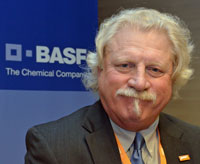
asta-css-basf-mcfatrichTwo main trends emerging in the seed industry are biological crop inputs and seed coatings, according to Mike McFatrich, BASF global seed solutions business director.

“I think we have seen a real increase in looking at more sustainable options and being able to do more with less,” said McFatrich at this week’s CCS 2014 and Seed Expo in Chicago where BASF is a major sponsor. “Both the biological crop input products, which impart either a biofungicide or nutrient-enhancing characteristic, and the seed coatings are two very strong trends moving forward.”

McFatrich says both of these areas are specifically interested in these two areas and the acquisition of Becker Underwood two years ago has helped the company broaden its footprint in that space. “When we look at the combination of traditional seed applied fungicides and insecticides with biologicals and coatings, we’re looking at extending the window of protection,” he explained.

Listen to my interview with Mike here: Interview with Mike McFatrich, BASF
2014 ASTA CSS & Seed Expo photo album

Coverage of CSS 2014 and Seed Expo brought to you by
Coverage of CSS 2014 and Seed Expo brought to you by the American Seed Trade Association and Coverage of CSS 2014 and Seed Expo brought to you by BASF Ag Products
ASTA, Audio, BASF, Crop Protection, Seed

Seed Industry to Launch Consumer Education Effort

Cindy Zimmerman

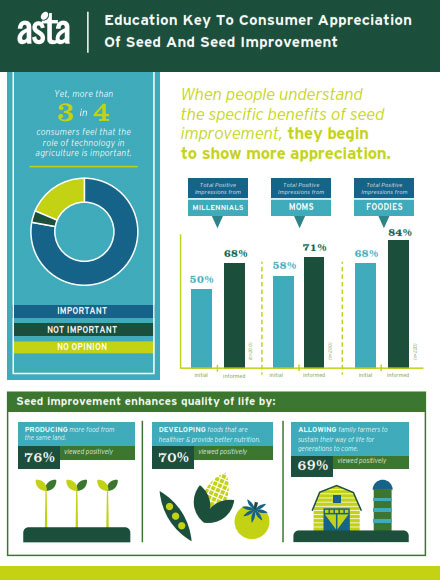
asta-infoThe American Seed Trade Association (ASTA) today unveiled results of new research that shows consumers have a lack of knowledge and appreciation for the importance of seeds and seed improvement, until they are presented with specific examples of the environmental, economic and health benefits of seed.

ASTA president and CEO Andy LaVigne briefed members of the media during the CSS 2014 & Seed Expo in Chicago. “The agricultural industry recognizes the significance of seed innovations and that many of the things that improve our quality of life can be traced back to a seed,” said LaVigne. “But, when we reach beyond the industry, we realize we have work to do in educating people about the value of seed and seed improvement.”

ASTA surveyed more than 600 moms, millennials and “food-focused” people – three consumer segments recognized for driving conversation around food issues and who have significant purchasing power – to measure consumer awareness regarding the role seed innovation plays in improving quality of life. According to LaVigne, the survey revealed that the work of the seed industry is generally undervalued among educated consumers. Yet three in four educated consumers believe that the role of technology in agriculture is important.

“When we spent time with those consumers and shared additional information about the seed industry, they began to show increased appreciation and understanding of seed improvement and innovation,” said LaVigne. Specifically, survey respondents were provided examples of seed improvements in areas of food, feed, fuel and fiber. Total positive impressions among millennials increased by 18%, total positive impressions among moms increased by 13% and total positive impressions among foodies increased by 16%.

Listen to Andy explain the research and how they hope to use it to educate specific target groups with the message “Seed – Where Better Life Begins.” ASTA CEO Andy LaVigne unveils consumer research
2014 ASTA CSS & Seed Expo photo album

Coverage of CSS 2014 and Seed Expo brought to you by
Coverage of CSS 2014 and Seed Expo brought to you by the American Seed Trade Association and Coverage of CSS 2014 and Seed Expo brought to you by BASF Ag Products
ASTA, Audio, Research, Seed