First Doan Award Presented

Cindy Zimmerman

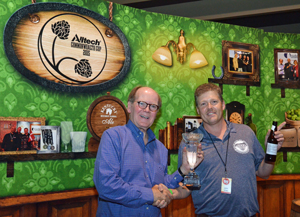
Doan winner Michelle Rook, with Sen. Pat Roberts and Sara Wyant, Agri-Pulse

Doan winner Michelle Rook, with Sen. Pat Roberts and Sara Wyant, Agri-Pulse

The very first Doan award honoring Excellence in Reporting Agriculture was presented at Washington Watch this week to Michelle Rook, managing farm director at WNAX in Yankton, SD.

The Doan is named after Stewart Doan, a farm broadcaster and senior editor at Agri-Pulse, who passed away suddenly in May 2012. He was known for his passion for politics and determination for delivering breaking farm and rural policy news. The Doan was presented by the NAFB Foundation, through a gift from Agri-Pulse Communications. “It’s extremely fitting that this award for excellence in agricultural reporting is named The Doan,” said Agri-Pulse Editor Sara Wyant. “Stewart Doan was one of the most persistent and dedicated journalists I have ever known. He wanted to get the story first but also make sure it was done right in order to better inform our audience.”

Michelle’s winning entry titled “Rail Crisis Costs Northwestern Corn Belt Farmers” outlines the crisis, the cost and some solutions – along with the railroads’ response. A Certificate of Merit was also awarded to Susan Littlefield, farm director at KZEN, Columbus, NE for her entry titled “Behind the Chutes”, a special report on the rodeo cowboy and their role during the rodeo.

Happy to see the “globe” resurrected for this award. I still have mine from 1990, one of the last years they did that.

During his visit with the NAFB members to present the award, Sen. Pat Roberts (R-KS) answered a few questions on a wide range of topics, including the budget, tax code, crop insurance, Cuba, and TPA. Sen. Roberts takes questions from farm broadcasters

Agri-Pulse, Audio, Media, NAFB

Chicken Litter – A Hot Commodity

Jamie Johansen

cms-15-141-editedJenny Rhodes, Extension Educator for University of Maryland in Queen Anne’s County and local poultry farmer, was asked to attend the 2015 Chicken Media Summit to talk about chicken manure. For her first 10 years in extension, Jenny wrote nutrient management plans. These plans are state mandated and any farmer meeting it’s requirements must have one for their operation.

“In the plan, we estimate the amount of manure on their farm and then work in a prescription approach. We test the soil, we test the manure, we know what nutrients the crop is going to take in and we write the farmer a prescription for that.”

Jenny sat on the myths and facts panel during the event and busted the myth that chicken litter is a waste product and farms are major sources of pollution. In fact, we heard from a local farmer that he wanted to buy chicken manure and couldn’t even find it. The hot commodity is an excellent source of fertilizer for all crops and these nutrient management plans aid farmers in knowing the exact amounts needed for an individual field.

“We are family farmers and we all want the same thing. We all want clean water and safe food.”

Learn more about nutrient management plans in my complete interview with Jenny here: Interview with Jenny Rhodes, University of Maryland Extension

Find photos from the event here: 2015 Chicken Media Summit Photo Album

Ag Groups, Audio, Chicken Media Summit, Fertilizer, Poultry

GROWMARK Crop Update

Cindy Zimmerman

2015-corn-plantAnother 10% of the nation’s corn crop was planted last week, bringing the total now a couple of points ahead of last year but still behind the five year average.

According to the latest progress report from USDA, farmers now have 19% of the corn crop in the ground and two percent has emerged, most of it in non-Corn Belt states.

laatsch-growmarkI had an opportunity last week to visit with GROWMARK Insect and Plant Disease Technical Manager Tim Laatsch to talk about how conditions are looking this season around Illinois.

“It’s sort of a tale of two cities,” said Laatsch. “The southern third of Illinois has been extremely wet with almost no field activity occurring. Those conditions gradually improve as you go northward.”

Laatsch says corn planting in Illinois jumped from near zero to 15% the week ending April 19, and farmers more than doubled that last week. One percent of the corn is emerged in Illinois and Laatsch says some of that early emerged corn was greeted with freezing temps last week. “The bigger problem is corn that has not yet emerged, it’s subject to any number of problems when soil conditions are wet and now turned cool,” he said.

Laatsch has spent the past few weeks scouting wheat fields in Illinois where just two percent of the crop is headed, compared to 16% for the five year average. “What we’re seeing is conditions setting up favorably for disease development in the wheat crop,” he said. “If conditions remain somewhat wet and humid and temperatures start warming up, we could see some moderate to severe foliar disease pressure develop.” Meanwhile, he is seeing little insect pressure in wheat at this point.

Tim has more observations in this interview: Interview with Tim Laatsch, GROWMARK

Audio, Corn, GROWMARK, Wheat

Anniversary of Bayer Bee Care Center

Chuck Zimmerman

Bayer Bee Care CenterBayer CropScience celebrated the first anniversary of their North American Bee Care Center located in RTP, NC. The center is open for public tours and today there was a lot of touring going on. Thanks to Jeff Donald for a photo. Wish we could have been there.

After some lunch time remarks for the media to update them on key successes from the first year the afternoon was dedicated to self-guided tours. The Bayer Bee Care Center unifies Bayer’s efforts to understand, research, promote and communicate on bee health.

Bayer’s Jim Blome and Becky Langer were joined by Dr. Richard Reich, agricultural services assistant commissioner, North Carolina Department of Agriculture & Consumer Services, who spoke of the importance of the Center’s work, public-private partnerships and the importance of agriculture to the North Carolina economy. You can listen to some remarks from them here: Bee Care Center Remarks

Bayer Healthy HivesAt the celebration, Bayer announced a new initiative focused on finding solutions to improve the health of honey bee colonies in the U.S. – Healthy Hives 2020. As part of the initiative, Bayer will partner with stakeholders and experts on bee health and establish an advisory council to discuss strategies to improve honey bee health by the year 2020. The first meeting of members of the inaugural council will take place June 2-3, 2015 at the Bee Care Center.

Agribusiness, Bayer, Bees

NCGA Staff Changes

Cindy Zimmerman

NCGA-LogoThe National Corn Growers Association has made some staff changes designed to emphasize market development and sustainability.

For one, NCGA will begin an immediate search for a Vice President of Market Development, who will be responsible for managing marketing initiatives to build demand for ethanol, livestock feed, biobased products and food uses of corn.

In addition, NCGA announced that Fred Stemme is being promoted to Vice President of Marketing and Operations as he takes over new management responsibilities. Paul Bertels will continue to serve the organization as Vice President of Production and Sustainability, and Vice President of Administration Rodger Mansfield is stepping down after 19 years of service to the organization.

“Looking to the future and continued productivity increases from our corn farmers, we need to be looking for new markets to create sustainable opportunities for today’s farm families,” said NCGA CEO Chris Novak. “Sustainable corn production is a major priority for food chain partners and consumers.”

The announced changes went into effect immediately and details regarding the new Vice President of Market Development position will be available soon.

Corn, NCGA

Zimfo Bytes

Talia Goes

Zimfo Bytes

  • Steve Sweitzer, Woodruff Sweitzer chief creative officer and agency principal, will retire effective April 22.
  • Swanson Russell has named Megan Carroll to associate interactive producer in its Lincoln office.
  • On May 19, the North Carolina Biotechnology Center’s AgBiotech Initiative is again convening ag biotech entrepreneurs, investors, researchers, and technology scouts for the third Ag Biotech Entrepreneurial Showcase in Research Triangle Park.
  • The Georgia Peanut Commission attended the Georgia School Nutrition Association annual conference held April 9-11 in Athens, Georgia.
Zimfo Bytes

How Will High Path Avian Flu Impact Industry?

Jamie Johansen

New Holland ZimmPollOur latest ZimmPoll asked the question, “What is your favorite alternative fuel (to gasoline)?”

A hands down winner in this week’s poll on alternative fuels was ethanol. Which is not a surprise. However, many may be surprised to see the clear runner-up was solar. We had many chime in for the other category. A few of those included: algae diesel, biohydrogen and biobutanol.

Here are the poll results:

  • Biodiesel – 10%
  • Ethanol – 42%
  • Propane – 9%
  • Natural gas – 7%
  • Wind – 6%
  • Solar – 17%
  • Other – 9%

Our new ZimmPoll is now live and asks the question, How will high path avian flu impact industry?

The states impacted by high path avian flu are on the rise. The most recent outbreak in Iowa on a chicken egg farm has led us all to wonder the short and long term repercussions it will have on the industry, exports and prices for the consumer. In this week’s ZimmPoll we want to know if you think this flu strain will transform the industry or will it bounce back quickly?

ZimmPoll

Hoard’s Dairyman’s Acquisition of Hay & Forage Grower

Chuck Zimmerman

hay-forageA company with a long history of innovating in the dairy world is taking over a publication that covers a wide variety of feed for cattle, especially in the dairy realm. Hoard’s Dairyman magazine recently bought Hay & Forage Grower, including the publication’s database. I met with Gary Vorpahl, Vice President at Hoard’s, during the Agri-Marketing Conference to talk about the deal.

“Right after the first of the year, we acquired Hay & Forage Grower,” he said, adding that his company recognizes there are big variations in how the different livestock producers feed based on where they are and what they’re trying to accomplish.

Gary said his company has always tried to do things some believe couldn’t be done. He cited how the company founder, W.D. Hoard, bucked the trend in the late 1800s in Wisconsin and tried to grow alfalfa, thought not hardy enough to make it through the tough local winters. “He proved it could live through a Wisconsin winter, and that’s how alfalfa became the major staple for the dairy industry.”

Gary also admitted they’ve been “standing on the end of the diving board” for some time, and now they’re ready to jump into this venture in Hay & Forage Grower. They expect to have their first hard copy issue available in August and September before World Dairy Expo, but they also hope to have an online version in the coming weeks. Webinars and e-newsletters are also in the works.

Listen to my interview with Gary here: Interview with Gary Vorpahl, VP, Hoard’s Dairyman Magazine

2015 Agri-Marketing Conference Photo Album

Coverage of the 2015 Agri-Marketing Conference is sponsored by New Holland and Brownfield Ag News
Coverage of the 2015 Agri-Marketing Conference is sponsored by New Holland     Coverage of the 2015 Agri-Marketing Conference is sponsored by Brownfield Ag News for America
Audio, Dairy, Forage, Hay, Media, NAMA

FAO & Partners Launch Pastoralist Knowledge Hub

Chuck Zimmerman

Pastoralists HubDo you know what a pastoralist is? Here’s one definition: a grazier or land-holder raising sheep, cattle, etc, on a large scale. Kind of sounds like a rancher to me. Why do I bring it up? Because the FAO and partners announced an online Pastoralist Knowledge Hub today. Their hope is that this will provide a platform for these folks to have a bigger voice in international policy debates and share valuable information to strengthen their agricultural livelihoods.

The Pastoralist Knowledge Hub – launched today by FAO, the European Union, Germany and other partners – will enable mobile livestock keepers to connect, to meet and discuss issues like agricultural innovations or land regulations and find shared solutions to common challenges.

“Pastoralists are able to produce food where no crops can be grown. Yet, their concerns are poorly heard by the international community,” Helena Semedo, FAO Deputy Director-General, said on Monday. “This hub is an important platform to help them project their voices, share knowledge, and affect policy debates.”

The hub also offers a growing database of research on pastoralism, contacts for a worldwide network of pastoral representatives, and discussion forums for pastoralist networks and partnering institutions.

You can learn more about it by listening to this FAO interview with Pablo Manzano. He is the Coordinator of the Pastoralist Knowledge Hub. In the interview, conducted by Sandra Ferrari, he elaborates on some of the challenges facing pastoralists today and how the knowledge hub can potentially support them. Interview with Pablo Manzano

Audio, International, Livestock

Plant Geneticist Wins CAST Communication Award

John Davis

Prakash1A plant geneticist is being recognized for his efforts to communicate. Dr. Channapatna Prakash, an honored faculty member at Tuskegee University in Alabama, will receive the 2015 Borlaug Council for Agricultural Science and Technology (CAST) Communication Award for decades of using the written word, public presentations, and TV and radio and social media to deliver clear, science-based information to the public and policymakers alike.

Colleagues focus on the widespread influence Prakash has had in the agricultural community. As one nominator points out, Prakash’s position involves research and teaching, but he has “arguably done more than anyone else in academia or industry to promote agricultural technologies that can help feed the world’s growing population.”

Prakash was instrumental in establishing the prestigious plant biotechnology research and training program at Tuskegee University, and he has a long list of influential publications and presentations—he has presented his messages about agriculture in more than 70 countries. Through teaching, research collaboration, and lectures, he has worked especially hard to promote biotechnology research and policy in the developing countries of Asia and Africa.

Educated in India and Australia, Prakash has a strong connection with those who have made an impact on global food production. Norman Borlaug once praised him for “bringing common sense into the use of biotechnology,” and Julie Borlaug Larson says that Prakash—much like her grandfather—is “dedicated to utilizing science and technology to improve the standard of living and quality of life for the world’s most impoverished and marginalized populations.”

Prakash will be honored at the World Food Prize Symposium on October 14, 2015, in Des Moines, Iowa.

Ag Groups, Agribusiness, Research, World Food Prize