Zimfo Bytes

Lizzy Schultz

Zimfo Bytes

  • The Midwest Organic and Sustainable Education Service (MOSES), a Wisconsin nonprofit that is nationally recognized for hosting the country’s largest annual organic farming conference, has hired John Mesko to serve as the organization’s new leader.
  • Linda, L. Chezem J.D., a lawyer with 22 years of experience on the Indiana trial and appellate bench as well as a significant University-based career, has joined Protect The Harvest as a new member of the organization’s Board of Directors.
  • Charleston|Orwig recently announced the hire of Karen Potratz as a new Senior Account Supervisor within its client services team.
Zimfo Bytes

#IFAJTour16 – Part 12 – Bayer Phytobac

Chuck Zimmerman

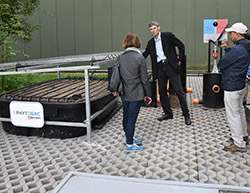
Bayer PhytobacHere is my final episode in a series from tour stops during the 2016 IFAJ Congress in Germany. In this program David Lembrich, Product Stewardship Manager at Bayer gives us an overview of the Bayer Phytobac system. This is a system Bayer has created to prevent contamination of surface waters. An example would be a crop protection products. Any pesticides in the rinse water that is left over after cleaning in the farmyard are broken down in exactly the same way as they would be naturally – only more efficiently. It is a customizable system for different size operations and needs. Here’s an infographic that might be helpful to understand the system.

The Phytobac™ system developed by Bayer experts ensures that contaminants cannot get into sewage systems or nearby bodies of water when spraying equipment is filled or cleaned on the farm. The dirty water first flows into a mud tank, where the rough dirt settles as sediment. The clear residual liquid is stored in the second tank and fed in doses into the substrate container filled with farm soil and straw. The straw serves as an additional source of carbon which promotes microbial degradation. Measurement and control elements regulate the soil moisture levels, creating ideal living conditions for microorganisms such as bacteria and fungi. The enzymes in these tiny helpers break down residues of fungicides, herbicides and insecticides while the water evaporates.

You can listen to the presentation here or watch below to learn more: David Lembrich, Presentation


2016 IFAJ Congress Photo Album

Coverage of the IFAJ Congress is sponsored by Coverage of the IFAJ Congress is sponsored by Bayer
Agribusiness, Audio, Bayer, Crop Protection, IFAJ, Sustainability, Video

Brownfield Reaches 20,000 Twitter Followers

Kelly Marshall

Brownfield Ag News Brownfield‘s social media presence is growing. Recently the ag news company surpassed 20,000 followers on Twitter; their presence on Facebook, Instagram and YouTube is also on the rise.

“Research shows that farmers of all ages continue to listen to the radio to get agricultural news and information, but seek out additional content sources as well,” said Cyndi Young-Puyear, Director of Brownfield & Ag Operations. “People want timely, relevant agricultural news and information and we do our best to provide what they want when and where they want it.”

In addition to the Brownfield Ag News Twitter account, all 12 of Brownfield’s award-winning anchor/reporters share original content daily from their individual Brownfield Twitter accounts.

Brownfield Ag News is one of the largest and oldest ag news radio networks in the nation.  They have more than 420 affiliate radio stations across the Midwest and 34 affiliated ratio station partners.  Find out mores at www.brownfieldagnews.com.

Agribusiness, Social Media

GROWMARK Puts 4R in Focus at #FarmProgressShow

Lizzy Schultz

fps-16-growmark-tim Nutrient management and stewardship was a hot topic at the 2016 Farm Progress Show, and the team at GROWMARK FS was on hand during this year’s event to speak with growers about a variety of innovative solutions to all of their nutrient management concerns.

Tim Berkland, Strategic Agronomy Marketing Manager for GROWMARK, sat down with AgWired’s Cindy Zimmerman to discuss some of the company’s latest nutrient management programs, including N-Watch , which pulls different soil samples at different times of the year to get a comprehensive soil profile for growers to stay as informed as possible when moving forward with nutrient management strategies.

“Nitrogen is so variable, it’s so weather dependent and changes from year to year, and N-Watch is just one program that we’re using to help growers dial in their nitrogen program,” said Berkland. “We work with growers on strategizing and building a nutrient plan, trying to place those nutrients at the right place and the right time while using the right source and the right.”

Learn more in Cindy’s full interview with Tim here:
Interview with Tim Berkland, GROWMARK

New Holland 2016 Farm Progress Photo Album

Coverage of the Farm Progress Show is sponsored by Coverage of the Farm Progress Show is sponsored by New HollandCoverage of the Farm Progress Show is sponsored by BASFCoverage of the Farm Progress Show is sponsored by Growmark
Ag Groups, Agribusiness, Audio, Crop Protection, Farm Progress Show, GROWMARK

Bayer-Monsanto Deal is Done

Cindy Zimmerman

bayer-logoBayer and Monsanto today announced that they signed a definitive merger agreement under which Bayer will acquire Monsanto for $128 per share in an all-cash transaction. Monsanto’s Board of Directors, Bayer’s Board of Management and Bayer’s Supervisory Board have unanimously approved the agreement. Based on Monsanto’s closing share price on May 9, 2016, the day before Bayer’s first written proposal to Monsanto, the offer represents a premium of 44 percent to that price.

“We are pleased to announce the combination of our two great organizations. This represents a major step forward for our Crop Science business and reinforces Bayer’s leadership position as a global innovation driven Life Science company with leadership positions in its core segments, delivering substantial value to shareholders, our customers, employees and society at large,” said Werner Baumann, CEO of Bayer AG.

monsanto“Today’s announcement is a testament to everything we’ve achieved and the value that we have created for our stakeholders at Monsanto. We believe that this combination with Bayer represents the most compelling value for our shareowners, with the most certainty through the all-cash consideration,” said Hugh Grant, Monsanto Chairman and CEO.

The combined agriculture business will have its global Seeds & Traits and North American commercial headquarters in St. Louis, Missouri, its global Crop Protection and overall Crop Science headquarters in Monheim, Germany, and an important presence in Durham, North Carolina, as well as many other locations throughout the U.S. and around the world. The Digital Farming activities for the combined business will be based in San Francisco, California.

“This combination is a great opportunity for employees, who will be at the forefront of innovation in our sector. This transaction also enhances Bayer’s strong commitment to the U.S., building on our 150-year history with operations across 25 states employing more than 12,000 people in the country. I am convinced that Monsanto will flourish as part of one of the most respected and trusted companies in the world,” said Baumann.

The companies will be holding a joint press conference at 8:30 central time.

Agribusiness, Bayer

Bayer Continues Investment in #FutureFarming

Chuck Zimmerman

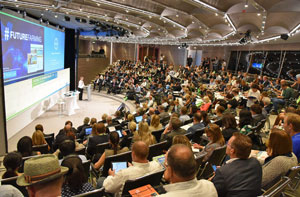
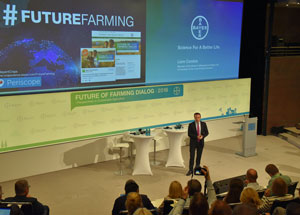
bayer-global-16-bethBayer and Monsanto today announced that they signed a definitive merger agreement under which Bayer will acquire Monsanto for USD 128 per share in an all-cash transaction. But “no comment” was the refrain last week when agricultural journalists were at Bayer headquarters in Leverkusen, Germany last week to talk about the future of farming. It was a fantastic event coordinated by the wonderful and talented Beth Roden and attended by about 200 journalists and bloggers, including a good group from the U.S., with several of us who were at the end of a marathon that had started with Farm Progress Show the week before!

The main message at the Bayer global press conference was continued investment in the Crop Science division to deliver new solutions for sustainable agriculture despite the current difficult business environment. “We are very confident about the long-term growth potential of the agricultural market,” said Liam Condon, Head of the Crop Science Division, in his keynote address. The company has earmarked EUR 2.5 billion for capital expenditure from 2017 to 2020 in addition to over EUR 1 billion annually for research and development.

bayer-global-16-liamDuring his address and also meeting with U.S. ag journalists, Condon talked about the company’s efforts in the emerging field of Digital Farming, currently selling and testing Digital Farming products in 10 countries and partnering with four “ForwardFarms” to demonstrate real life sustainable agriculture best practices, many of which rely on advances in Digital Farming.

Just about everyone tried to ask a question to get some kind of comment on the Bayer/Monsanto negotiations, and Condon was able to speak in generalities in answer to some of them – sort of. It’s fun to listen to! And you might find some comments to use with the announcement this morning that the deal is now done: Group interview with Liam Condon, Bayer

*Bayer and Monsanto have a press conference scheduled for 8:30 central time this morning*

Bayer Future of Farming Dialog 2016 Photo Album

Audio, Bayer

BASF Meets the Global Press #ShapeAg16

Cindy Zimmerman

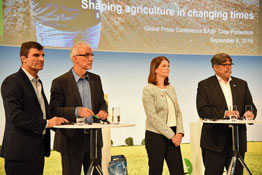
basf-german-16-pressBASF’s Crop Protection business continues to grow and the company is working to provide even more innovation and technology for farmers to keep doing the biggest job on Earth.

That’s the message that representatives of BASF gave during a global press conference last week in Germany. Speakers included (LtoR) Vincent Gros, Head of Europe, Africa and Middle East; Dr. Harald Schwager, Member of the Board of Executive Directors of BASF SE; Lena Adam, Head of Global Sustainability and Product Stewardship; and President Markus Heldt.

Dr. Schwager noted that BASF’s crop protection business sales have increased 75 percent over the past decade. “This outstanding performance shows that we deliver on our promises,” he said. “This confirms the importance of the Crop Protection division and its contributions to the BASF Group.”

For the remainder of 2016, BASF expects the agricultural market to remain volatile and the business environment to be challenging. Based on current developments, the financial goal for the Crop Protection division in 2016 is to strive for the same profitability level it reached in 2015. “Our sales force will be close to our customers. We will intensify our sales efforts, supported by the launch of new products and formulations,” said Schwager. “Changes lead to new opportunities for business growth and differentiation. We can look back with pride on BASF’s 100-year legacy of accomplishments in bringing breakthrough solutions for farmers to the market. Even more important is to look forward and to be part of an industry-leading team that helps shape and improve the future of modern agriculture,” concluded Schwager.

Listen to all of Harald’s remarks here: BASF Board of Executive Directors Member Harald Schwager

Gros and Adam discussed BASF’s stewardship efforts, what drives farmers, and how to meet their needs in a changing landscape. Listen to their remarks here. Vincent Gros and Lena Adam, BASF

You can find Markus’ remarks here.

BASF Global Press Conference Photo Album

Agribusiness, Audio, BASF

US Challenges Chinese #Rice #Wheat #Corn Support

Cindy Zimmerman

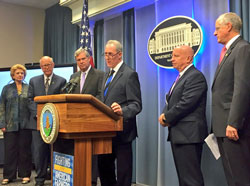
ustr-usda-chinaU.S. Trade Representative (USTR) Michael Froman, Agriculture Secretary Tom Vilsack, and a bipartisan group of federal lawmakers today announced the launch of trade enforcement action against China at the World Trade Organization (WTO). The action challenges China’s use of “market price support” for three key crops (rice, wheat, and corn) in excess of China’s commitments under WTO rules.

“These programs distort Chinese prices, undercut American farmers, and clearly break the limits China committed to when they joined the WTO. As this Administration has consistently and repeatedly shown, we will not stand by when our trading partners fail to follow the rules like everyone else,” said Ambassador Froman. “We will aggressively pursue this challenge on behalf of American farmers and hold the Chinese government accountable to the standards of fair global trade.”

“Through tariff cuts and the removal of other trade barriers, China has gone from a $2-billion-a-year market for U.S. agricultural products to a $20-billion-plus market,” said Agriculture Secretary Vilsack. “But we could be doing much better, particularly if our grain exports could compete in China on a level playing field. Unfortunately, China’s price supports have encouraged wheat, corn and rice production in China that has displaced imports. When China joined the WTO, it committed to limit this kind of trade-distorting support, which it has failed to do. This has resulted in significant losses to American producers. We see substantial opportunities to meet import demand for grains in China if China is willing to operate a WTO-consistent trade regime.”

“If we are to remain competitive in the global marketplace, it is critical that our partners adhere to and abide by the same rules that we have all agreed to,” said Senate Agriculture Committee Chair Pat Roberts (R-KS), one of a number of agriculture state lawmakers who appeared with Vilsack and Froman at the press conference. Others included Sen. Debbie Stabenow (D-MI), Rep. Kevin Brady (R-TX), House Agriculture Committee Chairman Mike Conaway (R-TX), Rep. Collin Peterson (D-MN), Sen. Heidi Heitkamp (D-ND) and Rep. Adrian Smith (R-NE).

Listen to the statements of all here: China Trade Challenge Press Conference

Audio, International, Trade

The Sustainability of #USSoy

Lizzy Schultz

ussec-16-4-edited Over 300 attendees at the 2016 U.S. Soy Global Trade Exchange came from nations outside of the United States, and Belinda Burrier, United Soybean Board Director for Maryland, made sure to utilize this global event as an opportunity to talk to international buyers and learn more about what properties of U.S. soy are making the greatest impact on buyers throughout the world.

“The international community wants to have U.S. soy because we are producing it sustainably,” she said in an interview during the 2016 event. “We are concerned our soil, our air, and our water, and we want to produce the best product that we possibly can, and it’s showing up in the amount of soy that we sell internationally.”

Burrier is truly working to put a face on the American farmer as she markets U.S. soy to a global audience. She has completed a number of international missions through her position with the United Soybean Board, and sustainability is always the top priority in her conversations whenever she is networking overseas.

“Soybean growers are very busy, and it’s important that we get out there and speak about the industry, especially about how sustainable we are, and promote the industry throughout the world,” she said.

Learn more in Jamie’s full interview with Belinda here:
Interview with Belinda Burrier, United Soybean Board

View and download photos from the event here: 2016 U.S. Soy Global Trade Exchange Photo Album

Ag Groups, Audio, Soybean, Sustainability, USB, USSEC

BASF Helping to #ShapeAg16

Cindy Zimmerman

basf-germany-16-markus-wideDozens of journalists from around the globe attended the BASF Global Press Conference last week in Ludwigshafen, Germany, including several from the United States.

Given the opportunity to speak with BASF Crop Protection president Markus Heldt, the journalists were most interested in finding out what his thoughts were on the negotiations between Bayer and Monsanto – and he had much the same answer that representatives from those companies have at this time. “It’s really too early to consider the consequences,” said Heldt. “We don’t comment on rumors on competitors.” However, Heldt did say that there are anti-trust concerns and BASF is continuing to watch the process.

Heldt was more interested in talking about the investments that BASF Crop Protection is making in its product portfolio as division sales increased by 75% over last decade and working toward the approval of the dicamba formulation Engenia. “We are the largest dicamba producer in the world,” said Heldt. “We will be a supplier to other companies but we will also market and position our own dicamba-based technology in cotton and soybeans, that’s where Engenia is fitting.” He further discussed some of the stewardship issues that have developed this year with farmers using other dicamba formulations with already approved dicamba-tolerant crops.

Listen to the U.S. ag journalists conversation with Heldt here: Interview with Markus Heldt, BASF

BASF Global Press Conference Photo Album

Audio, BASF, Crop Protection