
IL GROWMARK Essay Contest Winner Announced

Kelly Marshall

Jill Sackville from Aldeo, Illinois has been announced the Illinois winner of the 2017 GROWMARK essay contest for FFA students.  Sackville wrote an essay to answer the prompt: “What value do cooperatives provide to today’s farmers?”

“Today’s cooperatives still play a pivotal role in farming, allowing members to obtain high quality seeds, fertilizers, herbicides, insecticides, and many more essential agricultural needs. They set the pace for quality, price, and services and are a strong competitive influence in and amongst local farmers. They make the services of specialists available to farmers who otherwise would be unable to afford the extra help. Individualized products can be tailored to each of a farmer’s fields based on all manner of criteria,” Sackville wrote.

A student at Mercer County High School, Sackville is a member of the Mercer County FFA chapter.  For her efforts she will receive $500 from GROWMARK, and her FFA chapter will be given $300 in her honor.

Four state runners-up will each receive a $125 award. The runners-up and their FFA chapters are, in alphabetical order: Mikayla Busby, Monticello FFA, Monticello, Illinois; Koby Gooden, West Prairie FFA, Colchester, Illinois; Mallory Unverfehrt, Okawville FFA, Okawville, Illinois; and Garrett Williams, Flora FFA, Noble, Illinois.

This is the 24th year for the program, sponsored by the GROWMARK System and FS member cooperatives, in conjunction with state FFA leaders, to help young people develop their writing skills, learn about current issues in agriculture, and understand the unique role of cooperatives.


FFA, GROWMARK

Monsanto Shareowners Approve Bayer Merger

Kelly Marshall

Monsanto Company held a special meeting of shareowners earlier this week to vote on the merger of Monsanto with Bayer Aktiengesellschaft. The agreement states that Monsanto shareowners receive $128 per share in cash.

“We are pleased we received such strong support from our shareowners,” said Hugh Grant, Monsanto Chairman and Chief Executive Officer. “This is an important milestone as we work to combine our two complementary companies and deliver on our shared vision for the future of agriculture. By bringing together our expertise and our resources to drive this shared vision, we can do even more together to benefit growers around the world and to help address broad global challenges like climate change and food scarcity.”

“The acquisition of Monsanto is driven by our strong belief that this combination can help address the growing challenges facing farmers and the overall agriculture industry today and in the future,” said Werner Baumann, CEO of Bayer AG. “Together, Bayer and Monsanto will be able to offer the new, innovative solutions that our customers need. We look forward to completing the transaction and working closely with Monsanto to ensure a successful integration.”

Based on a preliminary tabulation of the shareowner vote, approximately 99% of all votes cast, which represents approximately 75% of all outstanding shares on November 7, 2016, the record date for the special meeting, were voted in favor of the merger. Monsanto shareowners also approved the proposal to approve, on an advisory (non-binding) basis, certain compensation that may be paid or become payable to the Company’s named executive officers in connection with the merger. The final voting results on all agenda items will be filed with the SEC in the company’s Form 8-K and will also be available at http://www.monsanto.com/investors/pages/default.aspx.

Follow with Bayer/Monsanto merger at www.AdvancingTogether.com.

Agribusiness, Bayer

USDA Announces New GIPSA Rules

Cindy Zimmerman

Agriculture Secretary Tom Vilsack yesterday announced updated regulations under the Grain Inspection, Packers and Stockyards Administration (GIPSA). The “Farmer Fair Practices Rules” outline “common sense protections to restore fairness and reduce the burden for farmers seeking justice under the Packers and Stockyards Act.”

“For years, American farmers have been calling for protections against the most damaging unfair and deceptive practices confronting family farms across the country,” said Vilsack. “Poultry growers in particular are vulnerable to market risks and concentration in the processor market. All too often, processors and packers wield the power, and farmers carry the risk. Today, USDA is taking a big step toward providing the protections that farmers deserve and need.”

Joining Vilsack for the announcement were Susan Keith with USDA, National Farmers Union president Roger Johnson and Mike Weaver, president of the Contract Poultry Growers Association of the Virginias. Listen to it here: USDA presser on Farmer Fair Practices Rule

The proposal has been met with mixed reaction from the animal agriculture industry and will have to be approved by the incoming Trump administration after the comment period.

Audio, Livestock, Poultry, USDA

DuPont Pioneer Virtual Pressers Unveil New Products

Cindy Zimmerman

With the theme of “Innovation Elevates Performance for Growers,” DuPont Pioneer used virtual press conferences this week to unveil new corn and soybean products by region, and pulled it off with technical perfection! Technical issues are common even in simple telephone press conferences, so it was amazing to see one incorporate a phone feed with a live web feed including slides and live web camera feeds of both the presenters and the media participants. Congrats to Susan Mantey and the DuPont Pioneer communications team for taking PR to a new level!

The news is that Pioneer is launching 54 new A-Series soybeans for North America; and 53 new top-yielding corn products as part of its expanded lineup for 2017 spring planting. We were plugged in to the Delta/Southeast regional presentation of the dual nationwide announcements for corn and soybeans so it focused on those products best suited for that region of the country.

Listen to it here and follow along with the powerpoint: DuPont Pioneer Virtual Presser

Audio, Corn, Pioneer, Soybean

Ag Coalition Signs Agreement with NRCS

Kelly Marshall

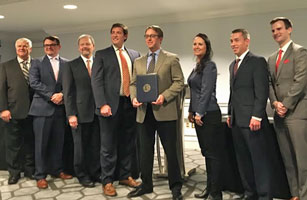
NRCS Chief Jason Weller (center) flanked by ag group representatives

Agribusiness and agricultural associations from across the nation, including the Agricultural Retailers Association, have joined together to promote and expand federal conservation programs.  Members of the group signed a memorandum of understanding with the USDA’s Natural Resources Conservation Service to expand the reach of technical and financial assistance to extend conservation adoption and increase the overall sustainability of farming, ranching and forestland operations.

It was signed by the National Association of Conservation Districts, National Association of State Departments of Agriculture, The Fertilizer Institute, ARA, American Society of Agronomy, Soil Science Society, Crop Science Society, Syngenta and CropLife America.

The MOU establishes “a collaborative framework for cooperative activities intended to enhance and accelerate the transfer and adoption of technologies and approaches.” Together, the partnering organizations will develop initiatives such as employee training, producer outreach, joint projects and communications efforts that advance conservation practices. Efforts will be focused on soil health and 4Rs (Right source, Right rate, Right time and Right place).

“The Agricultural Retailers Association is proud to join this collaborative effort to promote and expand conservation programs,” said ARA President and CEO Daren Coppock. “As a trusted resource, ag retailers are in a prime position to advise farmers on implementing conservation methods and tactics that improve nutrient stewardship, sustainability and profitability.”

ARA, Conservation, USDA

Bayer Support at #ARA2016

Lizzy Schultz

The Agricultural Retailers Association (ARA) is respected throughout the agriculture industry as a support system for growers and retailers, and that support has been a key factor behind Bayer’s continued sponsorship of the organization.

“ARA is very important to us as a supplier of products for farmers and growers,” says Bayer Strategic Business Lead Al Luke during an interview at ARA’s recent annual meeting in Orlando. “ARA’s charter is to support the ag retail community, which is the trusted advisor for growers, so that partnership goes a long ways.”

Luke noted ARA’s outstanding regulatory support and work on the Hill, explaining that both retailers and growers benefit from ARA’s efforts to ensure that the regulations and the laws that are passed are beneficial to the industry. “This organization is one of the strongest organization’s I’ve seen in terms of working through Washington, D.C. to help get legislation passed that can be helpful and try to modify legislation that can actually hurt our industry,” he said

Luke also highlighted the strength of the training programs offered by the ARA, many of which are held in conjunction with Purdue University. “The ag chemical business is very technical, and it is critical for the industry that our retailers are trained and have a strong understanding of the important safety and environmental implications of these products,” said Luke.

Learn more in this interview: Interview with Al Luke, Bayer

View and download photos from the event here: 2016 ARA Conference Photo Album

Ag Groups, Agribusiness, ARA, Bayer

Sorghum Yield Winners Announced

Cindy Zimmerman

This year’s winners of the National Sorghum Producers Yield Contest have been announced and the top yield for 2016 comes in at 208.40 bushels per acre.

“The future looks really bright for the sorghum industry because of the way we’ve seen our national average yield increase and as we get closer to the 250 bushel per acre goal in this contest,” said NSP board of directors Chairman Don Bloss.

Farmers from 28 states entered this year’s contest in 10 different categories. The first place winners are:

Jim Boehlke – Bell-Key Farms of Idaho in the Irrigated Conventional-Till category with a yield of 208.40 bushels per acre; Robert Santini, Jr. of New Jersey in the Dryland No-Till category with a yield of 178.04 bushels per acre; Winter Johnston of Pennsylvania in the Dryland Conventional-Till category with a yield of 184.80 bushels per acre; Rob Robinson of Nebraska who won the Irrigated Reduced-Till category with a yield of 197.68 bushels per acre; Sam Santini, Jr. of New Jersey in the Dryland Double Crop category with a yield of 198.36 bushels per acre; Travis Walker of Missouri in the Dryland Reduced-Till category with a yield of 184.59 bushels per acre; Jeffrey Barlieb of New Jersey in the Irrigated Double Crop category with a yield of 176.33 bushels per acre; Robert & John Reznik of Texas in the Irrigated No-Till category with a yield of 188.90; Triple Creek Farm of North Carolina in the Non-Irrigated Food-Grade category with a yield of 122.89; and Ron Robinson of Nebraska in the Irrigated Food-Grade category with a yield of 197.68.

The national winners will be officially recognized at the 2017 Commodity Classic in San Antonio, Texas at an awards dinner sponsored by DuPont Pioneer.

NSP, sorghum

Vilsack Receives Norman Borlaug Medallion

Cindy Zimmerman

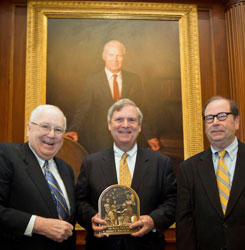
Ambassador Quinn (left) and John Ruan III (right) present Borlaug Medallion to Vilsack

At a special ceremony at the World Food Prize Hall of Laureates in Des Moines last week, the World Food Prize Foundation honored the USDA and Agriculture Secretary Tom Vilsack with the Dr. Norman E. Borlaug Medallion.

Ambassador Ken Quinn explained that the Borlaug Medallion, which was created to recognize institutions not eligible to receive the World Food Prize itself, was being presented to “honor the U.S. Department of Agriculture for its extraordinary development and promotion of American farming for over 150 years. “In the 10,000 year history of human agriculture, there is arguably no other organization that has done more to expand the knowledge of, and enhance the science involved in, food production than the USDA.”

At the ceremony, Vilsack and Quinn also signed a memorandum of understanding to strengthen the partnership of the World Food Prize and USDA and by extending the Wallace-Carver Fellowship program through 2021. The program was Secretary Vilsack’s vision to identify, educate and inspire the next generation of great scientific and agricultural leaders.

USDA, World Food Prize

Bayer Partners with ASTA for Communications

Cindy Zimmerman

Bayer’s Crop Science division announced a new partnership with the American Seed Trade Association (ASTA) at last week’s ASTA CSS and Seed Expo in Chicago.

David Hollinrake, VP Marketing for North America, says the partnership involves Bayer sponsoring the ASTA Communications Committee and sharing Bayer’s successful AgVocate initiative research and materials. “It’s really about engaging farmers and engaging all agriculturalists into the conversation with the general public around the benefits of modern production agriculture,” said Hollinrake. “We’ve been able to bring over 10,000 people into the social circle so that we can become stronger agvocates with a prouder voice.”

During his address to the ASTA CSS, Hollinrake noted the similarities between the ASTA slogan “Better Seed, Better Life” and Bayer’s “Science for a Better Life” tag line. “We’ve done a good job describing the better science component, but not so good at describing the better life component.”

In our interview, Hollinrake also discusses Bayer’s proposed acquisition of Monsanto and why they believe it makes sense for farmers. “We’ve got wonderfully complementary skill sets,” he said. “Monsanto is a leader in seed, genetics and biotechnology and we have been a leader in crop chemistry and seed treatments, so combining the capabilities of both really promises greater innovation for the American farmer.”

Listen to it here: Interview with David Hollinrake, Bayer

ASTA CSS 2016 Photo Album

ASTA, Audio, Bayer

White is the New Black from @Clariant

Cindy Zimmerman

Clariant used the ASTA CSS 2016 & Seed Expo to unveil their new Agrocer White 006 Dispersion pigment. As a leader in specialty chemicals, Clariant has created this new color using titanium dioxide to enhance the coverage of seeds and to be compatible with seed treatment pesticide formulations. The new addition makes the seventh important colorants for seed coatings offered by the company.

“It adds opacity, it gives better hiding power, it can also make the colors look more vibrant, and you can get very nice shades,” said Clariant Market Segment Manager for Special Applications Mark Self during an interview at the expo this week. “What we’re also talking with different companies about is brand differentiation and marketing strategies … where they can make their colors look different.”

See the difference Agrocer White makes!

Clariant’s exhibit at the expo had samples showing in living color how the addition of the white pigment makes all the difference in coloring black seeds. “When the black seeds are colored with traditional colors, it’s very hard to see,” Self explained. “But you add just a very small amount of white, the coating pops out.”

It was first time exhibiting at the ASTA CSS event for Clariant which is a large global specialty chemicals corporation located in Switzerland and formed in 1995 as a spin-off from Sandoz. Clariant’s global technical manager for seed coloration Andreas Wacker says they have been a global leader in the seed colorant business for many years. “It’s a growing industry,” said Wacker. “Seed treatment is the area within agrichemicals which is growing the fastest.”

Learn more about Clariant in this interview: Interview with Mark Self and Andreas Wacker, Clariant

ASTA CSS 2016 Photo Album

ASTA, Audio, Seed