
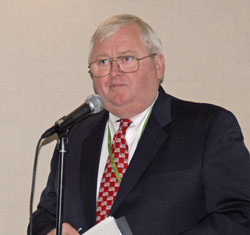
 Here’s my wrap up post from the Farm Foundation Transition To A Bio Economy conference. I learned a lot from the presentations here and hope the interviews have helped you too.
I spoke with board member, Cornelius Gallagher, who helped summarize the event. He says the conference brought together world class leaders who were able to listen to some fantastic presentations. I’ve posted interviews with almost all of them so please scroll back through them.
Corny, as he likes to be called, says that the conference accomplished what it was supposed to which is bringing leaders together to foster knowledge and provide attendees with a better understanding in a broad sense of the bio economy.
The next conference in the series will be held October 15-16 in St. Louis.
You can listen to my interview with Corny here: ff-bio-08-gallagher.mp3
You can also download the interview using this link (mp3).
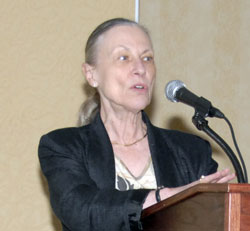 What we know and what we need to know was Peggy Caswell’s, USDA-ERS, topic here at the Farm Foundation Transition To A Bio Economy conference. She says we need to know things about how farmers or the providers of biofuels and feed stocks are going to have to change the way they do business. She used the example of having to look at different types of contracts and financing.
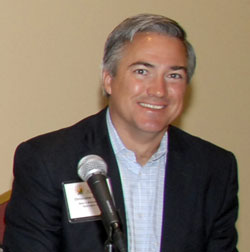 The issue of investment and financing for ethanol plants and bio refineries in general was addressed today by Chris Groobey, Baker & McKenzie, LLP. He works on project financing with investors and lenders and mostly in renewable fuels. He painted a pretty bleak picture.
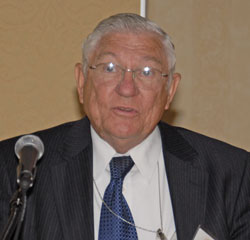 We had two Under Secretaries talk to us here today. It was my first time to meet our USDA Under Secretary for Research, Education and Economics, Gale Buchanan. He was here at the Transition To A Bio Economy conference to talk about the need for research in a growing bio economy. In fact, he sees a need for a tremendous amount of research to address the opportunities presented by the whole energy picture.
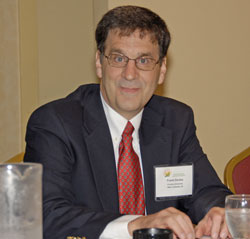 When it comes to infrastructure needs for a bio economy our rural road system is a key component. To speak about it here at the Transition To A Bio Economy conference we heard from Frank Dooley, Purdue University. He sees a big increase in grain production, primarily in the midwest. With that comes a growing demand for transportation. He thinks we should be concerned because most of the corn will be moved by truck and that’s going to impact rural roads. He also sees an increase in rail transportation but not significantly.
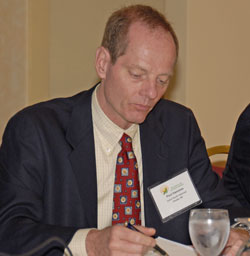 We hear a lot about the growth in ethanol production but do you know how it gets from the plant to where it needs to be to enter our fuel supply? How about rail car? During our discussion on the infrastructure needs of a Transition To A Bio Economy, we heard from Paul Hammes, Union Pacific Railroad. Of course his focus was on rail infrastructure and as it relates to biofuels. Specifically, he spoke to the different pieces of that supply chain like rail cars, the rail network and unload/load capacity.
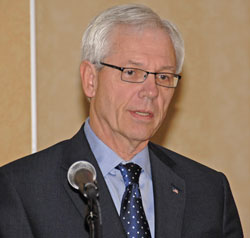 My good friend Tom Dorr, USDA Under Secretary for Rural Development, was our opening speaker for day two of Farm Foundation’s Transition To A Bio Economy conference. He was glad to see the golden ZimmComm microphone once again! We visited for a while before the session got started.
 Okay. This is the last one for today. But there’s more to come tomorrow.