Making Sustainable Ethanol By Managing the Water

John Davis

The amount of water that goes into growing the corn that goes into ethanol has been a big topic of conversation between those for and against production of the green fuel.  That’s why it is a topic of conversation at the Farm Foundation’s Transition to a Bioeconomy: Environmental and Rural Impacts Conference in St. Louis this week. This gathering of government officials, academics and industry leaders is designed to take on the tough questions facing Rural America as it moves to a bioeconomy.

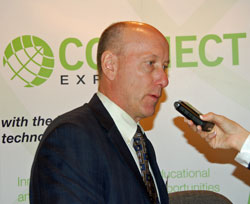
One of the people in the ethanol/water discussion is Noel Gollehon, a senior economist with the USDA’s Natural Resources Conservation Service.  He says the amount of irrigated corn is particularly concerning.

“About 15 percent of corn that is in counties that have ethanol plants is irrigated.”  He adds that it takes 2,500 gallons for a bushel of corn.  Now, while a large amount of that is grown in areas that uses the natural rainfall, what is worrisome is the corn grown in the drier western plains, where it equates to 750-1,000 gallons of irrigation water for each gallon of ethanol using irrigated corn as a feedstock.  He says the answer might be cellulosic ethanol.  However, he says it is no panacea and might be just as damaging to finite underground water sources.

“Working through this transition (to a bioeconomy), we have to use what we have,” says Gollehon.  “But as we look forward, we hope we can develop cellulosic-based ethanol that doesn’t rely on that type of crop that has to be irrigated in those environments.”

Gollehon says we’ve been irrigating in this country for about 100 years, and if we want, we can keep doing that until all the water is gone… if we want to go down that route.  But he believes that conversations, such as this one at the Farm Foundation’s conference, coupled with new technologies will get people to look at longer-term sustainability.

Hear more of my conversation with Gollehon here: Gollehon.mp3

Ethanol, Farm Foundation

Blog Action Day and World Food Prize

Cindy Zimmerman

Blog Action DayToday has been “Blog Action Day” and the theme this year is poverty. Coincidentally, that is the basic theme here in Des Moines at the World Food Prize Norman Borlaug Symposium – since the key focus is on feeding the hungry. So, I actually decided to participate in the event this year – both on AgWired and Domestic Fuel, since I am covering this event.

World Food PrizeThis year’s winners are former U.S. Senators George McGovern and Bob Dole, who are responsible for legislation creating an international school-feeding program which has provided meals to feed more than 22 million children in 41 countries. They are pictured here during a dialogue held at the event with 2003 World Food Prize winner Catherine Bertini, former executive director of the World Food Program.

Tonight’s conversation included lots of good-natured joking between the two former senators who sat on opposite sides of the aisle while in office but had a common goal of getting children in this nation and other countries as well at least one good solid meal a day – not just for their physical well-being but also because it helps them learn better in school. And nothing beats a good education when it comes to helping alleviate poverty.

The biggest focus at this symposium is on increasing agricultural productivity, especially in countries such as Africa where poverty and hunger are more common than just about any other continent. The need there is for increased agricultural research and development, better irrigation techniques, improved seed varieties with resistance to drought and insect pressure, better market development, etc.

See photos of the World Food Prize event here.

Farming, International, World Food Prize

John Davis in St. Louis For AgWired

Chuck Zimmerman

John DavisMeet John Davis in case you haven’t. I meant to let you know earlier that he’s covering the Farm Foundation’s Transition to a Bio Economy: Environmental and Rural Impacts Conference in St. Louis this week while Cindy is in Des Moines at the World Food Prize Symposium and I’m at Sunbelt Ag Expo.

I met John when I hired him to be a farm broadcaster for the Brownfield Network years ago. We got re-connected when he began as a contributing editor on our Domestic Fuel website. Here’s a little bit of information about John:

John is a veteran journalist with more than 20 years experience covering events at a local, regional, and national level. He spent a large portion of that time as a broadcast journalist in the U.S. Air Force, traveling to more than 30 countries on four different continents. Now, Jefferson City is his home that he shares with his wife and youngest son (as well as a menagerie of two dogs, a cat, two gerbils, and a fish). He enjoys hunting and fishing.

So, welcome John to AgWired. He’ll have a few posts from St. Louis still I’m sure and perhaps more in the future.

Uncategorized

Overview of Sunbelt Ag Expo

Chuck Zimmerman

Sunbelt Ag Expo OverviewI got an overview of Sunbelt Ag Expo today. By overview I mean from the control tower for this airport which was formerly a military airfield. I climbed up and took a few photos early today.

While I was up there I got out my FLIP (you can get them customized now) and shot a short video clip so you can see what it’s like. The old control tower makes a nice photo stand. I think we need to have one of these at all farm shows.

I’ve got a lot more for you from Sunbelt and will be posting them over the next couple days. The weather was “Chamber of Commerce” perfect today and probably will be on the closing day tomorrow.

Sunbelt Ag Expo Photo Album

AgWired coverage of Sunbelt Ag Expo is sponsored by the Propane Education and Research Council.

Farm Shows, Sunbelt Ag Expo, Video

World Food Dialogue for Solutions

Cindy Zimmerman

World Food PrizeEven though the word “crisis” is being used liberally here at the World Food Prize Norman Borlaug Symposium, there is a great deal of focus on solutions to feeding a growing global population.

The “Global Agricultural Crisis of the 21st Century” was the topic of the keynote speaker for the symposium kickoff, Sir Gordon Conway, who is chief scientific adviser for the UK. He talked about the spike in food prices over the past year and the underlying causes, which he listed about ten – including increasing population, higher per capita income, increased demand for meat, higher prices for energy and fertilizer – and yes, demand for biofuels – but that was only ONE of the causes!

World Food Prize Gordon ConwayConway stressed the need to address why we want to produce biofuels and the urgency to move quickly into second and even third generation biofuels – such as cellulosic ethanol from switchgrass and biodiesel from algae. “Maybe we should have a new World Food Prize on this,” Conway said. “In which we transform the world from one dependent on fossil fuels for energy and production of chemicals, into one that depends on plants as a basic source of our economy.”

He also talked about the need to increase yields in all areas of the world, especially Africa, and how genetically modified varieties can help. He noted that GM is actually growing in acceptance, “everywhere except in Europe.”

Listen to Conway’s comments here:
wfp-08-conway.mp3

You can also download the audio with this link: Sir Gordon Conway remarks at World Food Prize (mp3)

See photos of the World Food Prize event here.

Audio, Biodiesel, Biotech, Ethanol, International, Soybean, World Food Prize

Charging Ahead in a Transitioning Bioeconomy

John Davis

How we develop rural jobs as the country moves to a bioeconomy was the latest subject tackled today at the Farm Foundation’s Transition to a Bioeconomy: Environmental and Rural Impacts Conference in St. Louis.

One of the key speakers during this session was USDA’s Under Secretary for Rural Development Thomas Dorr, who talked about how we need to move forward and be aggressive… even in light of the recent stock market turbulence.

“I don’t think there’s any question that we have to move forward,” says Dorr.  He says with the U.S. importing $700 billion in foreign oil… many times from those who would wish us harm… it has become an energy security and national security issue.  “Why would we want to subject our kids and grandkids to that sort of dependency?”

Dorr admits that it might be easier said than done, “but there are an extraordinary numbers of hard working people who keep their shoulder to the wheel all the time to make these things work.  That’s the American way.”

No matter if Republican John McCain or Democrat Barack Obama wins the election in less than three weeks, there will be a new administration in Washington, DC.  Dorr expects plenty of policy debates, much like the debate we’re hearing at today’s conference, as the new administration moves forward.  He believes that biofuels will be a major point for whomever is the next one to sit in the Oval Office.

Listen to more of my conversation with Dorr here: ThomasDorr.mp3

Audio, Farm Foundation

Roasted Corn Makes You Grin From Ear To Ear

Chuck Zimmerman

Roasted CornWhen it comes to farm show food booths, one that’s getting a lot of business at Sunbelt Ag Expo is Roasted Corn.

Ron is the roasting man and I found him early in the morning before things got busy. He cooks with propane and says he does about 75 ears at a time. He like the combination of yellow and white sweet corn because it looks good and is very tasty.

As you’ll hear Ron say in this video, “we dip it in some butter and you’ll grin from ear to ear.”

Sunbelt Ag Expo Photo Album

AgWired coverage of Sunbelt Ag Expo is sponsored by the Propane Education and Research Council.

Corn, Sunbelt Ag Expo, Video

World Food Prize Press Room

Cindy Zimmerman

World Food PrizeThis is Justin Cremer, director of communications for the World Food Prize, at the door of the press room. Not too many media types here yet – more will be on hand for the bigger events, like the Laureate’s Forum tonight and the actual presentation of the World Food Prize on Thursday.

World Food Prize USDA eventOne person who is here is Susan Carter – the newest member of USDA’s broadcast team. She took over the spot vacated by the legendary Brenda Curtis when she retired early this year. Susan has been on the job since May and while she is smiling in this photo, she has been experiencing some of the usual on the road headaches – flight delays and cancellations, internet problems and computer issues. Bless her heart – and she is still smiling.

See photos of the World Food Prize event here.

Media, World Food Prize

World Food Prize Events Underway

Cindy Zimmerman

World Food PrizeThe World Food Prize Norman E. Borlaug International Symposium is getting underway here in Des Moines with a couple of side seminars early this morning. The opening ceremony takes place at 1 pm central time.

World Food Prize USDA eventOne of this morning’s seminars was hosted by USDA’s Foreign Agriculture Service, and since we didn’t have a speaker program for that event, I was surprised to walk in the room and see one of this year’s laureates, Hon. George McGovern at the podium. Wish I had known, I would have gotten a recorder on the podium because he had some very interesting remarks about the history of USDA and his role with Bob Dole in expanding and strengthening the school feeding program on a global basis. One of his comments was that he sees the role of USDA growing in the future to help feed a growing population. McGovern will be speaking at a forum this evening with Sen. Dole.

The USDA seminar was hosted by USDA Undersecretary Mark Keenum, who was just at Sunbelt Ag Expo yesterday, and Patricia Sheikh, deputy administrator of USDA-FAS.

See photos of the World Food Prize event here.

Media

Zimfo Bytes

Melissa Sandfort

    Zimfo Bytes

  • A recent survey (2008 Intern and New Grad Benchmark Report) of agriculture interns and new graduates released by AgCareers.com provides university and industry professionals with compensation information such as salaries, intern housing costs and relocation packages. This was the first year for the survey, but AgCareers.com is planning to conduct the survey on an annual basis. If you are interested in taking part in the 2009 survey, please contact Mary Barefoot at compensation@agcareers.com or call 800-929-8975.
  • BASF and Nufarm Americas Inc. announces that BASF has granted Nufarm an exclusive, license to the trademark Weedmaster in the United States. BASF will discontinue selling Weedmaster, which will be exclusively marketed and sold through Nufarm effective Oct. 1. Weedmaster, which contains the active ingredients dicamba and 2,4-D, offers dependable, long-lasting control of 64 of the toughest broadleaf weeds and brush for sugarcane, pastures, small grains and fallow.
  • A new Web site showcases the newest, most innovative Challenger products on the marketplace. From state-of-the-art combines and tractors to revolutionary technology that makes operator life much simpler, all the latest information on Challenger can be found here.
Zimfo Bytes