
 What’s new in used farm equipment can be found on the redesigned John Deere MachineFinder. They’ve also announced a blog to go along with it. Interesting . . .
John Deere announces that it has completely overhauled and redesigned its MachineFinder™ website (www.MachineFinder.com) from the ground up to make it easier for used equipment customers to more quickly find the equipment they’re looking for and to improve the user experience.
The revamped MachineFinder used equipment website features an enhanced search and browsing system, built-in shipping integration, and the ability to save searches. The changes to the website makes it easier than ever for customers to find and review pre-owned agricultural, construction, forestry, commercial, and residential equipment from the company’s network of authorized dealers.
“MachineFinder not only provides improved user interfaces, but new functionality that will better assist customers in acquiring used equipment from John Deere dealers,” says Michael Gause, division manager of John Deere Remarketing Services. “Our project team’s goal was to design MachineFinder so that our customers could conduct business with John Deere dealers as easily as possible.” Read More
 A new milestone in
  Let’s hope we see continued commitment to rural development in the new administration in Washington, DC. The outgoing one has sure done a lot in this area, especially to develop broadband which is providing new opportunities in our rural and farm communities.
 The topic of the
  Here’s a good example of the use of a webinar by the
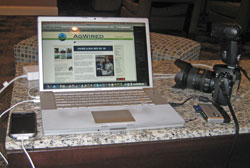 Here’s my work station earlier today at the DoubleTree Hotel in St. Louis. Macbook Pro, iPhone, card reader and my camera. Oh, and yes, I was using hotel lobby bandwidth.
 Despite icy roads and blizzard conditions, I made the haul from Brookings, S.D. to Lincoln, Neb. for a job interview. I decided that the poor economy and struggling job market was a lot scarier than a good, old South Dakota winter storm, so I made the 5 hour trip down to Neb. for the interview.
 At today’s