
I’ve been a fan of Leon The Milkman for a long time. Finally I got to meet him via YouTube. Leon says he’s starting Midweek With The Milkman, a video newsletter for dairy fans. Say hello to him:
New Media Soybeans
 I just found out about the United Soybean Board’s podcast called, BeanCast. I had heard they were planning to produce one but I guess I missed it somehow since it looks like it started last December. It came up in conversation today. I’m glad to see another ag group taking advantage of this new media option.
A couple of things hit me though when I looked at it. It’s not clear that I can subscribe to the podcast. It says I can subscribe to the blog though. I wonder if people will understand that the blog rss feed is okay to use in iTunes for example. The BeanCast is being produced by well known farm broadcaster David Russell but the site doesn’t say who David is. David works for Brownfield of course but I’m not sure everyone knows that. Might be good to disclose that information since he doesn’t work for the United Soybean Board.
I like the fact that they are posting each episode onto a blog. There are a lot of good reasons to do this starting with search engine optimization and online archiving. They’re also posting it as both a click to download option or play in a flash player. This provides choices to the visitor and I’ve found that to be much appreciated, especially if you hope someone else will “pass it along.”
I tried to find the BeanCast in the iTunes podcast library and instead found a trademarked “The Beancast: A Marketing Podcast” by Cool Bean Productions. There’s also a Beancaster.com podcast which is about financial information. No BeanCast for USB though. The iTunes directory is a good place to be found for people who are key word searching for podcasts since it’s probably the biggest online directory of podcasts that I know of anyway.
Zimfo Bytes
- Through a collaboration of 830 veterinarians, animal health suppliers and Pfizer Animal Health, nearly $500,000 has been donated to local FFA chapters across the country. Through purchases of Pfizer Animal Health’s vaccines, veterinarians and animal health suppliers were able to donate to a local FFA chapter of their choice.
- Syngenta Crop Protection, Inc. announced Lumax and Lexar herbicides and Quilt fungicide have received federal registration for use in grain sorghum from the EPA.
- For his career as a pioneer in corn breeding, A. Forrest Troyer is one of this year’s recipients of the prestigious Siehl Prize for Excellence in Agriculture.
- Makhteshim Agan of North America, Inc. has promoted Troy Bettner to the position of southern regional business manager. Previously he served as the company’s senior product manager, fungicides.

Earth Baby and Better Baby Bums
 I saw this today in the National Biodiesel Board’s e-newsletter and thought it was cute and funny and environmentally friendly.
Corn-based diapers have apparently been around for a couple of years now, first made by a Swedish company called Nature Baby Care, but they are getting a bit more buzz lately. If you search around on the web, you will find a number of different brands eco-friendly diapers and other websites specializing in places to find them – like Better Baby Bums, for example. You gotta love that name!
 According to BBB, the Nature Baby Care diapers were “the first ECO-friendly high-performance diaper, based on new green technology, protected by a Swedish patent. The diaper is soft, thin, comfortable and with perfect sizing. It’s performance is as good as the best ”traditional” diapers. It has an exclusive 100 % chlorine free absorbent material and the material against the baby’s skin is based on corn instead of plastic like traditional diapers, 100% compostable, breathable and extremely kind for the baby. The packaging is 100 % compostable and based on corn.”
Then there are companies like Earth Baby, based (where else?) in California, which offers “compostable diaper service” utilizing corn-based diapers. They claim they have composted over 9,600 pounds of diapers to date – turning them into nutrient-rich top soil in as little as 14 weeks.
Talk about new uses for corn!
Dupont Fellow Receives Award
 Dr. George Lahm has just been named to receive a big award.
One of the most accomplished researchers in the crop protection industry, DuPont Fellow George Lahm, Ph.D., has been named to receive the 2009 Kenneth A. Spencer Award for Outstanding Achievement in Food and Agricultural Chemistry. He received the award for his meritorious contributions to agricultural and food chemistry, including his contributions to the discovery of the two newest DuPont blockbuster insect control products, DuPont™ Rynaxypyr® and Cyazypyr™.
Lahm joined DuPont in 1980 and has led major discovery efforts in the company’s agricultural business, including work on innovative insecticides that increase the marketable value of fruits, vegetables and other crops, by reducing losses due to insects for growers throughout the world.
Lahm was selected to receive the Kenneth A. Spencer Award from a nationwide pool of candidates by a 12-person jury of American Chemical Society members representing industry, education and research. He will receive his award at an October 2009 symposium organized in his honor by the American Chemical Society. Founded in 1955, the award is administered by the Kansas City Section of the American Chemical Society and supported by a gift from the Kenneth A. and Helen F. Spencer Foundation. George Levitt, another DuPont Crop Protection researcher, received the Spencer Award in 1991 for his discovery of sulfonylurea herbicides.
Cellulosic Ethanol To Bridge The Gap
 Commercializing Gasification/Fermentation Technology was the topic of comments made by Mark Dietzen, INEOS Bio, at the Farm Foundation Transition To A Bio Economy Conference.
He says that they have a practical technology that they’re in the process of implementing to be online by 2011 to produce cellulosic ethanol. He thinks that it will help bridge the gap between what’s possible with crop based ethanol and allow the substitution of a larger percentage of gasoline with a bio based fuel.
You can listen to my interview with Mark here: ff-global-09-dietzen.mp3
You can download the interview with this link (mp3).
You can find photos from the conference here:
Transition To A Bio Economy Conference: Global & Trade Issues Photo Album
AgWired Getting Re-Published
 How to quantify social media reach and influence is becoming the top topic in conversations I’m having with agrimarketers. It’s not an easy one to answer. You can’t rely on website statistics to tell you the whole story. How do you factor in Twitter, Facebook and something that I have mixed feelings about. That is the re-publishing of my content.
Let’s take Hoosier Farmers as an example. The website says “Hoosier Farmers is a site from the Noblesville Daily Times designed to provide news and links of interest to Indiana farmers.” What it’s actually doing is re-publishing AgWired along with some other content from other sources. I found this in a Google search a couple days ago. There are actually quite a few websites doing this with AgWired and other ZimmComm properties. Sometimes they “scrape” all my posts. Sometimes just selected ones of interest to their audience. Usually they provide links back to AgWired. I think this raises a number of questions.
Should I be upset or pleased? How can I figure their traffic in my statistics since I don’t know it? How can I use knowledge of this to my benefit and the benefit of my clients?
I said I have mixed feelings because I have invested a lot of work in the content I produce and someone else is using it to attract traffic to their website. However, my clients want maximum exposure and this is one way it’s happening. I highly encourage ag media in particular to utilize pictures and audio they find on AgWired. Hopefully that helps them and my clients who are usually the subject of the content. I know we get plenty of anecdotal feedback that this is happening. Good. But that does seem a little different than the wholesale re-publishing of everything we post.
How about you? Is this a good thing or something else? Do you have the same “problem?”
Biotech Playing Key Role In Production Of Biofuels
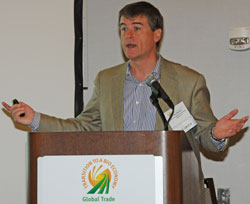 I spoke with Paul Willems, BP Energy Biosciences Institute, one of our speakers at the Farm Foundation Transition To A Bio Economy Conference. I had met him previously at an earlier conference in the series.
Paul says the BP Energy Biosciences Institute was created as a place to apply modern biology to energy problems. He told us that from their perspective, the turbulant times we’re in right now are temporary and that the fundamental trends for the future are unchanged. Those being the supply of oil and gas and the growth and demand for energy products. He says that their CEO likes to say that, “the future has been delayed, it hasn’t been canceled.”
I think he made a good point in my interview with him that we shouldn’t panic. He says there are numerous technology efforts going on in the alternative fuels industry and that it would be a mistake to see that work evaporate because we live in a world of crisis. He urges a steady course toward the future. He also talks about the benefits of biotechnology in developing more efficient alternative fuel production but points out that the industry is still just in its infancy.
You can listen to my interview with Paul here: ff-global-09-willems.mp3
You can download the interview with this link (mp3).
You can find photos from the conference here:
Transition To A Bio Economy Conference: Global & Trade Issues Photo Album
NAMA Connection Point Is Virtual
The NAMA Virtual Trade Show is up and running. You’ll be able to find ZimmComm New Media close to the entrance in booth #102. That’s where you’ll need to drop off your entry forms for our drawing to win either an HP Mini Netbook computer or Cube II desktop speaker/dock for your iPod or iPhone. We’ll also have some other take aways that will be Sizzling Hot.
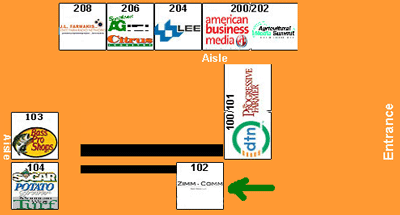
Connection Point Hours:
A Refreshment Station will be available in the center of the Trade Show area during all hours of the Connection Point courtesy of Southeast Ag Net/Citrus Industry Magazine.
Wednesday, April 16
6:00-7:30 p.m. – Best of NAMA Celebration Reception courtesy of DTN/The Progressive Farmer
Thursday, April 17
12:30-2:00 p.m.-Trade Show Luncheon courtesy of USDA/NASS
12:30-1:30 p.m.-Student Mentor Luncheon courtesy of Technekes and MoKan NAMA
3:00-4:00 p.m. – Ice Cream courtesy of Hoard’s Dairyman magazine
5:00-7:00 p.m. – Trade Show Closing/ABEF Silent Auction courtesy of NAFB & John Deere
Online Media Auction For NAMA’s ABEF
 Here’s a way you can provide support for the Agri-Business Educational Foundation (ABEF). It’s the annual online media auction which will run from today through 5pm April 9, 2009.
If you have questions about how it works you can visit the Online Media Auction Procedures.
ZimmComm New Media has submitted a package for you to bid on this year. You can find it with this link.