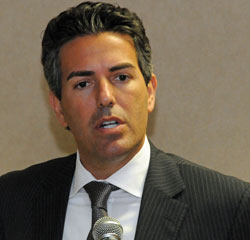
 The President of the Humane Society of the United States, HSUS, Wayne Pacelle, spoke to the National Association of Farm Broadcasting this evening. I would characterize his comments as a challenge to everyone involved in agriculture and especially animal agriculture. On the one hand he suggested that we should join with them on areas of common agreement but then on the other hand he made it very clear that the world is changing and farmers have to accept it that things are different. Kind of like saying that we have no choice but to succumb to their agenda so why not make it easy.
I had an opportunity to ask a question and although I had many like, “Why do you use your name to suggest that you’re affiliated with local humane societies and animal shelters when you really aren’t?” However one of my Twitter followers sent in a couple of questions and I posed one of hers. She’s a farm wife in Tennessee and here’s what she wrote.
I have so many questions for Mr. Pacelle and other animal rights activists. My first question would be how he plans to help those families he is so strongly trying to put out of business or are we to try and find a new way of life, a new home, a new life style? We’ve heard it before, but farming isn’t just a job – it’s a passion. We certainly don’t do it because we’re getting rich. We do it because we love the land, the animals, and the work. The attack on animal agriculture is really an attack on the entire ag industry as we are inter-dependent on one another.
I’m posting his answer to my question to see if you can understand what he said. I think he got a little defensive and avoided a direct answer. Feel free to post your thoughts.
You can listen to my question of Wayne and his answer here: ww-09-hsus.mp3
Wayne claims the organization has over $200 million to work with so I would suggest that agriculture take them seriously. Their emotional pitch is very seductive as evidenced by the number of celebrities who publicly support them and all the folks giving them money. But rather than be afraid of them I think we have a great opportunity to get out and use the new social media forms of communication to battle the sensationalized, isolated stereotypes these groups employ so effectively. Farming is a way of life and we wouldn’t have the great country we have today if if wasn’t for the American farmer. I think that’s a story the public wants and needs to hear and I encourage farmers in particular to tell and show it. I am seeing more and more of them doing it too.
Post Update: At the request of several followers I’m posting the full comments and question and answer session for you to listen to here. Basically, it is a good idea to know what the enemy says directly from their mouth. Please let others know so they can hear this. Agriculture as a way of life is very threatened by groups like HSUS and I think you’ll hear that very clearly.
You can listen to the full session here: ww-09-hsus-remarks.mp3
NAFB Washington Watch 2009 Photo Album

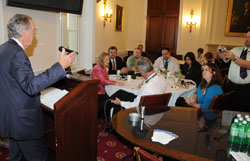 Members of NAFB are hearing from a variety of senators and congressmen this morning in the Longworth House Bldg. First up on the program was Senator Tom Harkin, D-IA.
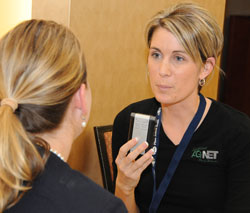 Julie McPeake,
  The organizers of two international agricultural shows have announced a formal alliance to coordinate show dates that will allow agriculture producers to attend a major international agriculture trade show each year.
 The alliance is between DLG (German Agricultural Society), the organizer of the world’s largest agriculture machinery show
  The
The  Our friends at Farm Foundation are sponsoring another discussion on an important issue facing farming in America: animal welfare as it relates to production agriculture.
 Sign up for the long-awaited Average Crop Revenue Election Program, or ACRE, started yesterday on the same day that farm broadcasters from around the nation were in Washington DC for the annual Washington Watch Issues Forum, so naturally it was a hot topic for representatives from the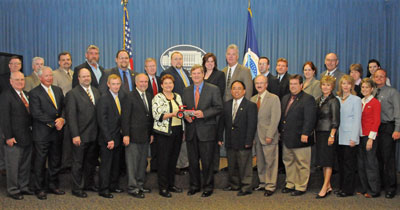
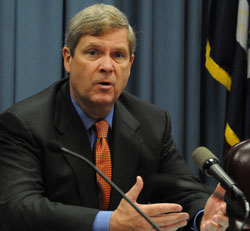 Internet access was lacking at the NAFB USDA visit this morning so I couldn’t live stream Sec. Vilsack’s comments as I had intended to do. During last year’s visit you may recall that I live streamed his predecessor which was the first time I had done that on location. But I did record Sec. Vilsack and have the audio available for you here.
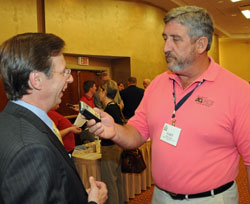 After the NAFB business meeting this afternoon it was time for the Issues Forum. This is where various organizations are set up with tables at which their spokespeople are available for interviews on the issues important to their constituents.