
There is a lot of discussion around the best way(s) to sequester carbon but the biggest discussion involves the issue of what is the best way to do this and what will be the long term effects. Several people took the stage during one of Sunday’s afternoon sessions called: Carbon Sequestration – The Path to the Promise.
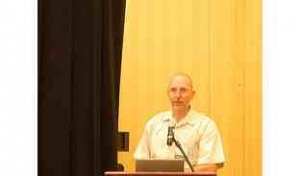 Theodor Friedrich with the Crop and Grassland Service of the FAO, along with Nathan Rudgers, with 25×25 Carbon Work Group, shared the podium to discuss the ability of farmers to capture and store atmospheric carbon in their soils as a way to reduce carbon emissions. This practice to be both a boon to the air and the soil as this could provide a new financial stream for farmers.
Friedrich focused on the role of soil in carbon sequestration noting that when soils are put into production they lose CO2. However, he said, this also makes them a big carbon sink and warned that a key element to the success of this process would be agricultural management of the soils. In the end, he cautioned that in regards to climate change, “agriculture must be a part of the solution, not part of the problem.
From there Rudgers took the stage to focus on how forestry can play in important role in carbon offset programs (cap and trade). He noted that under the cap-and-trade, regulated entities must reduce emissions or purchase offsets to cover them. He commented that his organization is looking at woody biomass which, “can be a robust contributor to energy solutions.”
To see the full presentation, visit IFAJ’s website.
AgWired coverage of IFAJ 2009 is sponsored by:

 and
and 
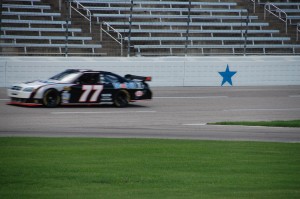 As I mentioned in the first part of my post, I had the opportunity
 After watching some participants of the Richard Petty Driving School (a program where people can pay to learn how to drive a one of the race cars that compete in the Nascar Sprint Cup Series) with much jealousy, we headed to
 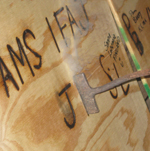 One of the coolest parts of the IFAJ/AMS Big Ol’ Western Welcome Party was pretty hot – branding boards with personal brands. Dozens of ag media types, both American and international, took the branding iron in hand and left their marks.
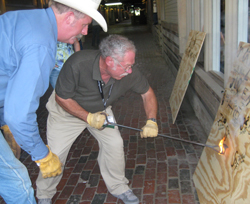 Our buddy Harlen Persinger – photographer extraordinaire – really got into it and designed a nice brand for himself. Check out the photo album for lots more photos.
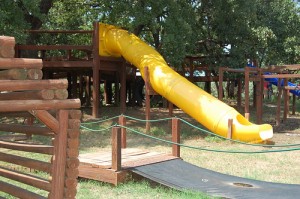 Also featured at the ranch is a playground featuring the largest treehouse in the country. For the first time ever, both children and adults have been able to experience the pleasure of sliding down a topsy-turvy slide.
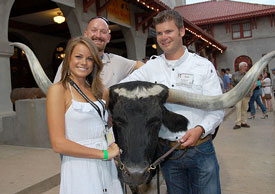 The International Federation of Ag Journalists kicked off the 2009 Congress events with an all American rodeo and some sweet southern cooking at
 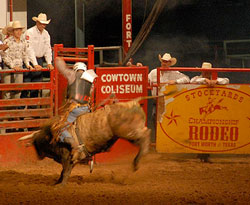 Inside the stadium you were greeted with the overwhelming aroma of livestock, all part of the experience, I guess. This was my first rodeo, as well as a first for most of the visitors to the conference and boy, was it a show! There was music, bull riding, calf roping, funny rodeo clowns, plenty to entertain us all. It was definitely a sight to see with something for everyone.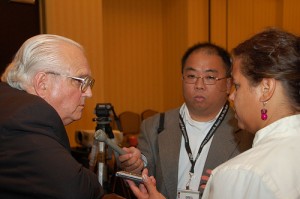
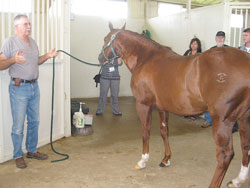 The rain started at Burgundy Beef but were well informed on the all grass feeding of their cows and the complexity of the beef industry. We also sampled some of their meats and cheeses and had to brave the monsoon to make it back to our bus. The last stop on the tour was Beakley Farms, which is a family owned business that features cotton, wheat and sunflowers. We were unfortunately held on the bus for the majority of the time there but got off just long enough to peek at some of the equipment stored in the shed.
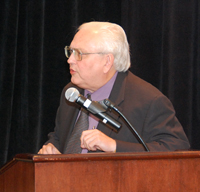 It was the Flinchbaugh-Stenholm show Sunday morning at the first combined session for the IFAJ Congress and the Ag Media Summit. A full house was entertained by the musings and mutterings of “The Great Debate” between former Texas congressman Charlie Stenholm and retired K-State ag economist Barry Flichbaugh.
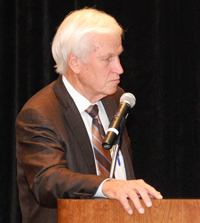 The crowd had lots of questions for the two after their debate over ag and international trade policy, as did several reporters after the fact. It was interesting to hear the international journalists ask questions about climate change policy and animal rights activism. Our own Joanna Schroeder and Kansas Ag Network reporter Greg Akagi also interviewed them both.
 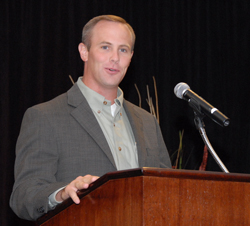 During an interview after his luncheon address, Drew DeBerry told me that he was not surprised with the reaction to some of his comments and the questions posed by the international journalists. “I’m impressed at the interest they have in our domestic policies here in the United States,” he said. “I’m encouraged that means there is an interest around the world in better understanding US domestic policies because we have to understand each others policies if we’re going to have fair trade.”